
- Solve real problems with our hands-on interface
- Progress from basic puts and calls to advanced strategies
Interactive Options Course
Posted August 13, 2026 at 10:45 am
A detailed daily look at how the developing historical El Niño is affecting global temperatures and their prediction markets.
I’ll take a break from daily local weather markets today to look at markets in global monthly and annual temperature.
El Niño has a well-known warming impact on year-to-year temperatures (see references in technical appendix), and thus the driving story is that the developing historically-strong El Niño is pushing up global temperatures over the remainder of 2026 and throughout 2027, well into record territory.
The figure below from research I published with Ken Caldeira in 2020 shows the typical surface temperature pattern associated with spikes in global temperature (on top), compared with the current surface temperature pattern on the bottom. They look very similar, indicating that we are in the midst of a classic El Niño-induced global temperature spike.
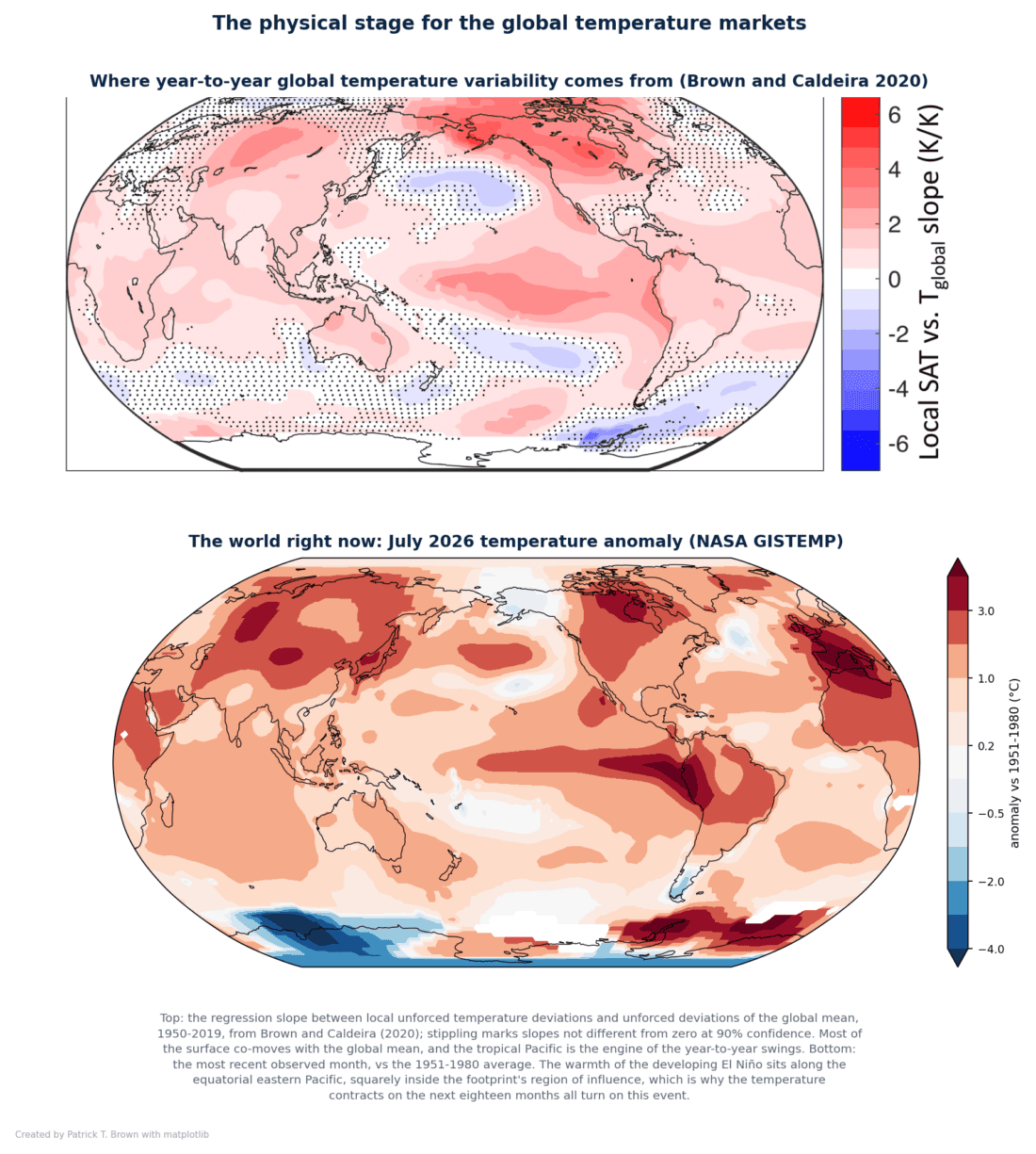
As global temperature variability is superimposed on top of the long-term warming from increasing greenhouse gas concentrations, El Niños are often associated with new global temperature records (in the instrumental record since ~1850).
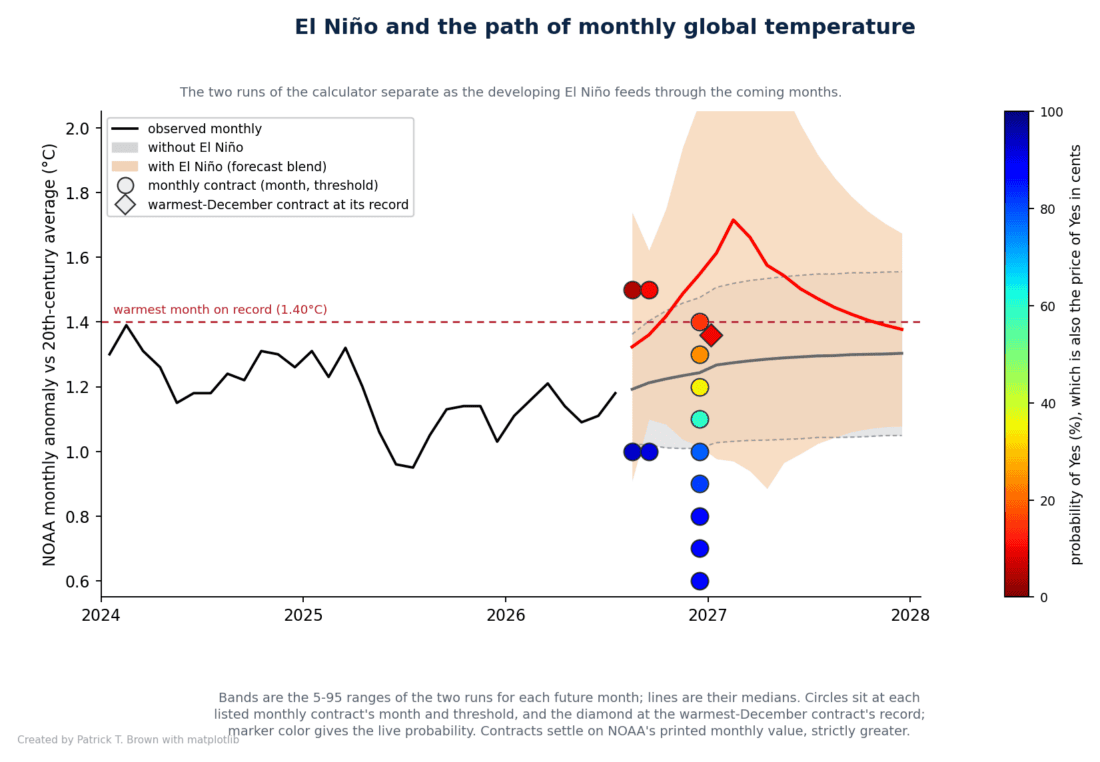
The figure below shows monthly global temperatures from 2024 to the present and going forward, an estimate of the difference between what we’d expect without an El Niño (black line and dashed band) and what we are currently expecting based on seasonal forecast models that take El Niño into account (red line, see technical appendix for details on the calculation).
ForecastEx has contracts for “Will 2026 be the warmest year on record?“.
In the NOAA dataset the ForecastEx contracts settle on, the record to beat was set in 2024 with a value of 1.26°C above the 20th-century baseline. In that dataset, July came in at 1.18°C, which brings the first seven months of 2026 to an average of 1.14°C.
For 2026 to match the 2024 record, the remaining five months would need to average 1.42°C in the NOAA dataset. That is a jump of nearly three-tenths of a degree above the year’s average so far, which has happened only once since the record began in 1850. That occurrence was 2023, which was also a year of expanding El Niño influence.

As far as current prices/probabilities are concerned, there is substantial disagreement across the prediction markets on whether 2026 will break the record.
ForecastEx currently has the probability at 36% (“Yes” = $0.36), while Kalshi prices the same outcome at 65% (“Yes” = $0.65) and Polymarket at 70% (“Yes” = $0.70).
A portion of this gap is likely attributable to differences in the settlement datasets themselves, because the NOAA bar requires the larger jump over the remainder of the year.
ForecastEx is the only one of the three venues with a listed 2027 global temperature record market.
The 2027 warmest-year contract is currently at 48% (“Yes” = $0.48).
ForecastEx also has global temperature markets with prices for exceeding various global temperature thresholds (strikes), and in those, the 2027 prices are above 2026 at every strike for the two-year share.
Thus, both the record-temperature and threshold-strike versions of the contracts recognize the expectation of a warmer 2027 than 2026.
But is the effect of El Niño being fully appreciated?
If we were not considering the El Niño-aware forecasts, the calculation indicates that the chance that 2026 would set a new record would be only 1.4%
However, with the influence of El Niño included, the calculation puts 2026 at 48% on NOAA and 53% on GISS.
ForecastEx’s 36% (“Yes” = $0.36) may therefore be underpricing the potential influence of El Niño.

The figure below shows the projections for 2026 and 2027 with the record values indicated, as well as the thresholds/strikes for the ForecastEx contracts.

The El Niño-neutral calculation puts a 2027 annual record at 59%.
However, with the El Niño representation from the seasonal forecasts, a record is above 80% (including the increased bar of 2026 being the new record to break).
The 2027 warmest-year contract is currently at 48% (“Yes” = $0.48).
A second, independent check comes from the Brown and Caldeira (2020) method mentioned above, which forecasts the subsequent three annual global temperatures using only recent patterns of observed surface temperature. Its first learned signal is the state of long-term global warming, and its second is the El Niño transition pattern.
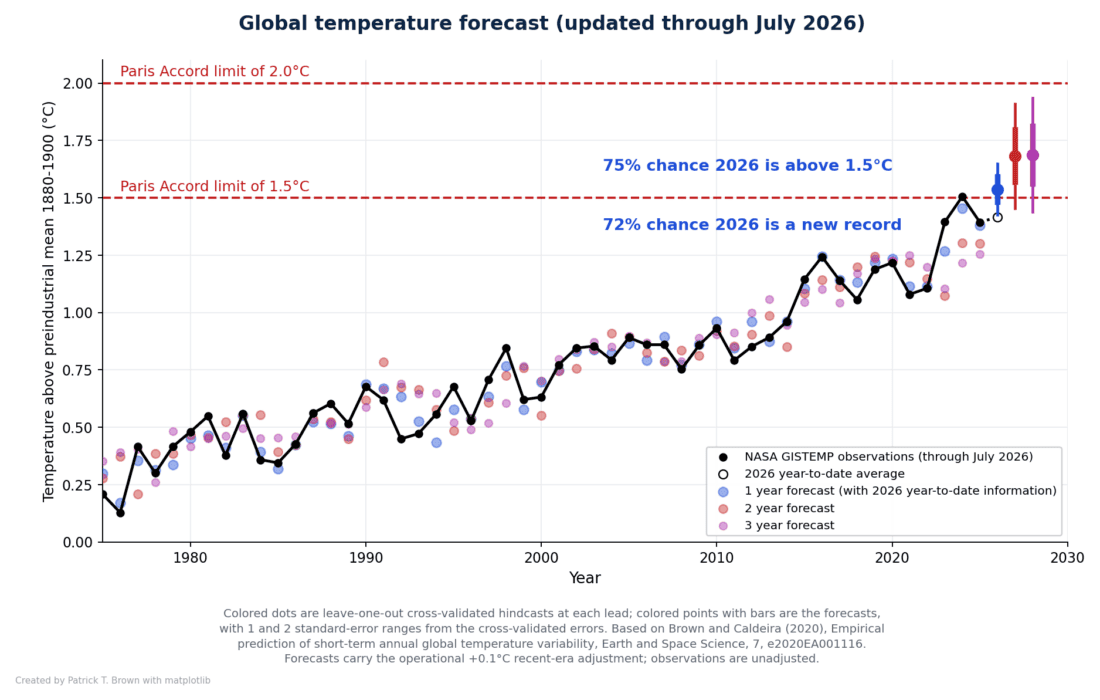
With the year-to-date information included, and run on the NASA GISS dataset, that method puts 2026 at 1.54°C above its 1880 to 1900 baseline, 2027 at 1.68°C, and 2028 at 1.69°C, with a 72% chance that 2026 sets a new record and a 94% chance that 2027 exceeds the current record.
The main point is that the developing El Niño is very likely to push 2027 above whatever 2026 ends up at. ForecastEx’s record contracts, especially for 2027, are currently priced well below what these analyses indicate they should be.
Looking more granularly at the threshold-strike contracts, August and September sit well below the El Niño forecast-anchored run at their top strike, with 1.5°C priced at 5% (“Yes” = $0.05) and 11% (“Yes” = $0.11) compared to the El Niño run’s indication of 23% and 18%.
December has 1.2°C at 35% (“Yes” = $0.35) against the El Niño-aware forecast run’s 85%.
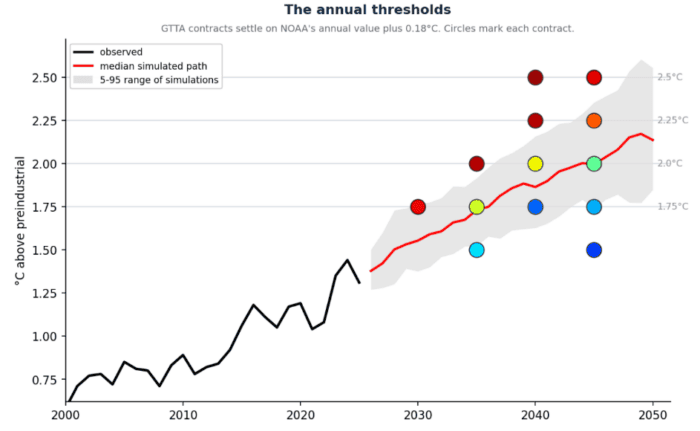
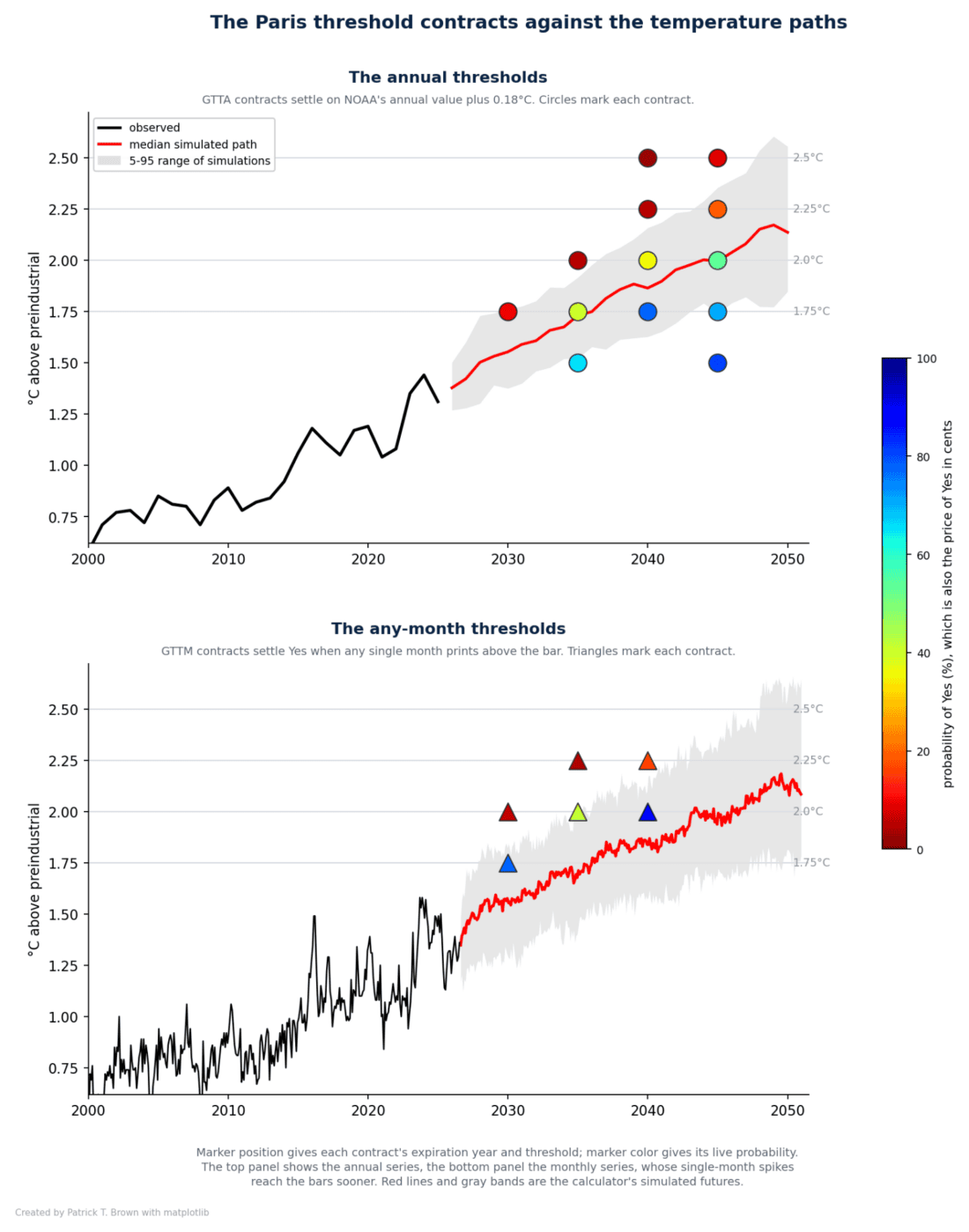
ForecastEx’s Paris Agreement Forecast Contracts (labeled as Monthly Global Temperature Threshold and Annual Global Temperature Threshold) ask whether any month or any year (respectively) will breach various temperature targets on or before various end dates.
That market has a probability of a single year above 2.0°C by 2040 at 36% (“Yes” = $0.36), and by 2045 at 54% (“Yes” = $0.54), indicating that it is essentially a coin flip whether the world breaches the long-standing 2.0°C target, at the annual level, before mid-century.
The figure below places every Paris Agreement contract at its expiration year and threshold, colored by its price.
A1. Temperature calculator.
The probabilities compared against the annual, monthly, and Paris contracts come from the statistical approach described in How Quickly Will The Globe Warm? Paris Agreement Forecast Contracts and 2025 Global Temperature Prediction Markets: Where We Stand in May.
At a high level, observed NOAA and GISS temperatures are laid over the average of CMIP6 climate-model projections, the residual year-to-year scatter is fit as an AR(2) process by exact maximum likelihood, and simulations condition on the months of the current year already observed.
A2. Accounting for the influence of El Niño.
The El Niño-aware run anchors the simulated months from August 2026 through April 2027 on an equal-weight blend of the NMME multi-model mean, NOAA’s CFSv2, and ECMWF’s SEAS5, converted to each settlement dataset’s scale using the months where forecasts and observations overlap.
The spread around the anchor in each month is the larger of the NMME ensemble’s internal disagreement and the disagreement between the three systems, inflated by half again.
A3. Selected references.
Brown & Caldeira (2020), Empirical prediction of short-term annual global temperature variability, Earth and Space Science.
Research on El Niño and global temperature.
Research on the 2023-24 records.
Research on forecasting short-horizon global temperature.
Research on impacts of short term temperature variability
Data.
NASA GISTEMP (Hansen et al. 2010, Global surface temperature change, Reviews of Geophysics).
NOAAGlobalTemp (Vose et al. 2012, BAMS)
.
Patrick T. Brown is the Head of Climate Analytics at Interactive Brokers, where his work focuses on the information discovery and risk-transfer applications of prediction markets in weather, climate, and natural disasters.
He holds a PhD in Earth and Climate Science from Duke University, a master’s degree in Meteorology and Climate Science from San Jose State University, and a bachelor’s degree in atmospheric and oceanic sciences from the University of Wisconsin, Madison. He is an adjunct faculty member (lecturer) in the Energy Policy and Climate Program at Johns Hopkins University and has conducted research at the Carnegie Institution at Stanford University, NASA JPL at Caltech, NASA Langley in Virginia, NASA Goddard in Washington, D.C., and NOAA’s GFDL at Princeton University. He has published scientific papers in Nature, PNAS, and Nature Climate Change, as well as many disciplinary journals, and his research and commentary have appeared in The New York Times, The Wall Street Journal, The Economist, CNBC, CNN, The BBC, The Washington Post, NPR, Newsweek, The Guardian, The Atlantic, Foreign Policy, and The Los Angeles Times, among other venues.
New to Prediction Markets?
Open a Prediction Markets AccountThe analysis in this material is provided for information only and is not and should not be construed as an offer to sell or the solicitation of an offer to buy any security. To the extent that this material discusses general market activity, industry or sector trends or other broad-based economic or political conditions, it should not be construed as research or investment advice. To the extent that it includes references to specific securities, commodities, currencies, or other instruments, those references do not constitute a recommendation by IBKR to buy, sell or hold such investments. This material does not and is not intended to take into account the particular financial conditions, investment objectives or requirements of individual customers. Before acting on this material, you should consider whether it is suitable for your particular circumstances and, as necessary, seek professional advice.
The views and opinions expressed herein are those of the author and do not necessarily reflect the views of Interactive Brokers, its affiliates, or its employees.
Event Contracts are only available to eligible clients, 21 years and older, of Interactive Brokers LLC, Interactive Brokers Canada Inc., Interactive Brokers Hong Kong Limited, Interactive Brokers Ireland Limited and Interactive Brokers Singapore Pte. Ltd. ForecastEx Forecast Contracts on US election results are only available to eligible US residents.
Futures, event contracts, and forecast contracts are not suitable for all investors. Before trading these products, please read the CFTC Risk Disclosure. For a copy, visit our Warnings and Disclosures Page.
Displayed outcomes and prices are based on real-time market sentiment from ForecastEx LLC, an affiliate of IB LLC, as well as other CFTC-registered DCMs, including Kalshi and CME. For more information, see ibkr.com/realfex Note: Real-time market sentiment updates are only active during exchange open trading hours. Updates to current market sentiment for overnight activity will be reflected at the open on the next trading day. This information is not intended by IBKR as an opinion or likelihood of a potential outcome.
This is commentary on economic, political and/or market conditions within the meaning of CFTC Regulation 1.71, and is not meant provide sufficient information upon which to base a decision to enter into a derivatives transaction.
Event Contracts are not available to clients of IBKR Canada.
Related Articles

















Join The Conversation
For specific platform feedback and suggestions, please submit it directly to our team using these instructions.
If you have an account-specific question or concern, please reach out to Client Services.
We encourage you to look through our FAQs before posting. Your question may already be covered!