
- Solve real problems with our hands-on interface
- Progress from basic puts and calls to advanced strategies
Interactive Options Course
Lesson 1 of 9
Already an Interactive Brokers Client?
New to Interactive Brokers?
Options traders spend considerable time searching for trade ideas, but a good idea is only the starting point. Before committing capital, many experienced traders want to understand how a strategy might have performed in the past under different market conditions. That’s where options strategy backtesting can help.
Backtesting allows traders to analyze how a specific options strategy would have historically performed using past market data. Rather than relying solely on intuition or recent market experience, traders can use historical analysis to evaluate risk, return potential and consistency before placing a trade.
What Is Options Strategy Backtesting?
Options strategy backtesting is the process of applying a defined trading strategy to historical market data to see how it would have performed over time.
For example, a trader might ask:
The purpose of backtesting is not to predict future results. Rather, it helps traders understand the historical characteristics of a strategy and determine whether its risk and reward profile align with their objectives.
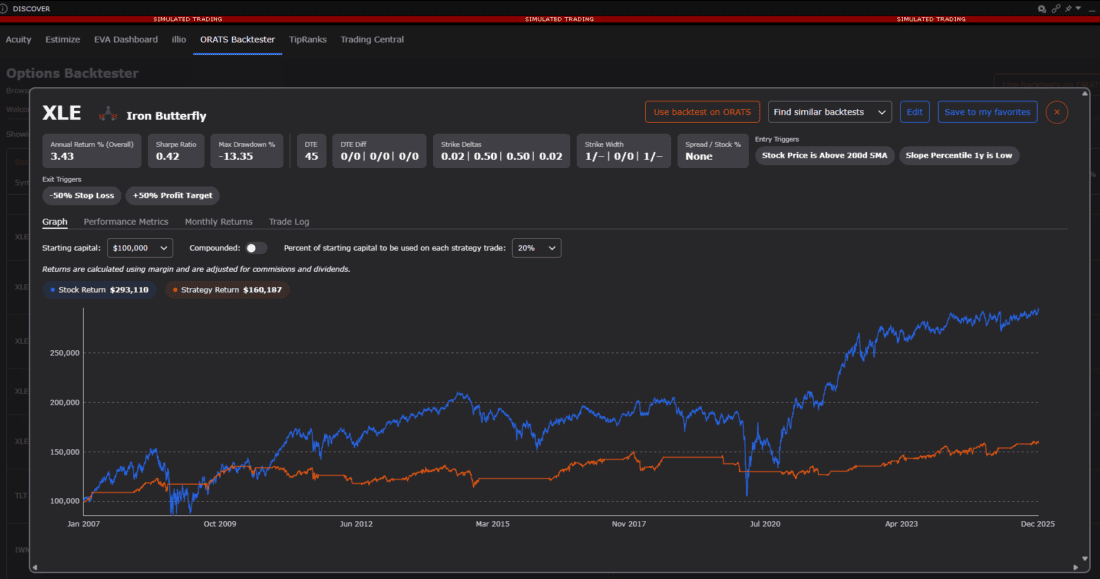
When evaluating options strategy backtesting results, total return is only one piece of the puzzle.
Win rate measures the percentage of trades that closed profitably.
While a high win rate may look attractive, it should never be evaluated in isolation. Some strategies generate frequent small gains but occasionally experience much larger losses.
Return on risk compares profits to the capital or risk required to generate those returns.
Many traders consider this one of the most useful metrics because it helps compare strategies that require vastly different amounts of capital.
Average return helps determine whether profitability comes from a few exceptional trades or from a consistent stream of gains.
Consistency is often just as important as total return.
Drawdown measures the decline from a previous peak in portfolio value.
A strategy that generates attractive returns but experiences large drawdowns may be difficult for many traders to follow through challenging market periods.
Some options strategies trade weekly. Others may only generate a handful of opportunities each year.
Understanding trade frequency can help traders determine whether a strategy fits their preferred level of activity.
Backtesting can be incredibly valuable, but only when results are interpreted carefully.
A strategy with a 90% win rate may appear superior to one with a 70% win rate.
However, if the losing trades are significantly larger, the lower-win-rate strategy may ultimately produce better long-term results.
Many traders focus on profits while overlooking the periods of loss that occurred along the way.
Understanding worst-case historical declines can provide important insight into a strategy’s risk profile.
A strategy that performed well during one market environment may behave very differently during another.
Whenever possible, traders should review results across multiple market cycles.
Changing dozens of settings until historical performance looks perfect can create unrealistic expectations.
The goal is not to find a strategy that worked best in the past. The goal is to understand how it behaved over time.
One of the most powerful uses of backtesting is comparing similar variations of the same strategy.
Consider a covered call strategy.
A trader could compare:
Each variation may produce different results in terms of:
Sometimes small adjustments can significantly impact historical performance.
Once traders understand what they want to measure, they need access to reliable historical data.
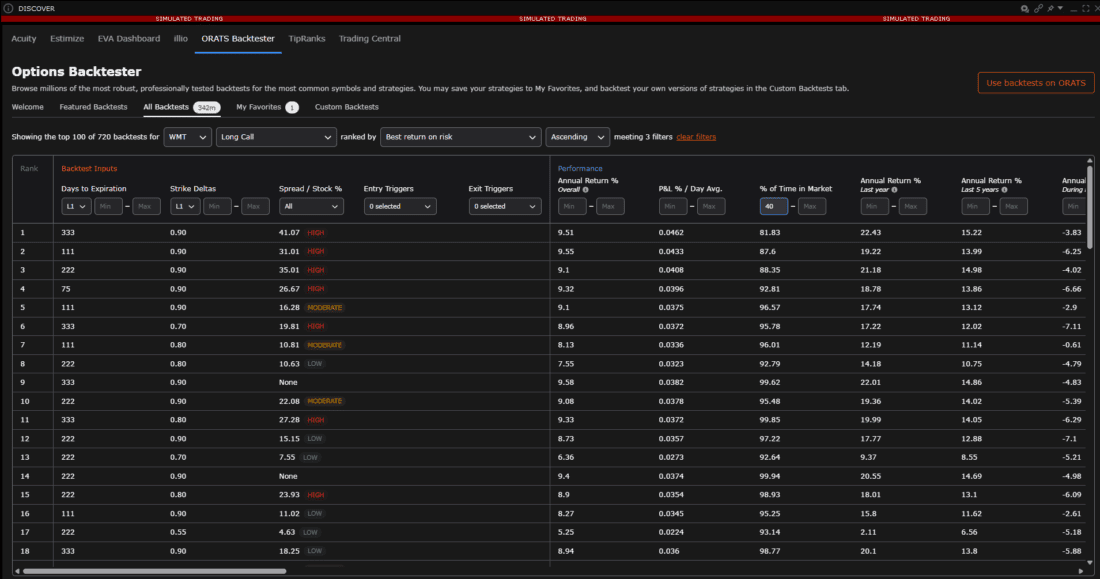
The ORATS Backtester, available within Trader Workstation, allows IBKR clients to search and analyze millions of pre-calculated options strategy backtests across stocks, ETFs and indexes. Users can review performance metrics, compare strategy variations, evaluate drawdowns and study historical trade results without building their own models. [interactiv…rokers.com], [orats.com]
By selecting a symbol, strategy type and ranking criteria, traders can quickly begin exploring how different approaches have historically performed. [interactiv…rokers.com]
Key Takeaway
Backtesting won’t eliminate risk or predict future outcomes. However, it can help traders make more informed decisions by understanding how a strategy behaved historically before capital is placed at risk.
The analysis in this material is provided for information only and is not and should not be construed as an offer to sell or the solicitation of an offer to buy any security. To the extent that this material discusses general market activity, industry or sector trends or other broad-based economic or political conditions, it should not be construed as research or investment advice. To the extent that it includes references to specific securities, commodities, currencies, or other instruments, those references do not constitute a recommendation by IBKR to buy, sell or hold such investments. This material does not and is not intended to take into account the particular financial conditions, investment objectives or requirements of individual customers. Before acting on this material, you should consider whether it is suitable for your particular circumstances and, as necessary, seek professional advice.
The views and opinions expressed herein are those of the author and do not necessarily reflect the views of Interactive Brokers, its affiliates, or its employees.
Options involve risk and are not suitable for all investors. For information on the uses and risks of options, you can obtain a copy of the Options Clearing Corporation risk disclosure document titled Characteristics and Risks of Standardized Options by going to the following link ibkr.com/occ. Multiple leg strategies, including spreads, will incur multiple transaction costs.
The analysis in this material is provided for information only and is not and should not be construed as an offer to sell or the solicitation of an offer to buy any security. To the extent that this material discusses general market activity, industry or sector trends or other broad-based economic or political conditions, it should not be construed as research or investment advice. To the extent that it includes references to specific securities, commodities, currencies, or other instruments, those references do not constitute a recommendation by IBKR to buy, sell or hold such investments. This material does not and is not intended to take into account the particular financial conditions, investment objectives or requirements of individual customers. Before acting on this material, you should consider whether it is suitable for your particular circumstances and, as necessary, seek professional advice. The views and opinions expressed herein are those of the author and do not necessarily reflect the views of Interactive Brokers, its affiliates, or its employees.








Join The Conversation
For specific platform feedback and suggestions, please submit it directly to our team using these instructions.
If you have an account-specific question or concern, please reach out to Client Services.
We encourage you to look through our FAQs before posting. Your question may already be covered!