
- Solve real problems with our hands-on interface
- Progress from basic puts and calls to advanced strategies
Interactive Options Course
Lesson 3 of 9
Already an Interactive Brokers Client?
New to Interactive Brokers?
Every options strategy is built around assumptions.
A trader may believe that selling premium works best during high volatility, or that covered calls generate better risk-adjusted returns than simply holding stock. But how can these assumptions be evaluated?
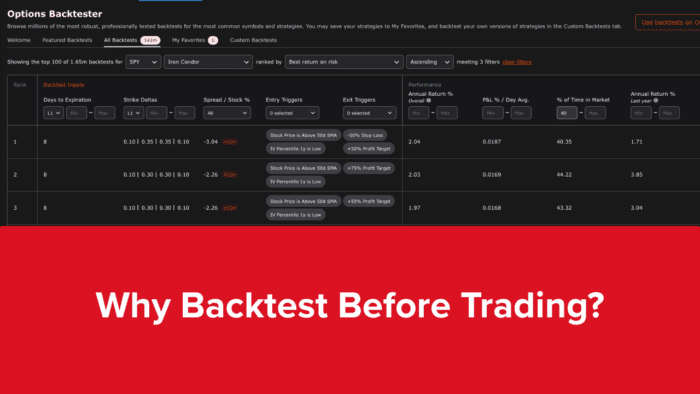
Backtesting provides a way to study historical outcomes before placing a live trade.
Many trading ideas sound attractive in theory.
For example:
Backtesting helps answer these questions using historical data instead of intuition alone.
Historical analysis allows traders to determine whether a strategy behaved the way they expected over multiple market cycles.
Even small changes to an options strategy can produce different results.
A trader might compare:
For example, selling a put 30 days from expiration may create a different risk and return profile than selling a similar put 60 days from expiration.
Rather than guessing which variation might work best, traders can compare historical characteristics side by side.
One of the greatest benefits of backtesting is the ability to learn before capital is placed at risk.
Historical analysis allows traders to evaluate:
While no backtest can predict future outcomes, reviewing historical data can help traders gain confidence in their decision-making process and better understand how a strategy has behaved in the past.
The objective isn’t to find a strategy that wins every time. The objective is to understand the trade-offs associated with different approaches and determine which strategies best align with a trader’s goals and risk tolerance.
In many ways, backtesting is simply research. The more thoroughly a trader researches a strategy before entering the market, the more informed their decisions may become.
The analysis in this material is provided for information only and is not and should not be construed as an offer to sell or the solicitation of an offer to buy any security. To the extent that this material discusses general market activity, industry or sector trends or other broad-based economic or political conditions, it should not be construed as research or investment advice. To the extent that it includes references to specific securities, commodities, currencies, or other instruments, those references do not constitute a recommendation by IBKR to buy, sell or hold such investments. This material does not and is not intended to take into account the particular financial conditions, investment objectives or requirements of individual customers. Before acting on this material, you should consider whether it is suitable for your particular circumstances and, as necessary, seek professional advice.
The views and opinions expressed herein are those of the author and do not necessarily reflect the views of Interactive Brokers, its affiliates, or its employees.
Options involve risk and are not suitable for all investors. For information on the uses and risks of options, you can obtain a copy of the Options Clearing Corporation risk disclosure document titled Characteristics and Risks of Standardized Options by going to the following link ibkr.com/occ. Multiple leg strategies, including spreads, will incur multiple transaction costs.
The analysis in this material is provided for information only and is not and should not be construed as an offer to sell or the solicitation of an offer to buy any security. To the extent that this material discusses general market activity, industry or sector trends or other broad-based economic or political conditions, it should not be construed as research or investment advice. To the extent that it includes references to specific securities, commodities, currencies, or other instruments, those references do not constitute a recommendation by IBKR to buy, sell or hold such investments. This material does not and is not intended to take into account the particular financial conditions, investment objectives or requirements of individual customers. Before acting on this material, you should consider whether it is suitable for your particular circumstances and, as necessary, seek professional advice. The views and opinions expressed herein are those of the author and do not necessarily reflect the views of Interactive Brokers, its affiliates, or its employees.











Join The Conversation
For specific platform feedback and suggestions, please submit it directly to our team using these instructions.
If you have an account-specific question or concern, please reach out to Client Services.
We encourage you to look through our FAQs before posting. Your question may already be covered!