
- Solve real problems with our hands-on interface
- Progress from basic puts and calls to advanced strategies
Interactive Options Course
Lesson 5 of 9
Already an Interactive Brokers Client?
New to Interactive Brokers?
When evaluating an options strategy, one of the first questions traders often ask is:
Has this approach worked well historically?
Answering that question requires more than reviewing a few recent trades. Traders need a way to evaluate historical option strategy performance over different market environments and compare strategies using consistent performance measures.
Strategy performance refers to the collection of metrics used to evaluate how a trading strategy behaved historically.
A profitable strategy is not necessarily a good strategy.
For example, two strategies may generate similar returns, while one experiences significantly larger losses along the way.
Looking at performance from multiple angles can provide a more complete picture of the opportunities and risks involved.
Win Rate
The percentage of trades that finished profitably.
High win rates may be appealing, but traders should always consider how much was gained on winning trades compared to what was lost during losing trades.
Return
Return measures overall profitability.
This is often the first metric traders review, but it should never be viewed in isolation.
Drawdown
Drawdown shows how much a strategy declined from a previous peak.
Many traders consider drawdown one of the most important risk measurements because it highlights the magnitude of historical losses.
Profit Factor
Profit factor compares total gains to total losses.
This metric can help determine whether a strategy’s profitability comes from a favorable balance between winning and losing trades.
Historical analysis becomes particularly useful when comparing strategies that share a similar market outlook.
Consider a moderately bullish investor deciding between:
Covered Call
Cash-Secured Put
While both strategies can benefit from stable or moderately bullish markets, their historical performance characteristics may differ significantly.
Comparing return, drawdown, win rate and risk metrics can help traders decide which approach better aligns with their objectives.

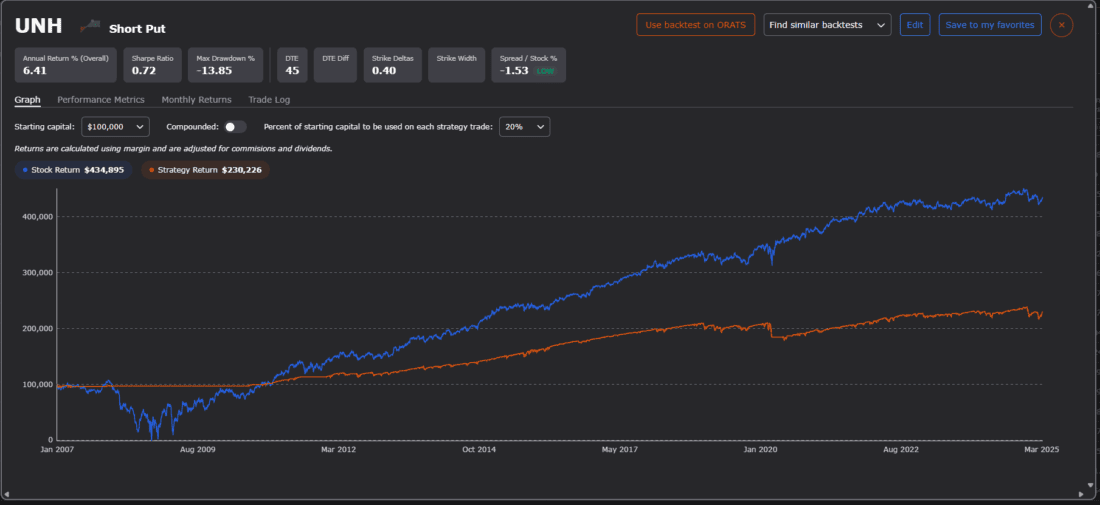
The same strategy can perform very differently depending on the market environment.
Bull Markets
Directional bullish strategies often benefit from rising stock prices.
Bear Markets
Defensive approaches or strategies with defined risk may perform more favorably during market declines.
High Volatility Environments
Higher option premiums can change the risk-reward profile of income-generating strategies.
Low Volatility Environments
Reduced premiums may make certain strategies less attractive while benefiting others.
Historical analysis helps traders understand how strategies behaved under different market conditions rather than evaluating only recent performance.
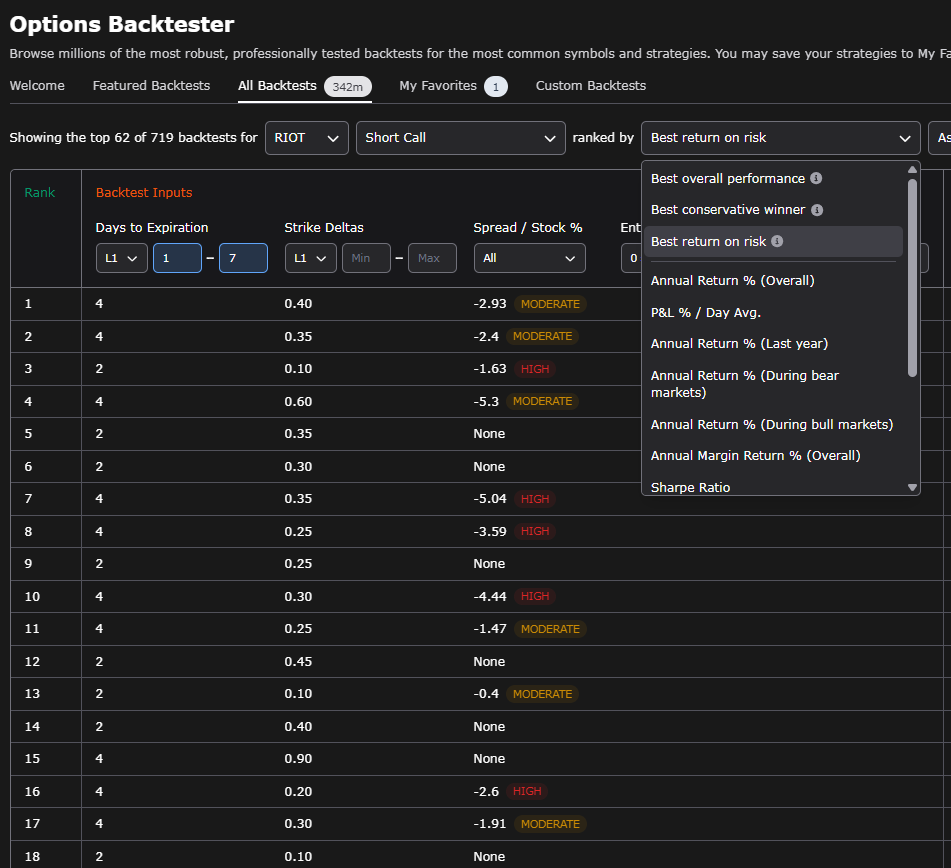
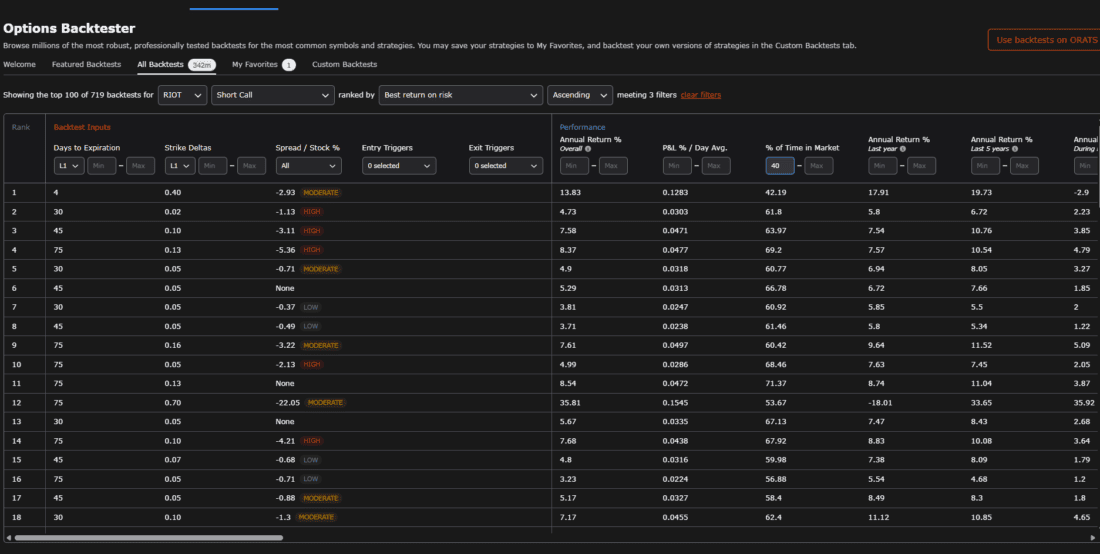
The ORATS Backtester provides access to a large library of historical options strategy tests that traders can search, rank and compare. Users can filter by symbol, strategy type and ranking metrics while reviewing historical performance data, equity curves and trade logs. [interactiv…rokers.com], [orats.com]
Rather than relying on assumptions, traders can use historical analysis to evaluate multiple strategies side-by-side and identify the characteristics most important to them.
Historical performance cannot predict future returns, but it can provide valuable context. By comparing strategy metrics across multiple market environments, traders can gain deeper insight into both the opportunities and risks associated with an options strategy.
The analysis in this material is provided for information only and is not and should not be construed as an offer to sell or the solicitation of an offer to buy any security. To the extent that this material discusses general market activity, industry or sector trends or other broad-based economic or political conditions, it should not be construed as research or investment advice. To the extent that it includes references to specific securities, commodities, currencies, or other instruments, those references do not constitute a recommendation by IBKR to buy, sell or hold such investments. This material does not and is not intended to take into account the particular financial conditions, investment objectives or requirements of individual customers. Before acting on this material, you should consider whether it is suitable for your particular circumstances and, as necessary, seek professional advice.
The views and opinions expressed herein are those of the author and do not necessarily reflect the views of Interactive Brokers, its affiliates, or its employees.
Options involve risk and are not suitable for all investors. For information on the uses and risks of options, you can obtain a copy of the Options Clearing Corporation risk disclosure document titled Characteristics and Risks of Standardized Options by going to the following link ibkr.com/occ. Multiple leg strategies, including spreads, will incur multiple transaction costs.
The analysis in this material is provided for information only and is not and should not be construed as an offer to sell or the solicitation of an offer to buy any security. To the extent that this material discusses general market activity, industry or sector trends or other broad-based economic or political conditions, it should not be construed as research or investment advice. To the extent that it includes references to specific securities, commodities, currencies, or other instruments, those references do not constitute a recommendation by IBKR to buy, sell or hold such investments. This material does not and is not intended to take into account the particular financial conditions, investment objectives or requirements of individual customers. Before acting on this material, you should consider whether it is suitable for your particular circumstances and, as necessary, seek professional advice. The views and opinions expressed herein are those of the author and do not necessarily reflect the views of Interactive Brokers, its affiliates, or its employees.










Join The Conversation
For specific platform feedback and suggestions, please submit it directly to our team using these instructions.
If you have an account-specific question or concern, please reach out to Client Services.
We encourage you to look through our FAQs before posting. Your question may already be covered!