
- Solve real problems with our hands-on interface
- Progress from basic puts and calls to advanced strategies
Interactive Options Course
Lesson 11 of 13
Contributed By: 
The following is a summary of a video recording and may contain errors in spelling or grammar. Although IBKR has edited for clarity no material changes have been made.
Hey everyone, we’re going to dive into the Distributed energy section of Big Ideas. I’m Sam Korus Director of Research at ARK Invest, and I’ll be joined by Daniel Maguire to dive through this section. And a shout out to Akaash and his team, who also helped with the research.
And so really starting off, you know, it’s important. What makes an economy grow and what’s the necessary input? If you track it all the way back, it comes to energy. And so, as we have a very exciting growth projections for global GDP, US GDP, all of the talk about AI and how much energy and power that requires, you know, it does come back to this element of where are you going to get the energy from?
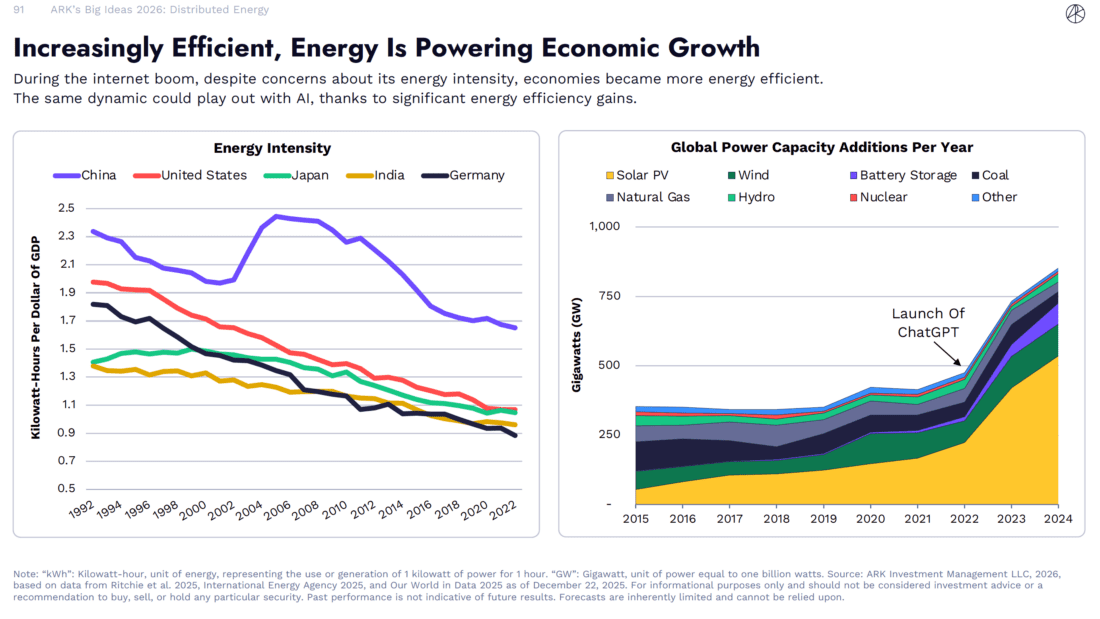
And I think it’s really important we look at this chart on the left, which is that, you know, energy is powering this economic growth. And even throughout all of this increasing efficiency has taken place. And so, you can see from the early 90s through today through 2022 is the most recent data point, the top economies have become increasingly energy efficient.
And this is interesting, right? That goes through the Internet boom and there were huge concerns at that time around its energy intensity. And yet this trend has continued. We think that will continue to play out as people are concerned about AI and the energy demands that it requires as well.
And if we look at this chart on the right, you can see that really the world for about 10 years was in slow growth mode when it comes to global power capacity additions. But this spark of AI and this, you know, potential return on invested capital on these data centers has jump started a new wave of investment in energy.
And a lot of people look at this, and they said that’s a bad thing. Whereas, you know, we, the research suggests this is in fact an incredibly good thing. For economic growth, we need to invest in energy. And the more we invest in energy, the less that energy will cost because it really is a simple supply demand type equation where you need to accelerate supply such that prices go down, as opposed to where we are today, which is limited supply and increasing demand, which would make prices go up.

So as Sam mentioned, energy is foundational to all economies. And what’s really driving that is Wright’s law, which is foundational to ARK research. Wright’s law states for every cumulative doubling of power or energy costs will decline by a constant percentage. And according to our research, this has held throughout history for solar, for batteries and even for nuclear before being derailed in the 1970s by regulatory hurdles.
But when you Fast forward today and look at the nuclear environment, there are so many tailwinds facing the industry, be it executive orders to build up the nuclear fuel cycle or the Department of Energy accelerating the deployment of advanced reactor timelines.
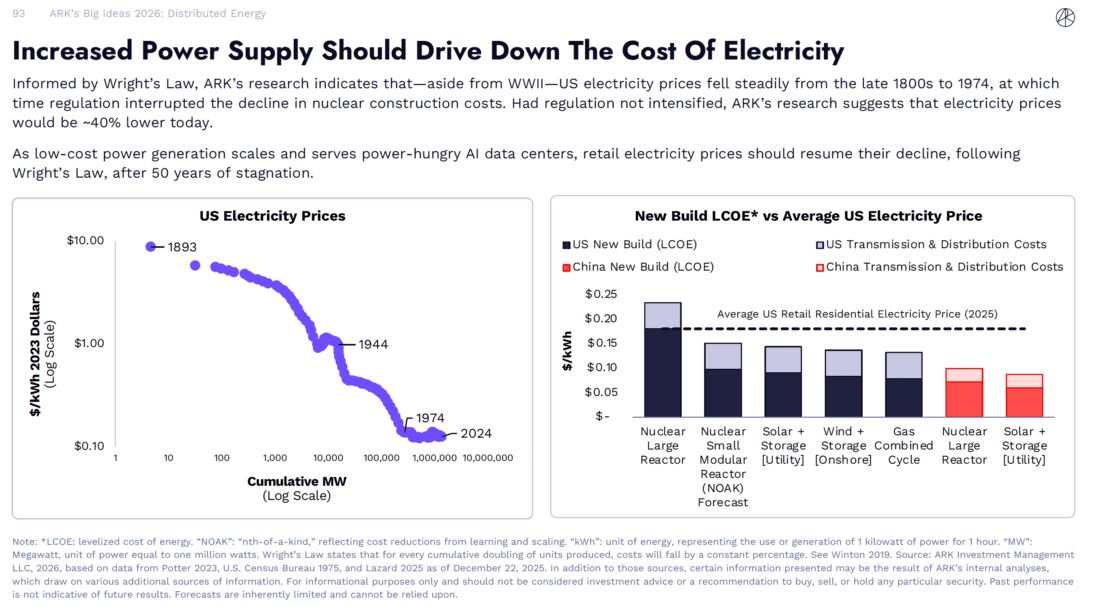
From our perspective, all of these tailwinds are positioning nuclear to return to its previous cost trajectory. So, the output from low-cost power generation comes electricity prices and economics one 101 states. When supply exceeds demand, prices will fall.
And again, according to Wright’s law, throughout history, with the exception of World War 2, electricity prices have declined constantly up until 1970s where regulatory hurdles derailed nuclear construction costs as I previously mentioned. And our research suggests that had these, had this derailment not occurred, electricity prices would have been roughly 40% cheaper than where they are today.
And that’s not to say we can’t get there. What’s required to continue this trend is to bring on new power generation. And at the margin, as you bring on low-cost power generation and it scales to meet the power-hungry AI data centers, retail electricity prices should resume the cost decline, marking a win for residential customers as well as AI hyperscalers.
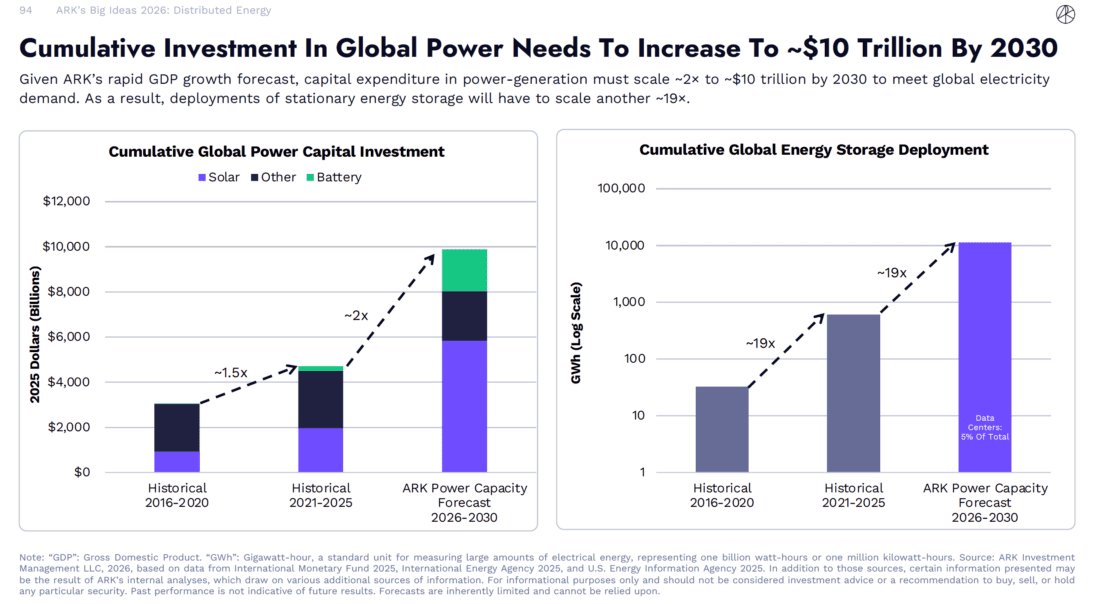
So, the message here is really clear. More energy is better. So then comes market sizing. And where does this net out? Well, if ARK GDP forecast is correct, according to our Chief Futurist, Brett Winton of roughly 7% annualized out to 2030, we believe power CapEx will roughly scale to roughly $10 trillion over the next five years. For context, that’s roughly double what cost has been spent on power CapEx over the last five years.
And in order to support this power CapEx, we believe stationary energy storage will scale roughly 19X over the same. Continuing the trend we’ve seen over the last five years.
So, in summary, for distributed energy, we would say more energy is good. There is a period of stagnation for building energy, but now we’re on the cusp of accelerating power CapEx and we think that translates to a multi trillion-dollar opportunity by the end of the decade. We’re excited to monitor the developments for the coming year on distributed energy.
Information posted on IBKR Campus that is provided by third-parties does NOT constitute a recommendation that you should contract for the services of that third party. Third-party participants who contribute to IBKR Campus are independent of Interactive Brokers and Interactive Brokers does not make any representations or warranties concerning the services offered, their past or future performance, or the accuracy of the information provided by the third party. Past performance is no guarantee of future results.
This material is from ARK Invest and is being posted with its permission. The views expressed in this material are solely those of the author and/or ARK Invest and Interactive Brokers is not endorsing or recommending any investment or trading discussed in the material. This material is not and should not be construed as an offer to buy or sell any security. It should not be construed as research or investment advice or a recommendation to buy, sell or hold any security or commodity. This material does not and is not intended to take into account the particular financial conditions, investment objectives or requirements of individual customers. Before acting on this material, you should consider whether it is suitable for your particular circumstances and, as necessary, seek professional advice.









Join The Conversation
For specific platform feedback and suggestions, please submit it directly to our team using these instructions.
If you have an account-specific question or concern, please reach out to Client Services.
We encourage you to look through our FAQs before posting. Your question may already be covered!