- Solve real problems with our hands-on interface
- Progress from basic puts and calls to advanced strategies
Interactive Options Course
Trading Course
ARK’s Big Ideas 2026 argues that we are still early in a powerful “Great Acceleration,” driven by converging technologies like AI, robotics, energy storage, blockchain, and genomics. The report highlights massive investment, productivity gains, and disruption across industries—from software and finance to healthcare and transportation, projecting faster economic growth and new market opportunities. Overall, ARK sees this innovation cycle as transformative, unlocking entrepreneurship, reshaping global systems, and potentially driving a step-change in GDP growth by 2030.
Contributed by 

In this lesson, ARK Invest CEO/CIO Cathie Wood walks through the report, emphasizing the key technologies and convergences guiding the next wave of innovation—and why they matter now. ARK’s Big Ideas 2026 frames the current moment as a “Great Acceleration,” arguing that AI is still early and that multiple innovation platforms—AI, robotics, energy storage, multiomics, and blockchain are converging to drive a step-change in productivity and economic growth.

The Great Acceleration describes a new phase of economic growth driven by the convergence of five rapidly declining cost innovation platforms: artificial intelligence, robotics, public blockchains, energy storage, and multiomics. With AI acting as the central catalyst, these technologies increasingly reinforce one another, accelerating capital investment, productivity, and the conversion of previously unpriced activity into measurable GDP.

In this lesson of Big Ideas 2026, Frank Downing, Director of Research, AI and Cloud, outlines how rapid cost declines and performance improvements in AI models are driving an explosion in demand and a significant acceleration in AI infrastructure investment. He provides historical context for today’s capital spending cycle, explains why current valuations differ from past tech bubbles, and examines how GPUs and custom silicon from hyperscalers are reshaping the future of data center compute through 2030.

This lesson of ARK’s Big Ideas explores the rise of the AI consumer operating system and the shift into an agentic era, where AI agents move beyond answering questions to taking actions on behalf of users. It covers how AI is transforming e commerce, advertising, and consumer decision making, driven by rapid adoption, new protocols, and emerging monetization models that reshape the digital economy.
This lesson examines how rapid improvements in AI performance and falling costs are transforming workplace productivity. It highlights the evolution from chatbots to capable AI agents, the economic value AI generates for knowledge workers, global competition in compute and semiconductor capacity, and how accelerating AI adoption could drive trillions of dollars in software, platform, and infrastructure investment.

This lesson examines Bitcoin’s evolution into a mature institutional asset. It covers increasing adoption by ETFs, digital asset treasuries, and sovereign and state level entities, alongside improvements in Bitcoin’s risk adjusted returns, declining volatility, and changing market dynamics. It also explores long term market capitalization scenarios through Bitcoin’s role as digital gold and its place within the broader digital asset ecosystem alongside smart contract platforms.

The Defi application section, this year has really been the year for applications. For many years, most of the value was going to layer one to underneath to the blockchain.

This lesson explores multiomics and its role in transforming healthcare, from biological data generation and diagnostics to drug development, functional cures, and longevity. It explains how advances across genomics, proteomics, metabolomics, and other biological layers—combined with artificial intelligence—are accelerating discovery, lowering costs, improving outcomes, and creating massive long term economic opportunity.

This lesson explores the rise of reusable rockets as a foundational driver of the emerging space economy. It highlights how SpaceX’s leadership in reusability has dramatically lowered launch costs, enabled large scale satellite deployment, and unlocked new commercial opportunities such as global satellite connectivity and future orbital data centers. The lesson also examines how falling launch costs, guided by Wright’s Law, are reshaping the economics of space based infrastructure.

This lesson explores the economic, technological, and societal implications of robotics and automation, with a focus on the shift from structured industrial robots to generalizable and humanoid robotics. It examines historical concerns around automation and employment, the current state of robot adoption across industries, and why unstructured environments represent the largest growth opportunity. The section also outlines the scale, complexity, and timeline of humanoid robot commercialization and its potential to transform global productivity.

This lesson examines distributed energy as a foundational driver of long term economic growth. It explains why energy availability underpins GDP expansion, how efficiency improvements have historically coexisted with economic growth, and why the surge in AI driven power demand is triggering a renewed cycle of energy investment. The section also explores Wright’s Law, nuclear energy’s return to cost declines, and the multi trillion dollar opportunity emerging across power generation and energy storage.
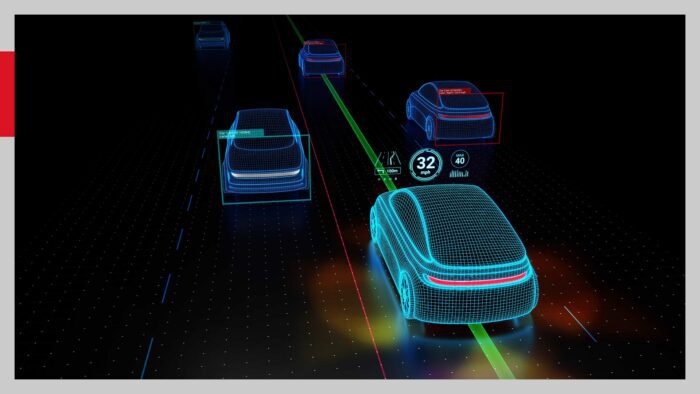
This lesson explores the rapid commercialization of autonomous vehicles, with a focus on robotaxis and their potential to transform urban transportation economics. It examines real world deployments, the critical role of data and scale, cost advantages versus human driven transportation, and how vertically integrated platforms may capture the majority of long term value. The section also outlines market sizing, ecosystem roles, and key risks to adoption.
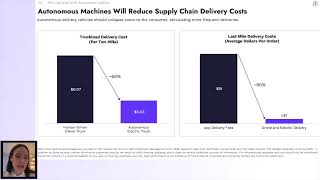
This lesson explores the rise of autonomous logistics, including drones, rolling robots, and autonomous trucks. It examines how removing human drivers from delivery systems can dramatically reduce costs, improve efficiency, and reshape consumer shopping behavior. The module highlights real world deployments already underway, the importance of scale and data for safety and cost reduction, regulatory considerations, and the long term revenue opportunity across last mile, middle mile, and long haul logistics.