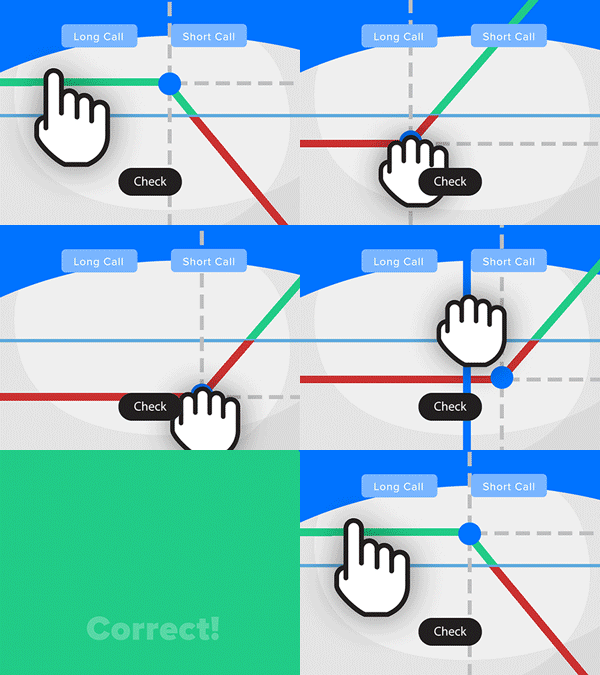
- Solve real problems with our hands-on interface
- Progress from basic puts and calls to advanced strategies
Interactive Options Course

Posted July 9, 2026 at 11:21 am
As women take on an increasingly influential role in wealth creation and investing, the financial industry is facing one of its biggest opportunities for change. Jenny Riera, Co-Head of Wealth Partnerships & Solutions for Latin America at BlackRock, shares insights on the rise of women investors, the barriers that remain and how the industry can better serve the next generation of wealth creators.
The following is a summary of a live audio recording and may contain errors in spelling or grammar. Although IBKR has edited for clarity no material changes have been made.
Hello, and welcome to this Interactive Brokers podcast focused on women, women who are actively in the financial markets and who actively participate in the portfolio management, in the asset management, and obviously BlackRock is a key component here. We have here with us Jenny Riera today, and Jenny is the co-head of Wealth Partnerships and Solutions for Latin America and for BlackRock.
Welcome.
Thank you so much for having me, Judith. I’m excited to be part of this podcast series.
Yes. And this podcast series, we thought of it as a way to elevate women, elevate women’s voices in the industry, highlight how women can get more impact and get more into the trading markets, the investing community, and feel it more accessible for women as well. So my first question to you, Jenny, is, and to start us off and to get to know you better, tell us about your role at BlackRock and the relevance of pertaining to focusing today on today’s discussion and to focus on the women’s.
Absolutely, Judith. So again, for those tuning in, and as Judith already mentioned, I co-head the wealth partnerships and solutions business for Latin America, while also leading our digital distribution efforts across the region for BlackRock. And what I really love about my role is that it sits kind of in the intersection of business strategy, cross-border partnerships, and client engagement.
And on a day-to-day basis, this means working very closely with our local wealth partners, key stakeholders across the firm, to really provide a holistic coverage model to our regional client base that includes wealth managers, private banks, family offices, and digital platforms across Latin America. And in this very dynamic and rewarding role, what I’ve seen consistently across markets and client segments is that we’re in the middle of a significant shift in how wealth is created, managed, and also transferred.
And what we’re seeing is that women play an increasingly important role in this shift, supported by factors such as longer life expectancy, increasing earnings power, and one of the largest intergenerational wealth transfers in history. Women already control a significant and growing share of global wealth, and yet a meaningful portion of those assets remain underserved or outside traditional advisory relationships, Judith.
And that gap represents not just a challenge, but on the contrary, one of the most compelling long-term growth opportunities facing our wealth management industry globally today.
Wow. And it’s true that you are really on the heart and center of all this, and you have the opportunity to touch it on a day-to-day basis. But then, to your point, I mean, we have been hearing about this rise of the female investors. Why is this such an important moment for the industry, as you said, and what do you think about this trend?
Like personally, what do you think? What can you add on to that?
Let me start maybe with a macro picture, Judith, because I believe that it’s quite compelling. Recent research from McKinsey shows that women already control about one third or so of all retail financial assets in the US and Europe. And that share is expected to rise to roughly 40 to 45% by 2030.
And what’s even more striking is that wealth controlled by women is growing faster than the overall global wealth. So put simply, women are playing an increasingly important role in shaping the future of wealth. And it’s not just about receiving wealth via inheritance, for instance. Women are simply increasing also in creating wealth through higher levels of education, increased participation in the workforce, and greater representation in higher income roles. And at the same time, because us women often have longer life expectancy, many may also become the sole or primary financial decision-maker at different points in their lives. And so when you put it all together, I believe it’s not just a niche segment, it’s one of the most important growth drivers for the wealth management industry over the next decade. But, and this is key point here, the industry still has some work to do. For instance, an estimated 53% of assets controlled by women are currently unmanaged by advisors versus, for instance, it’s just around 45% for men. And that represents roughly a 10 trillion advice gap by 2030 if that gap to men is closed. And potentially even more if the industry continues to evolve its offering to meet simply a broader range of investor profiles and needs. And importantly, we are already starting to see how this industry is adapting. So for instance, from our 2026 BlackRock Advisor Trends survey, one of the most interesting insights, Judith, is that many women advisors are emphasizing relationship-led advice alongside business growth.
And they are focused on deepening existing client relationships, building multi-generational connections, and identifying opportunity within their current client base. And strategically, that matters, right? Because stronger relationships can support more durable long-term growth and better client outcomes. And at the same time, many advisors are prioritizing business sustainability, whether that’s succession planning, adapting more sophisticated investment solutions like model portfolio or separately managed accounts, or building a deeper expertise to serve more complex client needs. And ultimately, this shows to me that the rise of women investor is no longer a niche conversation, as I mentioned, but it’s a core growth question for the industry and one that belongs at the leadership table.
It’s true. And with these numbers that support this vision, I mean, there is a gap, there is a need, and there is an opportunity. So there is everything to keep on growing. But then these opportunities are so clear, but then the business is working towards that goal, but which barriers, which are the main barriers you see?
Absolutely. And despite all of that momentum though, Judith, we still see a meaningful gap between opportunity and reality, right? And I would frame that gap around three core barriers. First is the engagement and trust gap. Today, over half of women assets are still unmanaged by advisors, which is significantly higher than for men, and this does not suggest a lack of engagement, I would say.
Rather it highlights that the industry still has work to do to better build deeper trust, relevance, connection with a broader set of investors. And when you look at the data, this point is validated, right? Because as many women say, they do not always feel fully understood by their wealth managers or that traditional advice may not always reflect their goals, preferences, or priorities.
And also, when we look at retirement planning, for instance, some women may face different considerations and challenges, right, particularly around longevity, career breaks, caregiving responsibilities. And while many are confident about their savings, right, the confidence gap versus men remains meaningful in several wealth markets. So the opportunity for the industry is to incorporate a broader, I would say, range of perspectives into how advice, solutions, and client experiences are designed. And so simply put, this is not, I would say, a product issue, but it’s really an empathy and relevance issue, and trust is ultimately the cost of entry.
Now, there’s a second barrier that I would call a product and language bias. And across the industry, traditional advice models have often been built around a narrow definition, I would say, of an investor. This can show up in how products are designed, in the way performance is communicated, and even in the language we use, which can sometimes be overly technical, transactional, or maybe not fully aligned with how different clients want to engage, quite frankly. And if clients feel that the experience ultimately is not designed with their needs in mind, it becomes harder to build long-term engagement, right? And I think this is just like any relationship ultimately works, right? And lastly, the third barrier I would define is the talent and structural gap.
Women also remain underrepresented, right, across any financial advisor role, and that has also real implications. In some client interactions, technical conversations may still default to one partner, even when another person or a woman is also in the room and is equally involved in or ultimately may be responsible for the decision-making. And so it becomes especially critical during key life transitions, if we think about the inheritance, we mentioned the big transfer in wealth, divorce, or even widowhood, when assets are actively moving. And if the relationship has not been built beforehand, clients may be more likely to reconsider where and how these assets are being managed going forward.
So when you step back, what you see is a very large, very real disconnect between how wealth is evolving and how the industry is currently set up, right, to serve a broader range of investors, I would say.
I mean, you are so smart on all the appreciations that you make about these barriers, and it’s good also… I mean, there is the opportunity, there are these barriers, let’s go for it, and let’s try to lower those barriers. And that brings me to the next point, right? So shifting to solutions, shifting to where you see that these firms are actually getting into practical approaches and make the difference and try to conquer the hearts of the women, but not only the hearts, the hearts and, obviously, the wealth of the women, and how can we service the female community better?
Sure. I would say the good news is that some firms are starting to get it right, and there are a few common themes we’ve seen across the most, I would say, successful approaches. So first, moving from, I would say, a demographic segmentation to more of a needs-based planning process. So the best teams don’t think about women as a single segment, right?
They recognize different client profiles and life stages, including maybe entrepreneurs, breadwinners, women in transition, multi-generational decision-makers, and they tailor, right, their approach accordingly. And that shift alone changes, I would say, the quality of engagement significantly.
I would say second, maybe redesigning the client experience around what I would call the three E’s: empathy, education and empowerment. And this means ultimately moving away from purely transactional conversations and more towards collaborative planning and using simple language, focusing on real-life outcomes, making sure the client feels heard and actively involved in the process. And it may sound basic to the listeners and viewers, but when done right, it can be incredibly powerful.
And then third, I would say lowering the barrier to entry. There’s also a persistent perception among many potential investors that you need a significant amount of disposable income to start investing, and that’s simply not true, right?
Firms that are successful in this space are making it easier to start small, whether it’s through education, automation, or more accessible investment pathways. So just the one I would say that Interactive Brokers offers, things like fractional shares, commission-free trading, no account minimums. And that mind shift of from you invest once you’re wealthy to you invest to become wealthy is critical.
I totally agree. I totally agree with this approach, and this will help. This will help female investors to get a better approach into the markets and closer to the financial education and to everything that you said. And the empathy, obviously, when you have people like you and me that are in the industry for so many years. But then let’s bring it closer to home. I mean, how is BlackRock, which is a huge entity, it’s a really relevant entity in this market, how is BlackRock thinking of the opportunities, and how are you personally, Jenny, involved on all these opportunities from your role perspective?
Absolutely. I would say at BlackRock, this is something we think about very intentional at a firm level and also, right, on a personal level. Recently, for instance, our leadership team hosted an inaugural BlackRock’s Women’s Wealth Executive Forum in our headquarters in New York, bringing together senior advisors and asset allocators across client segments to really focus, I would say, on one central question: how do we better serve women investors? And I would say not as a single segment, right, but as an increasingly influential group shaping the future of our wealth industry. And what stood out during this event is that this wasn’t just a narrow, right, women’s agenda. It was a leadership conversation, and the real value here came from bringing together influential voices to help us drive impact and reframe that this is a strategic opportunity for the industry.
And one of the most consistent themes throughout the discussion was that this is not only about inclusion. It’s important, right, but it’s ultimately about better outcomes, stronger relationships, and more sustainable growth. And another great example is an event that I actually had the privilege of hosting during the International Women’s Month this past March in Miami, where we also brought together female advisors and asset allocators from across the wealth ecosystem.
And Judith, you joined us on that occasion as well, right, and really contributed with invaluable perspectives to the discussion. And I’m sure you would agree that what made that discussion powerful is how we structured the conversation, I would say, around four themes: starting with the macro opportunity of women investor, how to design better wealth experiences, how firms can align strategy and culture, and finally, where the industry is heading.
And with all these type of client engagements, it also gives us a unique opportunity, right, to network and community build, where we can bring different perspectives into how we think, innovate, and serve clients in our communities more broadly.
Totally true, and it was a really productive event. I mean, it was inspiring, but at the same time everybody was really involved and participating and adding their perspective. It was really, really good. Thank you very much, Jenny. It’s true. Thank you very much.
So final question on this podcast that you have so kindly and nicely shared with us.
So as you look ahead, what do you think is going to happen in the industry to fully capture this opportunity, and what is the message that you want to leave for our listeners today, for the female community? So what is your last approach here to look ahead?
Great way to wrap us up here, Judith. So I would say if I had to step back and summarize one key message for today’s listeners and viewers, it would be that we are looking at one of the largest structural shifts in wealth creation and decision-making that our industry has ever seen. And the question clearly is no longer whether women will play a central role in shaping the future of wealth because, right, they already do, and their influence is continuing to grow.
The real question for me that we should ask ourselves is, will we as an industry evolve fast enough to serve this growing group of investors in a way that is relevant, inclusive, and differentiated enough? Because the firms that will get it right, Judith, those that truly listen, adapt, and redesign their advice models and teams, will not only better serve their clients, right, but will also capture one of the most compelling growth opportunities of the next decade. And to me, what’s equally important is that these conversations are long overdue. But the real test isn’t gonna be, right, a single moment or initiative like the events we hosted or this particular podcast, right? It’s whether we embed that commitment into how we operate every day, right? Even including how we mentor, how we sponsor, and how we elevate the next generation of women and talent. And so for me personally, that’s what makes this topic so important, right? It sits right at that intersection of purpose and future growth opportunity.
So nice, so inspiring, Jenny. It’s a pleasure to have had you here in our series of podcasts, and thank you very, very, very much.
Thank you so much for having me, Judith.
©2022 BlackRock, Inc. All rights reserved. BLACKROCK is a registered trademark of BlackRock, Inc., or its subsidiaries in the United States and elsewhere. All other marks are the property of their respective owners.
The analysis in this material is provided for information only and is not and should not be construed as an offer to sell or the solicitation of an offer to buy any security. To the extent that this material discusses general market activity, industry or sector trends or other broad-based economic or political conditions, it should not be construed as research or investment advice. To the extent that it includes references to specific securities, commodities, currencies, or other instruments, those references do not constitute a recommendation by IBKR to buy, sell or hold such investments. This material does not and is not intended to take into account the particular financial conditions, investment objectives or requirements of individual customers. Before acting on this material, you should consider whether it is suitable for your particular circumstances and, as necessary, seek professional advice.
The views and opinions expressed herein are those of the author and do not necessarily reflect the views of Interactive Brokers, its affiliates, or its employees.













Join The Conversation
For specific platform feedback and suggestions, please submit it directly to our team using these instructions.
If you have an account-specific question or concern, please reach out to Client Services.
We encourage you to look through our FAQs before posting. Your question may already be covered!