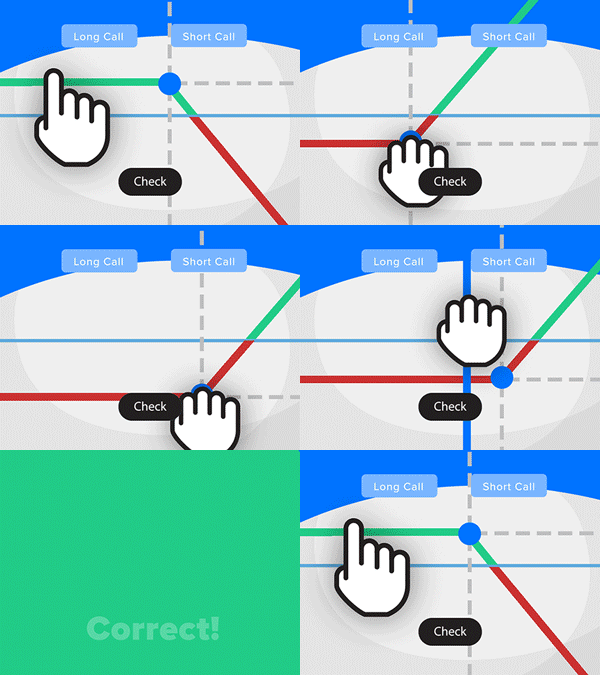
- Solve real problems with our hands-on interface
- Progress from basic puts and calls to advanced strategies
Interactive Options Course

Posted November 5, 2026 at 12:52 pm
Nearly one in four publicly listed U.S. companies has no analyst coverage. But what happens when Wall Street stops paying attention? Interactive Brokers’ Jeff Praissman sits down with Nasdaq’s Michael Normyle to explore why smaller companies are being overlooked, how a lack of research coverage can impact stock prices, and what this growing gap could mean for investors.
The following is a summary of a live audio recording and may contain errors in spelling or grammar. Although IBKR has edited for clarity no material changes have been made.
Hi, everyone. This is Jeff Praissman with Interactive Brokers. It’s my pleasure to welcome back to the IBKR Podcast Studio Nasdaq’s Michael Normyle. Hey, Michael. How are you?
Doing well, thanks. Glad to be back.
Love having you come in here for our monthly discussions on the economy and several other topics. Today, we’re fortunate enough that you and Phil Mackintosh wrote an article that was published in early October on Nasdaq’s website.
We’ll include it with the podcast as well so our listeners can read it. But I don’t know if you want to give us a quick summary of the premise of the article. Obviously, we’re going to dive into it, but let’s start there, and then we’ll jump into the questions.
Yeah, sure. So basically, we look at publicly listed companies in the U.S. and how many analysts they have covering them. There seems to be a pretty clear relationship between the size of the company and how many analysts they have covering them, if any. And maybe a surprising share of companies have no analysts at all.
So that’s what we’re looking at in the piece.
Yeah, I was going to say, that leads me right to my first question. I think when most investors think about public companies, they just assume someone on Wall Street is covering them. And maybe some of our less experienced investors think the same people on Wall Street cover every company, but that’s obviously not the case. Were you surprised, being in the industry, to find that almost a quarter of U.S.-listed companies have no analyst coverage at all?
Yeah, I think the share being that high was definitely a bit surprising. And I think part of the problem, too, is that it’s been rising over the last decade or so. So this isn’t some small, forgotten corner of the market or anything. It’s a quarter of all listed companies, and we see that share has been rising a little bit over time.
So it’s definitely something to keep an eye on here.
And for listeners who may not follow equity research closely, what value do analysts actually provide? Why does analyst coverage matter to investors and to the companies themselves as well?
Yeah, I mean, it’s the kind of quote-unquote “expert opinion,” I suppose. Companies put out their financial statements, but a lot of investors, especially your average retail investor, aren’t going to have the time or the training to dig through everything a company is putting out and figure out what it really means. And so the analysts do that work for you. They look at the industry, the competition, the company’s financials, and the risks. They boil all of that down in their analysis, and they’ll often provide a price target for the company so you know what they think its value should be, along with a buy, hold, or sell recommendation.
And so that matters for investors because it helps them decide where to put their money. But it actually matters for the company itself, too, because that research then affects its cost of capital, so basically how cheaply or expensively it can raise money, which then affects its ability to grow the business and hire people. So I think, from the retail investor side, analysts are almost like the equivalent of a mechanic for your car. They have the expertise to analyze what’s wrong or how things are going and translate that information to you as the end user.
And I found something really interesting in your article as well. It talked about losing analyst coverage and how that can impact a stock’s performance. So it seems like there’s a sort of chain reaction that may occur when researchers stop covering a company.
Yeah, and there’s some research that we link to and highlight in the article that’s pretty interesting. They look at companies losing analyst coverage, but they try to isolate cases where it’s unrelated to the company itself. For example, a brokerage shuts down, and so the company is no longer being covered. So they lose the only analyst covering them, and the researchers find that without analysts putting out regular reports, there’s just less information about that stock. This creates a kind of information asymmetry, meaning buyers and sellers are no longer working with the same information. And so the bid-ask spread, which is basically the gap between what buyers are willing to pay and what sellers want, tends to widen. When that happens, investor demand falls, and so does the stock’s price. So losing coverage isn’t just about the research. It also impacts stock prices as well.
And I would say, not surprisingly, the companies most affected tend to be smaller firms. So why are small-cap companies increasingly struggling to attract and maintain analyst coverage?
You mentioned that this problem is actually growing. Besides what you just described, with a small brokerage going out of business and potentially taking away a company’s only source of coverage, what other factors are at play?
Yeah, so it’s really just a simple story of economics here. Covering a company costs money. You’ve got to pay the analyst’s salary, they need research tools, and there are all sorts of other expenses. Those costs need to be covered by the revenue that the analyst’s firm brings in from things like trading commissions or investment banking fees related to that stock. And so for a huge company, there’s plenty of trading, there’s plenty of deal-making, and that justifies the cost quite easily. For a small company, though, that relationship isn’t as clear.
And we see that the numbers really back this up. The average company with no analysts has a market cap of around $230 million, and the median is under $50 million. Now, if you compare that to the biggest companies, which have market caps of several trillion dollars, they have dozens of analysts covering them.
So we’re really talking about these smaller companies that fall through the cracks a little bit when it comes to coverage, simply because the math doesn’t work out for firms to cover them.
Some of these largest companies, the household names, have dozens, if not 50 or 60 analysts covering them. And the small ones have none. Is that kind of how we ended up here? Everyone wants to read about Apple, but no one wants to read about XYZ small-cap company, right? Is that sort of how we got here?
Right. Yeah, I think it’s the flip side of that scenario, where you have these mega-cap stocks that everyone’s interested in. They have a lot of retail interest versus a micro-cap that someone hasn’t really heard of.
And so with the Nasdaq-100, for example, which has all large-cap and mega-cap stocks, on average, the companies in the Nasdaq-100 have 35 analysts following them. Some have more than 60. So these companies are really well covered, but then you have thousands of small companies with no coverage at all. And it just comes back to that same economics problem, where those bigger and more actively traded companies are going to attract analyst coverage, and we end up with a little bit of lopsided coverage here.
Jeff Praissman: And I would say this, too. There’s so much information out there. A lot of people would argue, and I think it’s probably true, that investors have more information than ever thanks to the internet and what’s available.
So do you think there’s a chance that online information, combined with AI, could fully replace professional analyst research at some point?
Well, I think these analysts aren’t necessarily just repackaging information that’s already out there. There’s definitely some original analysis going on, digging into a company’s competitive position, the risks, and the financials, and then turning that into an actual recommendation, a price target, or buy, hold, and sell ratings. So it’s not the same as just having access to a press release or some quarterly filing. The raw information might be out there, like you’re saying, but turning that into a clear, actionable view, I think that’s where the expertise element comes into it. And that’s the problem when a company loses coverage.
So I think there’s definitely an art and a science to it, which makes just having access to the raw information an imperfect substitute.
And you touched on this earlier, Michael. When companies aren’t covered at all or they lose their coverage, obviously, besides the stock price, you mentioned the cost of capital can go up. What else? Does it hurt them operationally, like hiring employees? What are some other side effects, if any, of this cascading effect from losing coverage or not having coverage to begin with?
Yeah, I think it really comes down to that cost of capital question you’re talking about, because when it becomes more expensive to raise capital, that will directly affect whether a company makes a decision to invest in something or hire more people.
So that’s where this problem goes from being a Wall Street problem to a Main Street problem, wherever that company is based and making those hiring decisions. It’s not just some novel research factoid here. It’s something that does impact investment decisions and hiring decisions. So it’s definitely impactful beyond just the stock price, which, of course, matters a lot to companies as well.
But it does have impacts beyond that, too.
And Nasdaq has tried to address this issue in the past through some initiatives aimed at increasing coverage for smaller companies. What have those efforts taught you about how difficult this problem is to solve?
Yeah, and this was well before my time at Nasdaq, so I’ll do my best here. But from the research I did on this, there were two attempts.
Back in 2005, Nasdaq launched something called the Independent Research Network, which ran until 2007, with the specific goal of generating coverage for small- and mid-cap companies after some reforms in 2002 resulted in reduced coverage.
Then again in 2010, we partnered with Morningstar to try a similar approach. But the fact that neither was able to sustain itself does show how challenging this is to address.
Yeah, and it seems like there could be an opportunity somewhere in this, right? So just thinking about it, if you could change one thing today to improve analyst coverage for smaller public companies, what do you think would have the biggest impact?
Yeah, I think this could be a case where maybe some regulatory response could be useful, since this has proven to be a pretty intractable problem. And there’s been an effort in other areas of equity markets to scale rules based on the size of the company involved or how recently they’ve become public. So that might be a model for how to address something like this, since we really do see it falling along the lines of company size. Now, what exactly that policy looks like, I can’t really say, though.
Yeah, so that actually leads me right into our final question. As regulators focus more on encouraging IPOs, because the information becomes public and I think you could make a case that it makes things a little bit safer, are we at risk of bringing more firms into the market that may struggle to get attention? Not every company is going to be a huge household name, and many may be smaller firms. Could that continue to increase the roughly 25% of listed companies that aren’t getting analyst coverage?
And if so, could regulatory involvement, perhaps requiring some level of analyst coverage, be a potential long-term solution?
Yeah, I think this is a case where we probably need to look at the wider net benefit here, because I think the upside of encouraging more IPOs is pretty high. You could allow household investors to invest in companies that may have otherwise stayed private. And if these companies are coming to public markets earlier and growing in those markets, that helps grow the wealth of American households more broadly. But of course, like you’re saying, you need to be mindful of generating coverage for these newly public companies, since that will help with their cost of capital.
There’s research that we’ve seen and highlighted before, and that the SEC has actually highlighted as well, showing that going public not only provides companies with capital but also improves their overall ability to raise funds.
Credit spreads fall nearly 25%, borrowing costs decline, and the pool of lenders grows. And when you fast-forward four years post-IPO, you see the benefits. Public companies have 40% greater capital expenditures and 50% larger assets than similar private companies.
They also have more bank debt because they’re able to borrow at lower rates. So I think the net benefit here seems pretty positive, including access to capital and the cost of capital. But in terms of what you’re saying about longer-term solutions and making sure these companies get coverage as they go public, there certainly seems to be more work to do there.
Michael, as always, this has been great. Love having you stop by the IBKR Podcast Studio. For our listeners, you can find more from Michael Normyle at Nasdaq.com and also on our website, InteractiveBrokers.com. Just click on Education, where you’ll find lots of great podcasts, webinars, and articles. Until next time, Michael, thanks for stopping by.
Yeah, thanks for having me.
New to Interactive Brokers?
The analysis in this material is provided for information only and is not and should not be construed as an offer to sell or the solicitation of an offer to buy any security. To the extent that this material discusses general market activity, industry or sector trends or other broad-based economic or political conditions, it should not be construed as research or investment advice. To the extent that it includes references to specific securities, commodities, currencies, or other instruments, those references do not constitute a recommendation by IBKR to buy, sell or hold such investments. This material does not and is not intended to take into account the particular financial conditions, investment objectives or requirements of individual customers. Before acting on this material, you should consider whether it is suitable for your particular circumstances and, as necessary, seek professional advice.
The views and opinions expressed herein are those of the author and do not necessarily reflect the views of Interactive Brokers, its affiliates, or its employees.
Index
Nasdaq® is a registered trademark of Nasdaq, Inc. The information contained above is provided for informational and educational purposes only, and nothing contained herein should be construed as investment advice, either on behalf of a particular security or an overall investment strategy. Neither Nasdaq, Inc. nor any of its affiliates makes any recommendation to buy or sell any security or any representation about the financial condition of any company. Statements regarding Nasdaq-listed companies or Nasdaq proprietary indexes are not guarantees of future performance. Actual results may differ materially from those expressed or implied. Past performance is not indicative of future results. Investors should undertake their own due diligence and carefully evaluate companies before investing. ADVICE FROM A SECURITIES PROFESSIONAL IS STRONGLY ADVISED.
© 2023. Nasdaq, Inc. All Rights Reserved.
Options
For the sake of simplicity, the examples included do not take into consideration commissions and other transaction fees, tax considerations, or margin requirements, which are factors that may significantly affect the economic consequences of a given strategy. An investor should review transaction costs, margin requirements and tax considerations with a broker and tax advisor before entering into any options strategy.
Options involve risk and are not suitable for everyone. Prior to buying or selling an option, a person must receive a copy of Characteristics and Risks of Standardized Options. Copies may be obtained from your broker, one of the exchanges or The Options Clearing Corporation, One North Wacker Drive, Suite 500, Chicago, IL 60606 or call 1-888-OPTIONS or visit www.888options.com.
Any strategies discussed, including examples using actual securities and price data, are strictly for illustrative and education purposes and are not to be construed as an endorsement, recommendation or solicitation to buy or sell securities.
© 2023. Nasdaq, Inc. All Rights Reserved.
IPO investments carry substantial risks including extreme price volatility, limited operating history, lack of liquidity, potential for significant losses, and uncertainty regarding future performance.













Join The Conversation
For specific platform feedback and suggestions, please submit it directly to our team using these instructions.
If you have an account-specific question or concern, please reach out to Client Services.
We encourage you to look through our FAQs before posting. Your question may already be covered!