
- Solve real problems with our hands-on interface
- Progress from basic puts and calls to advanced strategies
Interactive Options Course
Lesson 13 of 13
Contributed By: 
The following is a summary of a video recording and may contain errors in spelling or grammar. Although IBKR has edited for clarity no material changes have been made.
I’m Tasha Keeney. I Director Investment Analysis for ARK Invest and Research for the Autonomous Technologies and Robotics team. Today I’m going to talk about autonomous logistics.

So fully autonomous deliveries here, actually globally, we have roughly 4 million deliveries happening by drone and rolling robot on an annualized basis already. And when you combine this with autonomous trucks starting to pull the safety driver out, the space is really starting to take off.
You have drone providers like Zipline who’ve completed more than two million cumulative autonomous deliveries starting their operations in Rwanda and really starting to scale US operations recently. Then look at robots, you have Starship Technologies who had a lot of success on college campuses or Meituan who’s really accelerating the rollout of integrated road robots.
And then finally, when you have trucks specifically in the United States, you have Aurora Innovation, Kodiak AI and Gatik AI, all operating driverless operations today.
And the reason why we track deliveries and miles travelled is with each additional delivery completed and each mile travelled, you’re accelerating the safety validation of your system and notably improving the operating efficiency of the system, which translates to lower cost to the end consumer as Tasha will detail now.
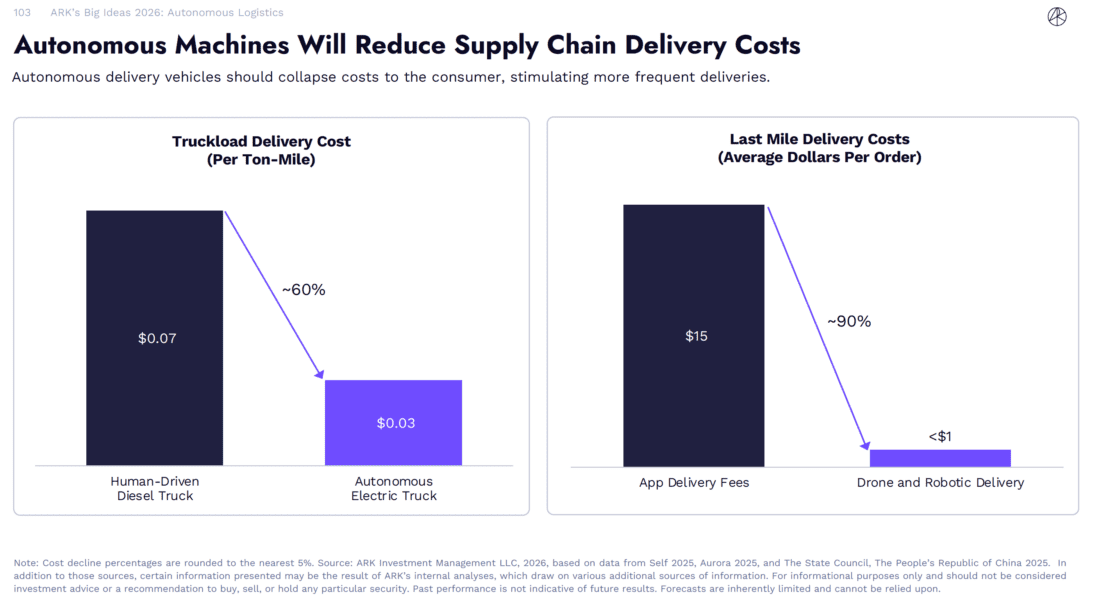
And big picture here, why are we talking about autonomous logistics? Well, we think that compared to today’s human in the loop delivery systems, that cost will come down dramatically thanks to autonomous technology.
So, for trucks, the cost per 10 miles of a human driven diesel truck is around $0.07 today. That could fall to just $.03 cents with autonomous electric trucks and for last mile delivery, if you use today’s food delivery apps like DoorDash, for instance, in Western markets, the price to get your delivery is actually roughly equivalent with the cost of the meal itself.
So, you’re pretty much paying double to get something delivered. It’s pretty incredible that players like DoorDash have been able to command such pricing power. But that should collapse pretty dramatically with drones and robots. So that could fall to less than $1.00 for the delivery fee.
So really what it’ll look like it is it will be looped in with the price of what you are buying. So, you may not see the delivery fee explicitly. Overall, your order costs will just come down.
And we think that this is really what could change consumer shopping habits. And you could we see, you know a lot more goods flow over e-commerce and app-based delivery because of this. And you can see and consumer buying patterns change and become a lot more frequent as the cost of delivery dramatically collapses.
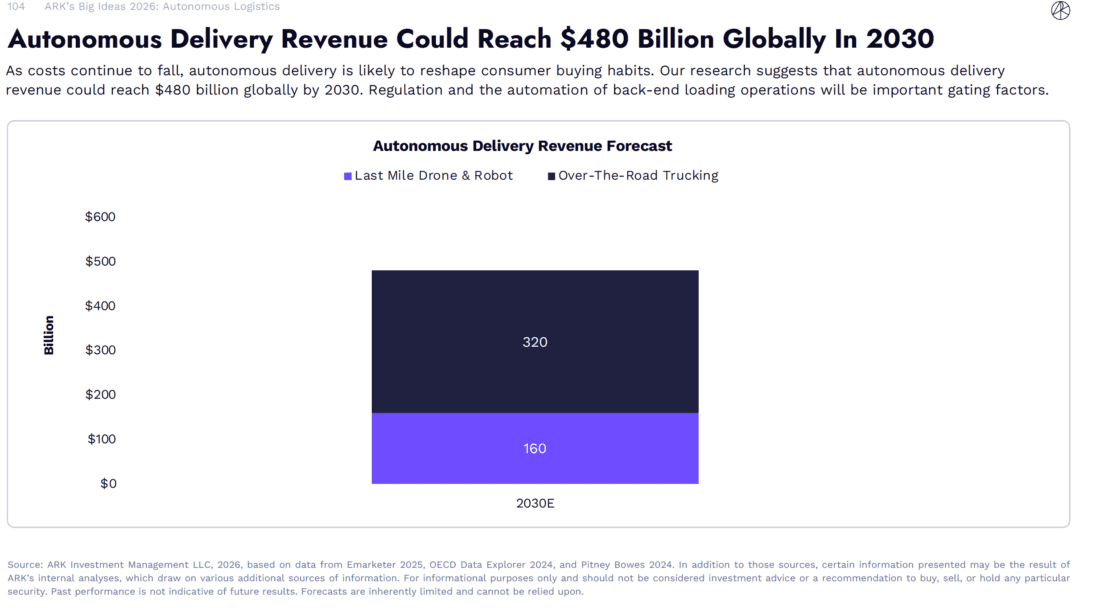
All in all, we think that autonomous delivery revenue could reach 480 billion in 2030. Again, we think this could reshape consumer shopping habits and this at the last mile will be driven by drones and robots, but really autonomous vehicles of all forms, likely smaller form factors for the last mile and for the long haul and the middle mile, this will be autonomous electric trucks.
I will say that similar to robotaxis, you know, regulation is a factor here, especially with aerial vehicles, regulations tend to be tighter for safety reasons.
And also, in in this space, one thing that is unique that we’re seeing is that for drones and rolling robots, for instance, and trucks as well, but I would say more of an impact on the last mile solution. We’re seeing a lot of the automated solutions today actually have fairly labor intensive upfront cost.
So, you know, someone who has to load the drone itself or you know, put the package in the rolling robot. These are pieces of the puzzle that we would expect to be fully automated in the future, you know, but the pace of that automation could potentially have an impact on the pace of the rollout of the autonomous technology itself.
But you know, but big picture, we think that autonomous delivery will make receiving goods less expensive for everyone.
Information posted on IBKR Campus that is provided by third-parties does NOT constitute a recommendation that you should contract for the services of that third party. Third-party participants who contribute to IBKR Campus are independent of Interactive Brokers and Interactive Brokers does not make any representations or warranties concerning the services offered, their past or future performance, or the accuracy of the information provided by the third party. Past performance is no guarantee of future results.
This material is from ARK Invest and is being posted with its permission. The views expressed in this material are solely those of the author and/or ARK Invest and Interactive Brokers is not endorsing or recommending any investment or trading discussed in the material. This material is not and should not be construed as an offer to buy or sell any security. It should not be construed as research or investment advice or a recommendation to buy, sell or hold any security or commodity. This material does not and is not intended to take into account the particular financial conditions, investment objectives or requirements of individual customers. Before acting on this material, you should consider whether it is suitable for your particular circumstances and, as necessary, seek professional advice.









Join The Conversation
For specific platform feedback and suggestions, please submit it directly to our team using these instructions.
If you have an account-specific question or concern, please reach out to Client Services.
We encourage you to look through our FAQs before posting. Your question may already be covered!