
- Solve real problems with our hands-on interface
- Progress from basic puts and calls to advanced strategies
Interactive Options Course
Posted August 20, 2026 at 12:40 pm


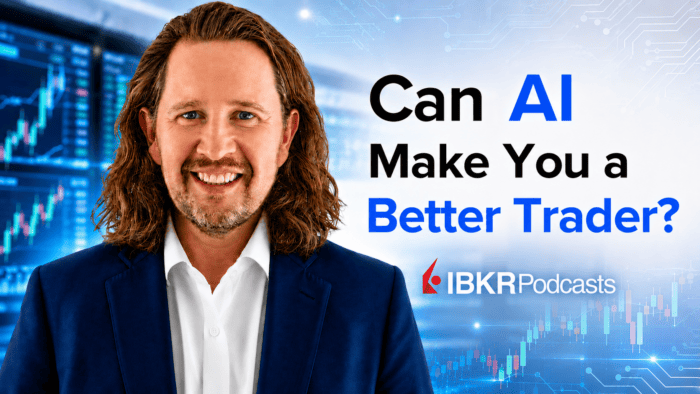
Trading coach Sam Warner-Baker joins IBKR’s Andrew Wilkinson to explore how traders can use AI to improve preparation, challenge investment theses, assess portfolio risk, and review trading decisions. They discuss how AI can help traders strengthen their overall approach to the markets through smart questions and clear strategy.
The following is a summary of a live audio recording and may contain errors in spelling or grammar. Although IBKR has edited for clarity no material changes have been made.
Sam Warner is a trading coach and also a contributor to IBKR Campus, where he recently posted an article about the use of third-party artificial intelligence tools directly to an Interactive Brokers account. Sam Baker-Warner also created a course for Traders Academy called The Golden Rules of Trading, which we’ll add links to in the show notes for you to enjoy.
Welcome to the program, Sam.
Thank you very much for having me, Andrew. Good to be here.
Now, you’ve said professional performance comes from better decisions rather than more trade ideas. How does artificial intelligence help improve decision quality?
Well, most people think trading is about finding opportunities, whereas I think opportunities are abundant.
I think there’s infinite opportunities in the market, and it’s part of the reason why I’ve been taking on traders and training them over my 20-year career. Professional traders don’t struggle because they can’t find trades.
They struggle because they don’t consistently make good decisions.
AI doesn’t change the amount of opportunities in the markets, but it does improve the quality of the decisions we make around those opportunities, and that’s a very different use case.
Can you walk us through your morning routine and show where artificial intelligence fits into your market preparation process?
What, for example, are the first three prompts you would run every morning?
Sure thing. With my coaching hat on, I call it my AM bookend, where I have a routine to get me into the right mindset before I even trade. I won’t go fully into it, but making sure you maybe have a walk, some breathing exercises, get your mind in motion, maybe a cold shower, grab a coffee, sit at your desk, start checking out your basics like your economic calendar, open positions, and then I start instructing AI. So the kind of prompts that I’ll then go to AI with after preparing myself as normal: prompt one, “Summarize the key macro drivers affecting the markets I trade today.” And you can fit in your markets there that I trade. It could be gold that day, it could be silver, could be biotechs, whatever.
But yeah, summarizing the key macro drivers affecting the market today would be prompt number one to warm me up. I put another after I’ve gone through that. I always have a little opportunity to learn in there: “Based on the macro drivers, which markets deserve further research today?” So it might bring up some new markets that aren’t even on my radar. And then if there’s something that I don’t understand, prompt number three comes up: “Explain any market that I don’t fully understand.” So I have that kind of holistic view of the markets, digging down a bit, and then researching them further if I fully don’t understand a market, and it’s very useful.
Gotcha. Now, some people go into every day without a position, but most people do have a live portfolio. One of the more intriguing ideas is being able to ask questions directly about your account and positions. What are the most valuable portfolio questions investors should be asking?
You have to put your trader and asset manager hat on and then ask questions like, “Am I too exposed to one theme, one market sector?” “What positions are maybe highly correlated?” is a good one. And then throwing some curveballs in there like, “If inflation surprises tomorrow, what positions are most vulnerable?” That’s kind of the professional mindset that you wanna use while you’re working with your AI agent.
You recommend asking AI to critique trade ideas rather than confirm them. Why is that such a powerful mental shift?
I’d say it’s because AI will always tend to agree with you, so you want to almost test AI to disagree with you. A prompt that I like to use a lot is, “Could you take the opposite side of my trade and then convince me that I’m wrong?”
And what are the prompts investors can use to stress test their investment thesis before entering a trade?
As well as that, playing devil’s advocate and taking the opposite side of the trade, I think you can, rather than asking, “Will this trade work?” start asking, “How can I lose money out of this idea and this thesis?” It’s very much a proprietary trader or a professional trader’s approach.
So a professional trader would often tell me that risk management matters more than forecasting. How can AI help investors become better risk managers?
Sam Baker
Again, those devil’s advocate trades. You don’t want to be put off through your trading, but you do wanna understand all of the factors that could prove you wrong. And then using that kind of AI research tool, as it were, to give you all the information available to make your decision as good as it can be.
What would you say the best prompts are for evaluating downside scenarios before entering a position?
I’d say contingency planning. “What should I be looking out for that could affect my trade when I’m in the trade?” I think.
“What are the dangers of executing my trade now?” Because timing’s everything. You could have missed some data that was coming out, for example, before the trade’s being put on. AI agents are very good at telling us that. Before you get in, so anything that could damage you at the time you’re about to get in. During the trade, “Are there any events, key events, that would affect the market price of the assets that I’m in while I’m in them?” And then looking to get out of the trade, “Are my stops reasonable? Is my risk-reward reasonable for the trade that I’m putting on?” And maybe some discussions about duration. Testing, asking how long perhaps a duration of this trade should be.
Something that struck me in the article that you wrote for Traders Insight was that you like to use AI to evaluate trading decisions afterwards. Why is post-trade analysis so important?
It’s kind of the crux of most of my teaching.
I have a process that I’ve used for years for myself and traders I’ve taught: identify a trade, execute a trade, manage a trade, and evaluate a trade. And all four pillars are very important. And that fourth pillar, evaluate a trade, is essentially where we have a motto, “Win or learn.” ‘Cause every trade gives you a lesson, even if you win or lose, and it’s up to you to extract that lesson. You can plug in all of your details for your trade and your thesis and your execution and the result, and then you can run simple tasks like, my basic evaluation is, “How could I have made more? How could I have lost less?” And then see what it comes up with, see if it picks out any key bits of information that you can then use for next time when you’re running through your trade process.
What does a great AI-assisted trade review look like?
I think it’s exactly that, really. You’re plugging in as much data as you can give it from your trade, your thesis, your execution parameters, perhaps how you were feeling while you were managing that trade. That’s a big one. And once you’ve plugged all that in, again, going through those questions: “How could I have made more? How could I have lost less?” And some more growth mindset questions, or, “If I were to repeat this 100 times, this thesis and this entry execution scenario, would I succeed as a trader?”
Things like this, trying to think a little bit out of the box when reviewing.
Could artificial intelligence eventually become your personal trading coach? Is it gonna cost you your job, Sam?
No, I don’t think so. I’ve thought about that with a lot of technological advances over the years. I’ve been in the game 20 years now. When I first started, they said algorithm trading was gonna destroy the point-and-click trader. But thanks to the likes of IBKR and retail trading, access has never been more available, really, so there’s more point-and-click traders than ever before.
So with AI and coaching, absolutely not. There’s not that human element, which is very important, that empathy, psychology, judgment, experience. AI certainly helps. It helps me as a coach and as a trader. But at the end of the day, you’ve got to have that human in the loop, as we talk about a lot when we talk about AI. It is only a tool at the end of the day. We shouldn’t really have it making the bulk of our important decisions.
You’ve posed your initial three questions about the macro situation and looking deeper into markets. Where do you go from there?
Okay. So we’ve got our baseline. We’ve almost done a morning briefing. We’ve got to do the work of a team of analysts, essentially. So we’ve done an analysis, and then probably some ideas have come from that analysis, markets to look into, doing maybe a bit more of a deep dive, running through our checklist.
I’m a big believer of the trading checklist, and it’s something that I use with all of my clients and students and junior traders, and I have done for years now myself. So I’ll start running through methodically my checklist, and it will help me out with parts of that checklist, be it the fundamentals, the technicals, seasonals. And then I’ll kind of run through that throughout the day through my trade process and plugging it into my checklist. The checklist then runs through the process to identify, execute, manage, and I’ll be asking it questions throughout every trade process. I’ll also be portfolio reviewing throughout the day.
I’ll have check-ins. I’ll have a check-in pre-European open, then pre-US open as standard, and then towards the European close to check my portfolio balancing and assessing the risk, really, if there’s anything I’ve missed, be it a macroeconomic risk or an imbalance. I get to challenge my ideas once I’ve got trades on. And then at the end of the day, I will then plug in my trade data and then ask for a comprehensive review. And then it’s a good back and forth, really, because if you’re asking AI the right questions, it normally opens up doors of curiosity that will lead you to ask more questions and find more knowledge, and that’s where AI agents are very good.
What capabilities do you believe investors will be using 12 months from now that seem cutting edge today?
I think, well, number one, I don’t think AI is going to replace traders and us humans as decision-makers.
I think that’s what’s very important. But I do think that traders who use AI will outperform traders that don’t, and I think, depending on your ability and your understanding of how to trade in the right way, it’ll only enhance you if you use AI. So you’ve gotta have that baseline understanding, and that’s what’s very important. I think that’s what’s missing in this technological leap, is a lot of people haven’t got much knowledge or process or the right way to trade, and they’re just jumping into AI. It’s those that are taking the time to learn trading, to understand trading, and then filtering in AI from there that are going to succeed.
If any of our listeners are connecting their IBKR account to ChatGPT or Claude or other AI tools today, what are the three actionable things that they should do this week to become better traders?
Okay. One of them is, I think I’ve said it a few times, stop asking for predictions. Okay, that’s number one.
Stop asking things like, “Should I buy gold?” Okay, you’ve gotta get a bit deeper than that. Start using AI to improve your preparation. In my book, Learn to Trade Like a Professional, it’s very much preparation, process, and then practice. So really dial it down to help you with that preparation. And then ask AI to challenge your ideas, not to confirm them, so you can take the other side of that trade. Because it’s very hard to do that with the mindset of, you’ve got a trade, you’ve got a thesis, you’ve got an idea, ’cause you’ve gotta have the confidence to then put that trade on and then run with it, right? But then you can use AI to think outside the box and give you some solid feedback.
Sam Baker-Warner, thank you very much indeed for taking the time to join me on this episode of IBKR Podcasts.
It’s been an absolute pleasure. Hopefully it’s got out there and helped some people connect their AI with IBKR and use it effectively.
Lovely. Thanks, Sam. And the name of the company is Teach the World to Trade. You can find Sam online. And if you enjoyed today’s show, remember to like and subscribe wherever you download your podcasts from. Bye for now.
The analysis in this material is provided for information only and is not and should not be construed as an offer to sell or the solicitation of an offer to buy any security. To the extent that this material discusses general market activity, industry or sector trends or other broad-based economic or political conditions, it should not be construed as research or investment advice. To the extent that it includes references to specific securities, commodities, currencies, or other instruments, those references do not constitute a recommendation by IBKR to buy, sell or hold such investments. This material does not and is not intended to take into account the particular financial conditions, investment objectives or requirements of individual customers. Before acting on this material, you should consider whether it is suitable for your particular circumstances and, as necessary, seek professional advice.
The views and opinions expressed herein are those of the author and do not necessarily reflect the views of Interactive Brokers, its affiliates, or its employees.
This content may include AI-generated material provided for informational purposes only. It should not be considered an endorsement or investment advice Information may be incomplete or inaccurate and should be independently verified before making any decisions.
The projections or other information regarding the likelihood of various investment outcomes generated by the Tool mentioned are hypothetical in nature, do not reflect actual investment results, and are not guarantees of future results. It is important to understand that these projections are based on certain assumptions and models, and actual outcomes may differ significantly. Please note that results may vary over time.
Interactive Brokers does not guarantee the accuracy or completeness of the data and information provided through the AI service that you choose independently Information provided using AI integration is not investment advice or a recommendation from Interactive Brokers. Interactive Brokers is not responsible for any investment decision you take in reliance on information generated through the AI integration. You should independently verify information before more making any trading or investment decisions. The Instructions are created based on information provided by your AI service and may not be accurate or reflect what you wish to do. You are responsible for carefully reviewing the Instructions, editing them as appropriate, and deciding if you wish to convert your Instruction to an order on the IBKR platform. All trademarks, logos, and brand names are the property of their respective owners and are used for identification purposes only and does not imply endorsement.







Join The Conversation
For specific platform feedback and suggestions, please submit it directly to our team using these instructions.
If you have an account-specific question or concern, please reach out to Client Services.
We encourage you to look through our FAQs before posting. Your question may already be covered!