
- Solve real problems with our hands-on interface
- Progress from basic puts and calls to advanced strategies
Interactive Options Course

Posted September 11, 2026 at 3:16 pm


Sleep no more? How will your trading strategy adjust to 24/7/365 on-chain markets? In this episode of IBKR Podcasts, host Steven Levine sits down with Adrian Reid, founder of Enlightened Stock Trading and a 20-year veteran of rules-based, systematic trading, to explore the seismic shifts reshaping today’s markets.
From the explosive rise of tokenized real-world assets (RWAs) and ‘round-the-clock crypto trading to the erosion of traditional market structures like daily opens and closes, Adrian breaks down what’s changing—and what timeless principles will remain…timeless.
Discover why Bitcoin’s volatility is starting to resemble high-beta tech stocks, how to adapt trading systems when overnight gaps disappear, and why constant market-watching is a trap rather than an edge. Adrian shares hard-won insights on diversification across markets and asset classes, the dangers of excessive leverage, and his golden rule: you can’t win the game if you’re not in the game.
Whether you’re a systematic trader, a crypto-curious investor, or just trying to make sense of markets that increasingly never close, this conversation offers a grounded, experience-backed roadmap for navigating the new crossroads of traditional finance and digital assets.
Already an Interactive Brokers Client?
New to Interactive Brokers?
Trading in digital assets, including cryptocurrencies, is especially risky and is only for individuals with a high risk tolerance and the financial ability to sustain losses. For more information about the risks surrounding the trading of Digital Assets please see the “Disclosure of Risks of Trading Digital Assets“.
IB is not party to any transactions in digital assets and does not custody digital assets on your behalf. All digital asset transactions occur on the Paxos Trust Company (“Paxos”) or Zero Hash LLC (“Zero Hash”) exchanges. Any positions in digital assets are custodied solely with Paxos or Zero Hash and held in an account in your name outside of IB.
Digital assets held with Paxos or Zero Hash are not protected by SIPC.
For more information about eligibility to trade digital assets with Paxos or Zero Hash, please see the FAQ.
Zero Hash LLC and Zero Hash Liquidity Services LLC are licensed to engage in Virtual Currency Business Activity by the New York State Department of Financial Services.
INTERACTIVE BROKERS LLC IS A MEMBER OF NFA AND IS SUBJECT TO NFA’S REGULATORY OVERSIGHT AND EXAMINATIONS. HOWEVER, YOU SHOULD BE AWARE THAT NFA DOES NOT HAVE REGULATORY OVERSIGHT AUTHORITY OVER UNDERLYING OR SPOT VIRTUAL CURRENCY PRODUCTS OR TRANSACTIONS OR VIRTUAL CURRENCY EXCHANGES, CUSTODIANS OR MARKETS.
The following is a summary of a live audio recording and may contain errors in spelling or grammar. Although IBKR has edited for clarity no material changes have been made.
Hello and welcome to IBKR Podcasts. I’m Steven Levine, Senior Market Analyst at Interactive Brokers. I’m your host for today’s program. Today, we’ll be straddling the intersection – perhaps we can call it the ‘crossroads’ – this is where traditional markets meet digital assets. I mean, that’s crypto trading becoming increasingly mainstream. And here with us to provide us his insights into this really pivotal topic at this juncture: Adrian Reid, founder of Enlightened Stock Trading and a trader with more than 20 years of experience developing rules-based systems and back-tested strategies. Great to have you here, Adrian. Thanks for joining us!
Yeah, Thanks so much for having me on the show. I’m really excited to do this.
Source: Screenshot from Podcast Video
Yeah, I’m excited, too. I mean, it’s a really timely topic, especially, you know, markets seem to be shifting. They’re like constantly shifting, it seems, in terms of market structure. We’ve been seeing an increasing volume of tokenized real-world assets (RWAs) … like stocks. Of course, the move to 24/7 trading, which we’ll talk about. And this is great. You’ve been focused on systematic trading for 20 years. 20 years? Is that right?
Yeah, that’s right.
Great. I mean, that’s longer, I think, than Bitcoin‘s even been available for trading. I think that launched in 2009. So, I’d love to start learning more about what you do. I think our listeners would love to learn more about what you do and how you first became interested in systematic trading. And what’s kept you involved for the past two decades?
Stepping into Systematic Trading
Yeah, absolutely. Let’s start with that, because what’s kept me involved is really what’s going to get people excited about this. The markets are a constant challenge, right? It’s a puzzle to be solved. It can never be solved completely, but you can find little bits of the solution and then that hints to other bits of the solution. And so, you gradually just build an increasing awareness and understanding of how the markets work and how to extract an edge from the market and profit from that and how to stay in the game when the markets change, which is a lot of what we’re going to talk about today, I think. So, it’s that sort of puzzle-nature of trying to figure out how the markets work that really keeps me excited about it.
That’s one big puzzle. That’s got to be a huge puzzle for 20 years. That’s a lot of pieces.
Of course. And look, there’s a lot of different markets to trade, a lot of different types of instruments, and quite a number of different types of systems, which I’m sure we’ll talk about as well during this session.
So, what got me interested in systematic trading in the first place was really a process of elimination, frankly. I mean, when I started in the markets, I was looking to build wealth and ultimately replace income, just like most people. And I tried a number of different strategies, different approaches to the markets, and most of them either didn’t fit me or I didn’t enjoy them, or they didn’t fit with my lifestyle or I didn’t have the level of quant research or PhDs investigating the problem that the funds have. And so really what I did when I started trading and investing was prune all of the different options and settle on the one approach that makes the most sense for me personally as an analytical kind of logic-oriented person and fit my lifestyle as a busy person who wasn’t trading full-time at the time.
I had a full-time job, and I had a young family, and I didn’t have a lot of time. And eliminated the emotions that I was feeling and suffering from, because like most people in the markets, as soon as I got involved, and as soon as real money was there and it was moving up and down, my emotions were swinging around, and I found that I wasn’t able to make consistent decisions.
And long-story-short, I read hundreds of books. And when I discovered the ‘Market Wizards’ series of books, which is fantastic, a great set of interviews, I looked at all of those different interviews and really started to identify what I did like, what I could do, what I didn’t like, what I couldn’t do, and filtered all the way down. And what was left was systematic trading – ‘algorithmic trading’, you might call it – basically the same thing. And as soon as I found that, I went deep on systematic trading.
I launched my first strategy in stocks, started making money finally, and then over time diversified, added more strategies, added more markets, including ultimately crypto. Unfortunately, not in 2009, I was somewhat of a slow adapter in crypto.
You’re not alone.
So yeah, that’s kind of the journey. And I discovered it, or I kind of settled on systematic trading, because as an analytical person who realized that emotions were the killer of trading results, and I like to test – to create hypotheses and test them – and prove that I understood something about the way the market worked. And I didn’t have a lot of time to implement and research day-to-day. Systematic trading really made a lot of sense.
Source: Screenshot from Podcast Video
I think it’s really, really fascinating. And especially when you touch on emotions. I think we should maybe touch on that as we go, but it seems like there’s a lot of emotions factored into the decisions being made in the crypto space. And I don’t know how much of that is really predominant or the driving force for a lot of the major swings that we see in some of these. But maybe we can talk about that as we go. I think … I mean, I’d love to have maybe some kind of, maybe just start with a big compare contrast picture with your approach -with systematic trading of stocks, with the crypto markets. I mean, just even touching on the relatively recent launch of Bitcoin – I know most of the crypto assets we’ve talked about are really pretty new, right? Not just Bitcoin. Bitcoin might be the oldest, I think, of these currencies. Most of them have been around just after that, right?
Yeah, absolutely. Look, the market is pretty new. But in terms of the approach, from a systematic trading perspective, I would say the process for developing strategies is the same, right?
It’s:
I’ll talk more about that sort of as we go.
And then once we’ve validated it, sort of test it on unseen data, on related markets, on other markets to make sure that it holds up over time.
I mean, at a very brief 30,000-foot view, that’s kind of the steps that we go through. And the challenges really with crypto are that there’s not a lot of history. And in that short period of history that we’ve got, the market has changed immensely. And the reason it’s changed is because it’s maturing.
And you mentioned earlier, we talked about emotions and how a lot of the moves and the behavior in crypto driven emotionally. And that’s true. And that’s true of all markets, right? There’s a lot of emotion in all tradable markets. But in crypto, the volatility has shifted dramatically over time. It’s really come down. If you look at Bitcoin and the average volatility from when it first launched to now, in percentage terms, is much, much lower. And that’s because the market is maturing over time. It’s because it’s becoming, I mean, yes, retailers are still involved, obviously, but it’s becoming more institutionalized. There’s bigger holders, there’s funds, there’s big institutional money involved. And that tends to dampen volatility, does probably reduce the amount of emotion that drives the moves a little, but it’s still there.
So, we have our process for developing systems, and we have a market that is shifting over time and doesn’t have a lot of history. So, we need to be really careful when developing strategies for crypto. And the biggest trap is to run a strategy development process over the whole history, starting all the way back at the beginning of Bitcoin to now and develop your rules around all of that limited data. Because that first period, the first, let’s say, seven or eight, nine years was characterized by very large volatility, huge trends, equally huge bear markets. And if you look at the behavior today, it’s just not like that. We don’t have the huge multi, 100,000% moves in the mainstream crypto tokens now than we did back then at the beginning. And so, we need to be careful not to assume that behavior from way back then is the same as what we have now, which gives us even less data to deal with, because we sort of got to ignore … or put a set aside some of the early data and focus on the more recent data to develop strategies that work in the current environment.
So, you would call the early days of Bitcoin something of a fat tail, I suppose, in terms of the pricing behavior and volatility?
There were more outliers. There were probably more extremes early on. The bull markets and bear markets were much larger earlier on. I mean, the first couple of big Bitcoin run-ups, bull markets, were just astronomically huge compared to what we’re seeing today, which is behavior much more like a high beta sort of tech stock. So, I would say the behavior in Bitcoin especially, but probably crypto more generally, is heading towards what we see in tech stocks.
It’s not quite there yet. It’s not exactly the same, but that’s sort of the analog that makes the most sense right now. And that also drives the sort of strategies one might look at when we’re developing systems or strategies for the crypto market, because we don’t have a lot of history, so we’re going to look somewhere else to get ideas and to validate our rules and so on. And I like to look at the tech market to get a view on where that’s going and what type of strategies would actually work and make sense to start with.

Source: Screenshot from Podcast Video
Yeah, it makes a lot of sense to me. I mean, I think that people who are investors who go into crypto see it as maybe in part a currency play, but they also see it as a technology play themselves. And so, I think as the market, as you say, matures, or definitely as it’s maturing, around blockchain, et cetera, these currencies become more intertwined with the technologies that they are responsible for, I suppose. That’s sort of where my mind goes with it. I’m understanding like gold, sorry, Bitcoin, ‘digital gold’, Bitcoin is a store of value and as a technology play, for example. And that’s what I hear from those who are assessing or analyzing its ‘fundamental’ (quote-unquote) properties, as an asset.
Yeah, I’m quite cautious about … I mean, I don’t really like the term ‘cryptocurrency’ … ‘currency’, because it’s not quite the same. I mean, it’s something you can exchange for something else. So, you can buy things with it. So, I guess in that respect, yes. It’s not really a store of value like gold is, I mean, where it’s a physical thing. It’s a digital token that we have agreed a value on based on a market that trades. And some of those tokens, like other cryptocurrencies, minor ones, well, many of them tend to go towards zero over time, because there is no value there. And so, I treat it as a risk asset, and I think the market does, too. When the market goes risk-off, crypto falls. When the market goes risk-on, crypto rises. And so, it’s driven like that. That’s a behavior that we see in high beta stocks, in tech stocks.
And I’m certainly, you know, I don’t treat something like Bitcoin as a store of value, like, I’ll just put all of my spare cash there, and it will store value over time, because a market that can fall 50% in a very short period of time is not a particularly great store of value in my view.
I view it as a tradable asset because it has liquidity, it has volatility, and all of the usual factors influence it, particularly supply and demand and perception and emotion and all of that, and the state of the confidence in the economy, the risk-on, risk-off kind of nature of the current situation.
So, I really just view these things as tradable assets, and I don’t I don’t like the idea of just plunking cash into these markets and hoping that it stays stable in value because that’s not really what we’ve seen. We’ve seen a lot of volatility, historically.
Yeah, I haven’t heard of them as a safe haven asset—
Oh, certainly not…

Source: Screenshot from Podcast Video
…alongside others [like the] Swiss franc or [U.S.] Treasuries or physical gold. So, interesting stuff.
I think maybe if we switch gears a bit and think about – or talk about how your practice, or how your strategies or approach to looking at the stock market or looking at stocks and price behavior might change. I don’t know. I’m thinking it probably has changed with technology over time … high frequency trading and algo trading, et cetera. But now we’re talking about 24/7 trading. So, I’m wondering how this might affect your strategies.
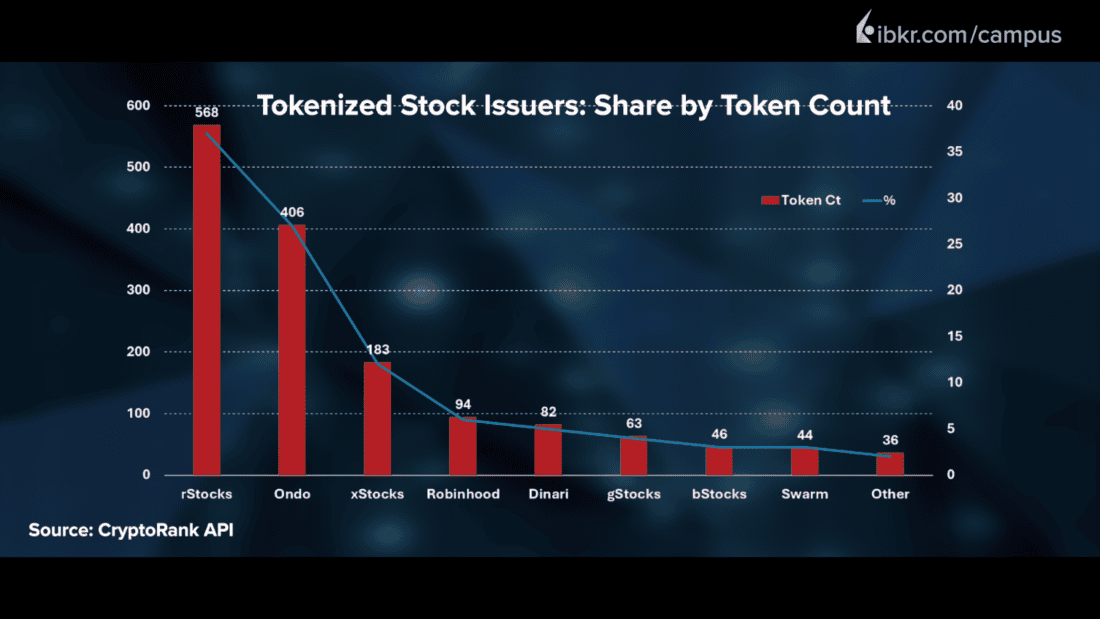
I have a picture in my mind that tokenized stocks, which I understand are representative of stocks, that you can trade on various exchanges now. I think there’s something called Ondo and bStocks and xStocks…. And I also understand that, okay, tokenized assets or real-world assets themselves have spiked. I mean, there’s something like 270% over the last year. And most of this or a lot of this has to do with equities.
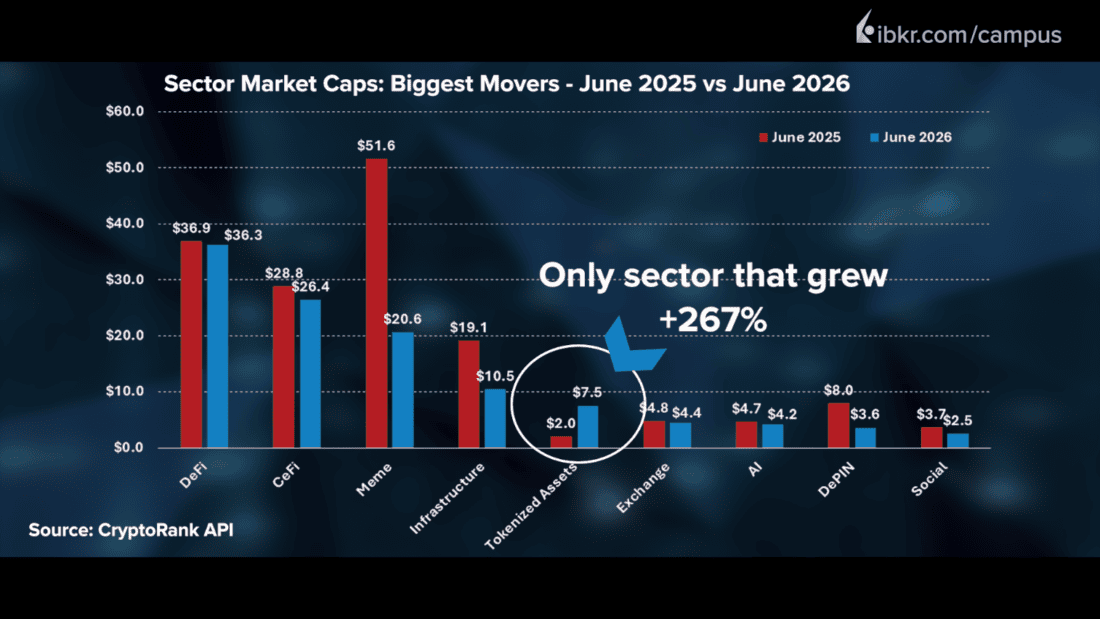
Source: CryptoRank API; Data Source: CryptoRank.io
So, a lot of stocks and ETFs are now being tokenized and available for trading 24/7. And I wonder if that picture looks different than the traditional or (quote-unquote) ‘traditional’ markets, where you have after-hours trading, where you have weekend closures. Is the liquidity different in these time periods, for example? How do you look at these two pictures?
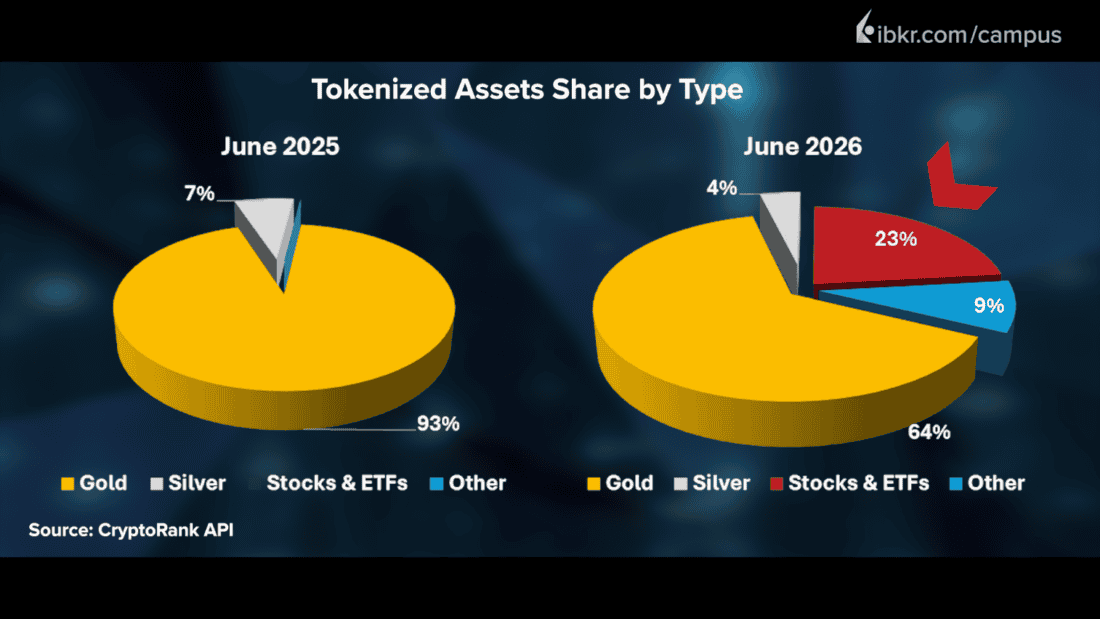
Source: CryptoRank API; Data Source: CryptoRank.io
Source: CryptoRank API; Data Source: CryptoRank.io
Yeah, look, it definitely changes the way the markets move and the way strategies work and where the liquidity is. In a traditional market, where you’ve got a daily open and a daily close, there’s a concentration of liquidity around those two reference points. And that’s because a lot of people use it as a reference point. And that’s where, particularly the close is where a lot of big players will make their transactions.
In the absence of that, the liquidity tends to be more spread out. It’s a little thinner. There will be concentrations, because not everyone is going to trade 24/7. New York comes awake at a certain time and goes to sleep at a certain time, and London does the same thing, just like in the currency markets. So, we’ve already got many years of precedent, I guess, in the currency markets, where currencies are moving pretty much all the time. But currencies also move differently to stocks, and stocks that have a lot of after-hours trading move differently to stocks that don’t. I mean, not every market has all of these things.
And so, I guess one of my principles is that the markets will change over time, and they always do. And we need to be on the lookout for evidence that it’s changed and evidence that our strategies are still working or not working and eroded.
And one of my principles is that I don’t want to be so concentrated in a particular market that if that market changes, my profitability is destroyed. So, for example, I don’t just trade U.S. stocks, because if there’s a big shift in the way the U.S. market works, then the whole portfolio is affected. I trade Australian stocks and U.S. stocks and Canadian stocks and Hong Kong stocks, and I also trade crypto. And I’ve looked at other more … even more emerging markets, things like Malaysia, Taiwan, Thailand … really small markets, because they’re much less mature as a stock market. So, the behavior is a long way behind, say, the U.S.
And so, as an individual trader, one of the things that we can do to prepare ourselves for these shifts, which we may not be able to predict exactly, is to diversify more broadly so that our entire portfolio isn’t affected by that shift. Now, is there going to be a shift? Yeah, absolutely. Is tokenization going to continue? Yes, I suspect so. And will it become more and more 24 hours? Yes. Which means our stock trading is going to become a little more like crypto in a sense, because crypto is decentralized right now. You can trade it 24/7/365. There’s always an exchange where you can make a trade. And that means the open and the close don’t have the same kind of meaning as they do in stocks. In crypto, the open is a notional time at 0 GMT, right? So, it’s different, and we need to be monitoring how liquidity changes, how slippage changes, how price moves change. We don’t get overnight gaps. If you’re trading 24/7, literally, there’s no gaps, right? So, there’s different … some signals will disappear. Like if you have a strategy based on gaps, that’s gone. But you might have a strategy that keys off reference points. You can still do that. You might have a limit system that says, okay, based on the high of the last 24 hours, or the highest high of the last X days or something like that, you can still set limits and stop points. But it just changes how you do it, because you’re not necessarily keying to a particular point like the open or the close.
It’s really fascinating. I know that there’s been some use of, say, weekend trading on certain assets like perp futures, for example, to find price discovery on when, say, the CME opens, for example. And so, there’s this sort of hybrid effort to find that price discovery, either for the future or the commodity at hand, or even like, say, pre-IPO. SpaceX, there was a lot of open interest on a 24/7 exchange like Hyperliquid, for example, that gave enough information to arrive at some kind of valuation for that IPO. I thought that was also pretty fascinating.
So, I mean, do you see any kind of change, again … in the indicators … that might point to different kinds of … what used to be ‘openings’, or maybe openings, I don’t want to say, ‘used to be’, but some kind of ‘opening’, as the 24/7 exchange continues to operate in parallel or alongside a traditional exchange?
Yes. I mean, if you look at a market, where there’s continuous price discovery, and then alongside it, there’s another market that trades the same asset that doesn’t have a continuous pricing – it’s got an open and a close, that market that doesn’t trade continuously tends to gap, right? Because there’s continuous price discovery in the other market. And if it doesn’t gap to match the current price, then there’s an arbitrage opportunity. And there probably are arbitrage opportunities, but they very quickly get arbed away by bigger, smarter players with better tech and faster pipes.
So, if you have continuous price discovery, and you have assets that are not traded continuously, the behavior starts to look different, more erratic, those sorts of things. Trading on those assets becomes, I would say, probably more risky, because you’ve got liquidity outside of regular market hours that you can meaningfully trade. If there’s a couple of hours of after-hour action like in the traditional stock markets, pre-market trading, those sorts of things, it’s not quite the same as if Bitcoin is trading all night on a on a decentralized exchange and then it trades during regular hours on a traditional market through some sort of listed instrument.
So, this shift changes how assets will move. And whenever the nature of price movement changes, your market edges, your systems, your strategies are at risk. And so, the key message is: As this shift happens, we need to very closely monitor all of our strategies and make sure that they hold up.
And we need to consider how much we’re relying on things like the difference in price between the close and the following open, because that disappears. How much we’re looking at overnight gaps, because that can disappear or change. And adjust some of our strategies. We’re going to be turning more strategies off as that edge disappears, and we’re going to be finding more strategies and starting new ones up to replace them. So, it’s not a time for complacency and expecting that everything you’ve always done will always work. It won’t.
There’s other inflection points in the markets that we can look at. I mean, when high frequency trading came in, when decimalization happened way back, and these things create shifts in the way the market moves. And if you [look] back to some strategies … back 10, 20 years … you can see these inflection points in the markets about when edges eroded and changed. And usually edges erode. They don’t usually get better over time. I mean, occasionally it can happen, but we need to be looking out for some of these changes to make sure that it’s not a point that drives erosion beyond sustainability. Does that make sense?
Source: Screenshot from Podcast Video
Yeah. It does. It makes a lot of sense. And I’m already sort of becoming … the more you talk about what will change in terms of … what was likely to change … or what you have to monitor as this transition starts to happen more and more in terms of your strategies.
I start to become very forward-looking nostalgic, I suppose. I wonder what kind of … this is sort of on the edge of what we’re talking about … but what else do we lose exactly in terms of our market sentiment and our trading behavior, as we start to lose after-hours trading, as we start to lose the sense of weekend trading, as our psyche becomes so completely integrated with — we are always going 24/7/365 days a week. No, not even any holidays. I mean, all the federal holidays – it will skirt those, too.
So, daylight savings time used to be a big thing, I remember, in behavioral finance. I suppose that was something where traders would just become adjusted to the change in the hours of their sleeping patterns and that would affect their abilities to push the right buttons. So, I wonder if we’re losing … or what in your opinion, do you believe will become nostalgic?
Well, the downtime when the markets are closed to make calm decisions – based on a purely logical analysis – goes away. I mean, if you compare right now … trading systematically, algorithmically in crypto versus stocks in a traditional stock market that’s not 24/7, right? In stocks, we have this great luxury. When the market closes … between when the market closes and when it opens the next day, we can do all our analysis and make our decisions for the next day. And we have a lot of flexibility about when to do that, because the time between when the market closes and the following open is many hours, right? And look, that’s, I got to say, for the longest time, that has been just a fantastic blessing, because end-of-day trading, swing trading, trend trading and above, rather than intraday trading, it’s just such a relaxed way to operate in the markets. The market closes, you wait for your data to update, you run your models, your systems, you generate the orders for the next day, and you place them. And then when the market opens, off we go. And then we do it again the next day after it closes.
In crypto, it’s quite different, because the market is 24/7. And this is where tokenization takes us, right? So, if you want to trade longer time frames, you’ve kind of got to choose a kind of notional open-close point for the day. You can also trade a four-hour or one-hour or 30-minute or whatever. I like longer time frames, because the longer the time frame, the bigger the move, the more signal, the less noise. Also, the less activity. I don’t like frantic levels of activity. The less record-keeping and accounting and all of that. And you can still capture big moves. So, I like longer time frames.
In order to trade longer time frames in crypto, you’ve got to choose a kind of notional open-close point, where the daily bar cuts over to the next day, and that’s at midnight UTC. And at that point, if you’re going to make your decisions and place your trades for the next day, the next open, you’ve got to do it immediately at that moment. And that’s not always convenient. So, we lose the convenience of being able to sit back and fit it in easily with our lifestyle – do the analysis and place the trade sometime between close and open. We’ve got to do it right then, as fast as possible at that moment, if we’re going to trade in that way.
And so that means things like automation become very, very important. So, in crypto … I mean, in stocks as well, I trade 100% fully automated … but I would never consider trading a 24/7 market manually, because It’s just too restrictive. You have to be at your desk at that moment, every day, at the same time. And I just don’t want to live my life like that.
Yeah. You can make your shifts, like, you know, keeping watch? They have that in certain wartime, right? You have somebody keep watch, and then you let the other person go to sleep, and then you change shifts.
Sleep No More?
I think there’s a temptation to assume that 24/7 trading means you always need to keep watch.
And I think that’s a mistake, because we’re human, we need to rest.
And way back at the beginning of my journey, I mentioned the ‘Market Wizards’ books earlier. And one of the interviews that really affected me negatively was an interview with a currency trader. I forget the name, it doesn’t really matter. But he was always keeping watch. There were screens in the bathroom, screens in the bedroom, and he’d wake up and just check his phone in the middle of the night, like check his signal service in the middle of the night and all of that. And I looked at that, I thought, ‘Oh, no, I would never want that life. I would never want to live that life.’
And I think it’s a trap, because checking the market more frequently is not correlated to higher profitability. It is correlated to higher stress levels, higher emotional burden, more burnout, more noise, more frustration. So, just because we go 24/7, I would caution against 24/7 monitoring. I think what we need is strategies that survive the 24/7 cycle and keep us safe. And a lot of that means we sort of need to stay outside the short-term noise and be able to make a decision at several points in time.
Now, you may arbitrarily decide what those points are. I mean, you might do it at midnight UTC, or you might say, ‘Okay, well, I’m going to shift my day, and I’m going to do my analysis at a different time, and I’m going to construct my own daily bars and do the analysis that way and make my open, close, cut over at a different time of day that’s more convenient,’ or you just automate the whole thing and ensure that the strategies can survive that intraday volatility.
When do On-Chain Markets ‘Open & Close’?
Yeah, that’s, I mean, it’s a mammoth prospect, I think, to carve up times within the day that you’re going to do this, but you have an entire continuous canvas of activity that is flowing constantly with every activity asset class as they become tokenized. I think that it’s basically today’s markets on chain. And I do find that sort of fascinating.
I mean, there’s sort of two ways to deal with it really: you create a notional daily bar, and you use the open and the close at that time as a reference point to key off in your strategies, or you create strategies that don’t require that and have reference points based on the data – the historical data – and say you put your limits, you put your stops in referencing historical price movements, and those limits and stops just get adjusted over time in the strategy rather than worrying about a particular open or a particular close. You’re more looking at ranges or highs or lows and so on within a particular range. So, you don’t have to have a notional open or close, you can just assume it’s a continuous market and use price action and references to create your strategies.
I think this whole thing has been really, really interesting. And it is in this juncture, this very pivotal, transitional place, it seems to me, where this market structure is shifting. And I just love to hear from you how you are contending with it as things go.
An Ever-Evolving Puzzle….
Let me get into that. What I want to draw a connection to, though, is something you said at the beginning. It’s like, it takes a long time to be figuring out the problem. This is why I’m still here, and it’s still interesting. Because the markets shift over time. Things change. And behavior changes and rules change. Like exchange rules have changed over time. And this is just another example of that.
So, now we’ve got to figure this problem out. And I’m not going to pretend I figured it all out. I’ve got enough diversification strategies and markets that I’m going to be fine, and I’m going to have enough time to adapt as these changes come through. But what I am definitely doing is monitoring how existing strategies work and noticing how other strategies start to work. And so, if there’s anything that I’m doing, it’s accelerating the testing and the monitoring cycle of strategies. I think because the markets are evolving quite quickly now … tokenization, everything, as you said, move to 24-hour, crypto becoming more mainstream, so these things are sort of converging, things will change, and edges will evolve, and traders will get stung if they’re not vigilant.
Steven Levine
Yeah, this is critical. And it’s the critical part, I think, of all of this is that microscopic view or look at what is going to be in the service of or disservice of those who are aiming to use these strategies that have worked in the past but may no longer be on the same level.
Adrian Reid
One thing I’ve done recently, which was quite interesting and useful in this space, is I’ve developed tests that can be run very quickly, automatically, on a large number of strategies to check that they’re still valid and stable and representative of how they have performed historically. It’s important to know, has the behavior shifted? Has the edge shifted?
And so, if you’re trading systematically, algorithmically, you want to know – is the set of trades that I’m getting now, the distribution of trades that I’m getting now, the same as it was historically? Or has the average, have the stats shifted?
And so, now in my own trading, I’ve got this tool that very quickly looks at the nature of the edge, the distribution of trades, the way the equity curve moves, and says, ‘Okay, is that representative of what it was just a little while ago, a few years ago?’ And if it is, then chances are the market hasn’t shifted enough to break the strategy.
But you do find that as the market shifts, as we get through these inflection points, as behavior and rules change, edges do shift. And we need to be monitoring our strategies closely for that.
I mean, we should never have been assuming strategies will last forever, because there’s always erosion. But I think that’s even more true now. We need to be monitoring more closely and more frequently. I wouldn’t want to leave a strategy for months and months assuming that it is still stable. I want to be monitoring on a much more frequent basis and make sure that I’m not seeing anything out of character in the strategy in terms of volatility, in terms of trade distribution, in terms of win rate, in terms of size of wins, size of losses … and even correlation with other things. These are all shifting and we need to make sure that our portfolio is going to be safe.
I think it’s fascinating. Is there anything else that you’d like to add, Adrian?
Adrian Reid
Look, I would say that despite the fact that markets are changing, I still believe very strongly that a systematic, kind of rules-based approach to trading is critical, because for most people, emotions just get in the way. And emotional trading and decision-making will destroy profitability far faster than any subtle shift we get in the markets, because of a rule change or tokenization or any of that. So, despite what we’ve talked about that the markets are shifting and we need to monitor our edges and everything, having a rules-based approach will save so many traders from themselves.
And it looks like we can adapt that to the 24/7 tokenization —
Of course. Of course.
…as with everything else, it’s just evolving markets and certain things, in a sense, at least – at the core of it – do not change.
Yes. That’s absolutely right. The things that don’t change are the fact that a proven strategy that you have confidence in reduces your emotional swings and makes you more consistent. That doesn’t change.
The equation for profitability of a system, of a strategy, doesn’t change. We’ve got the expectancy equation, which is the size of wins, times the percentage of wins, minus the size of losses, times the percentage of losses. That math has to turn out positive, or you’re going to lose money.
What also doesn’t change is the need for careful risk management and position sizing. If we size too big, an unexpected loss is going to give us a drawdown that we can’t recover from. If we use too much leverage, then a sudden market shock is going to take us out.
We’ve seen Korea with that pretty recently. This was, I think, a pretty prime example of just mentioning that we saw swings that were something like 18, twenty-five percent of just mentioning that. Just basically on leverage, I think. A lot of people were very, very, very leveraged. Those losses magnify, and they pile up quickly.
Yeah, and there was a big hedge fund that basically, I wouldn’t say ‘blew up’, but failed just last week as of the time of recording. And that was because of big leverage bets on certain markets.
So, we’ve got to be vigilant and stick to good trading practice. That means position-sizing conservatively, small positions in each token ticker that we trade, or token that we trade, and not using excessive leverage or ideally not using much leverage at all, and having a strategy that’s proven and monitoring that strategy. I mean, it’s just good hygiene for traders and investors that doesn’t change.
So, don’t get crazy just because the world is shifting, and we go to 24/7. There’s some principles that will keep you alive in the game long enough to figure out the nuance of some of these new market rules. And we’ve got to stick to that.
My favorite saying, and let me leave you with this, is that you can’t win the game if you’re not in the game. And if you do something that blows you up, or something that could blow you up, you’re not going to be in the game for long. So, we need to stay in the game. And that’s the number one priority for everyone. You’ve got to stay in the game, which means you’ve got to not blow up. Making money is secondary to survival.
Yes.
And if we can survive through these changes and observe what stops working and what starts working, then we can go on to continue to profit in the future. But if we trade so aggressively that a little shift, a little change in structure, a little change in rules destroys our account, you know, then we can’t survive, we can’t win the game ultimately.
I’m so happy you took the time to do this, Adrian. I hope you’ll be back with us.
Thanks so much for having me on the show. I really enjoyed the conversation, and I hope it was helpful to everyone.
Learn More!
Thank you. Thank you. Thank you. Enlightened Stock Trading.com. That’s where people can find you. (enlightenedstocktrading.com) You’re going to get a wealth of information that Adrian’s been talking about. You can also read more commentary and market analysis, including from Adrian on systematic trading topics, as well as on the crypto markets at IBKR Traders’ Insight – a lot of great content there.
Please also look to ibkr.com to find out more information about Interactive Brokers’ crypto offerings.
And for a full list of financial educational resources, visit the IBKR Campus, where, as always, all of our educational material is provided to the public at no cost.
And until next time, I’m Steven Levine. Thanks for joining.
Related Links:
How Crypto Sector Capitalizations Changed Over One Year
Open an IBKR Account / Start a Free Trial
Cryptocurrency Products Offered at IBKR
Getting Started with Cryptocurrency
Why All the Hype Behind Hyperliquid? (21Shares, June 25, 2026)
Cryptocurrencies – Tech, Tokens, and Unique Traits (Bitwise Asset Management, May 15, 2026)
Crypto Trends Signal a Seismic Shift in TradFi (21Shares, Apr 14, 2026)
Combating Crypto Skepticism (WisdomTree, Dec 8, 2025)
The GENIUS of Stablecoins (Abra, Dec 1, 2025)
The analysis in this material is provided for information only and is not and should not be construed as an offer to sell or the solicitation of an offer to buy any security. To the extent that this material discusses general market activity, industry or sector trends or other broad-based economic or political conditions, it should not be construed as research or investment advice. To the extent that it includes references to specific securities, commodities, currencies, or other instruments, those references do not constitute a recommendation by IBKR to buy, sell or hold such investments. This material does not and is not intended to take into account the particular financial conditions, investment objectives or requirements of individual customers. Before acting on this material, you should consider whether it is suitable for your particular circumstances and, as necessary, seek professional advice.
The views and opinions expressed herein are those of the author and do not necessarily reflect the views of Interactive Brokers, its affiliates, or its employees.
Trading in digital assets, including cryptocurrencies, is especially risky and is only for individuals with a high risk tolerance and the financial ability to sustain losses. Eligibility to trade in digital asset products may vary based on jurisdiction.
Trading Bitcoin involves significant risk. Bitcoin prices can be highly volatile and may fluctuate rapidly, potentially resulting in substantial losses. Because Bitcoin operates on a decentralized blockchain, network congestion or technical issues may occasionally delay transaction settlement. Regulatory frameworks for digital assets are still evolving and could impact availability, liquidity, or pricing. When trading through Interactive Brokers, execution and custody are facilitated by regulated partners such as Paxos or Zero Hash; however, these arrangements do not eliminate the possibility of operational or counterparty risk.
U.S. Spot Gold trading through IB LLC accounts is only available to legal residents of the United States that do not reside in Arizona, Montana, New Hampshire, and Rhode Island.
Stablecoins and Tokenized assets are not legal tender, are not insured by the FDIC or any government agency, and may lose value; they carry risks including issuer insolvency, regulatory changes, operational failures, and potential inability to redeem for fiat currency. By transacting in stablecoins, you acknowledge and accept these risks.
There is a substantial risk of loss in foreign exchange trading. The settlement date of foreign exchange trades can vary due to time zone differences and bank holidays. When trading across foreign exchange markets, this may necessitate borrowing funds to settle foreign exchange trades. The interest rate on borrowed funds must be considered when computing the cost of trades across multiple markets.
Any discussion or mention of an ETF is not to be construed as recommendation, promotion or solicitation. All investors should review and consider associated investment risks, charges and expenses of the investment company or fund prior to investing. Before acting on this material, you should consider whether it is suitable for your particular circumstances and, as necessary, seek professional advice.
Investments in certain commodities (precious metals) may be subject to significant price volatility and often involve risks related to market fluctuations, liquidity constraints, geopolitical events, and changes in global economic conditions that could adversely affect their value.
Futures are not suitable for all investors. The amount you may lose may be greater than your initial investment. Before trading futures, please read the CFTC Risk Disclosure. A copy and additional information are available at ibkr.com.
IPO investments carry substantial risks including extreme price volatility, limited operating history, lack of liquidity, potential for significant losses, and uncertainty regarding future performance.
Day Trading can be extremely risky and may not be appropriate for individuals with limited resources, investment experience or low risk tolerance. Please review the Day Trading Risk Disclosure Statement before deciding whether Day Trading is appropriate for you.
The order types available through Interactive Brokers LLC's trading platforms are designed to help you limit your loss and/or lock in a profit. Market conditions and other factors may affect execution. In general, orders guarantee a fill or guarantee a price, but not both. In extreme market conditions, an order may either be executed at a different price than anticipated or may not be filled in the marketplace.
Trading on margin is only for experienced investors with high risk tolerance. You may lose more than your initial investment. For additional information regarding margin loan rates, see ibkr.com/interest











Join The Conversation
For specific platform feedback and suggestions, please submit it directly to our team using these instructions.
If you have an account-specific question or concern, please reach out to Client Services.
We encourage you to look through our FAQs before posting. Your question may already be covered!