
- Solve real problems with our hands-on interface
- Progress from basic puts and calls to advanced strategies
Interactive Options Course

Posted June 25, 2026 at 12:38 pm
Hyperliquid has fast become one of the most discussed platforms in the crypto space, notably for its 24/7 perp futures trading, as well as for its price discovery opportunities. 21Shares’ Eliézer Ndinga, Global Head of Research, and Adrian Fritz, Chief Investment Strategist, discuss their deep insights into the technology that might just be the model for, or perhaps the go-to platform for, the future of finance.
Already an Interactive Brokers Client?
New to Interactive Brokers?
Trading in digital assets, including cryptocurrencies, is especially risky and is only for individuals with a high risk tolerance and the financial ability to sustain losses. For more information about the risks surrounding the trading of Digital Assets please see the “Disclosure of Risks of Trading Digital Assets“.
IB is not party to any transactions in digital assets and does not custody digital assets on your behalf. All digital asset transactions occur on the Paxos Trust Company (“Paxos”) or Zero Hash LLC (“Zero Hash”) exchanges. Any positions in digital assets are custodied solely with Paxos or Zero Hash and held in an account in your name outside of IB.
Digital assets held with Paxos or Zero Hash are not protected by SIPC.
For more information about eligibility to trade digital assets with Paxos or Zero Hash, please see the FAQ.
Zero Hash LLC and Zero Hash Liquidity Services LLC are licensed to engage in Virtual Currency Business Activity by the New York State Department of Financial Services.
INTERACTIVE BROKERS LLC IS A MEMBER OF NFA AND IS SUBJECT TO NFA’S REGULATORY OVERSIGHT AND EXAMINATIONS. HOWEVER, YOU SHOULD BE AWARE THAT NFA DOES NOT HAVE REGULATORY OVERSIGHT AUTHORITY OVER UNDERLYING OR SPOT VIRTUAL CURRENCY PRODUCTS OR TRANSACTIONS OR VIRTUAL CURRENCY EXCHANGES, CUSTODIANS OR MARKETS.
The following is a summary of a live audio recording and may contain errors in spelling or grammar. Although IBKR has edited for clarity no material changes have been made.
Steven Levine
Hello, and welcome to IBKR Podcasts. I’m Steven Levine, Senior Market Analyst at Interactive Brokers. I’m your host for today’s program. Today, we’ll be talking about Hyperliquid; it’s a blockchain built for trading and decentralized finance [DeFi], which has gained a lot of attention recently – notably for its 24/7 markets, and here I’m underscoring weekend trading, and I’m highlighting also the perpetual futures they offer, along with pre-IPO price discovery. We’ll be talking about that as well … a lot of talk about SpaceX in recent days … for good reason. And what just might be either the model for, or perhaps the go-to platform for, the future of finance. So, time will tell how that will play out. But, very interesting case.
And back with us to fill us in with all their insights – from 21Shares, Eli [Eliézer] Ndinga, Global Head of Research, and Adrian Fritz, Chief Investment Strategist.
Great to see you again! Welcome back, Eli and Adrian.
Adrian Fritz & Eli Ndinga
Thanks for having us.
Steven Levine
It’s really great to have you with us, again. And thanks very much, as always, for taking the time to do this. I just want to remind those of you – or if you’re a first timer to this podcast series – 21Shares has launched several crypto exchange-traded-products [ETPs] on various European exchanges and various currencies, including U.S. dollars, euros, Swiss francs … many more.
And I’ve read your work on Hyperliquid. The material uptick in oil perp futures – really interesting – over weekends, when traditional futures exchanges like the CME is closed. And during those off hours, you get, say, spikes in Middle East volatility. And what I’d take away from that is that Hyperliquid might become or, I don’t know, already might be a really critical source for price discovery when traditional markets open.

Screenshot from the podcast video
I mean, participants who trade on this exchange don’t necessarily … they don’t own these assets, at least not these perp futures, right? It seems they’re mainly speculative, and much of the speculation seems to be really leveraged. There are certain crypto tokens that can be owned through Hyperliquid: Its native token HYPE – also, Bitcoin, Ether, Solana … others; they’re available on a spot basis, but the perp futures are something different. And they lend themselves to price discovery. Or at least that’s what it seems. Not only in the futures markets, I understand, but also with pre-IPO names like SpaceX or AI chipmaker Cerebras.
But I’d like to step back here a little bit. And perhaps start with how has Hyperliquid become one of the most discussed platforms in the crypto-sphere? I don’t know if I can say that: ‘crypto-sphere’? Crypto space. How did this happen?
Eliézer Ndinga
It’s a phenomenal question, Steven. As we’ve seen, especially after the war that started in Iran with the bombings, and eventually market makers and traders around the world were looking for hedging over the weekend, after market close, because oftentimes the escalations on the geopolitical landscape really started after market close on Fridays.
So, as we’ve seen that Hyperliquid has become the Google moment for the crypto space for investors around the world to find price discovery around the weekend, especially on these different assets – and not just crypto assets. And that’s why for us — Adrian and I at 21Shares — we truly believe that Hyperliquid is a financial story. It’s not a crypto story. It’s a story for exposure over the weekend for real-world assets; and that’s why half of the top ten in the traded assets on Hyperliquid are actually coming from real-world assets — from commodities, stocks as well as, of course, multiple other asset classes, like pre-IPOs, as we’re going to discuss in the future.
And that’s fascinating because crypto has been meant to create the democratization of financial assets around the world with a unified platform, which is a blockchain. And Hyperliquid has been able to do that with an easy-to-use platform — a business that is community-first and owned by the community, built by the community, and for the community.
And then lastly, and most importantly, it’s a business that makes real revenue that investors can really understand. And when we’re talking about revenue, we’re talking about billions of dollars on a yearly basis. Last year, they made close to $1 billion in revenue with just 11 employees, which makes hypothetically the most efficient company in the world beyond several other companies that are trying to actually make the ends meet around that.
So, that’s why we’ve seen people around the world, especially in the U.S., having exposure to Hyperliquid, and using Hyperliquid, as a pre-IPO, or even after market close — exposure for several assets.
The last thing, as well, for you to know is that Hyperliquid is not available in the U.S. markets, because they have to comply with local jurisdictions.
It has been a craze in the past, but globally, it’s a phenomenon that we’ve never seen before in the crypto space.
Steven Levine
It’s amazing that there’s only 11 employees. And it’s likely, I understand, they’re all based in, like, Singapore. And Hyperliquid is incorporated in the Cayman Islands.
So, it seems to be a very unapproachable type of place if you’re trading in the U.S., but it seems like it’s working really, really well, globally. And that’s a phenomenal feat in terms of operational capabilities. It’s incredible. But you’re saying also that investors based in the U.S. can’t participate for regulatory reasons? Was that right?
Eliézer Ndinga
Yes. That’s correct. If you’re trying to open the Hyperliquid interface, it’s restricted to you. It’s also restricted in countries where there is a sanction – whether it’s Iran or North Korea, etc. So, you can see that, in the past, because of the previous administration in the U.S., that was basically approaching regulatory frameworks with regulatory and regulation by enforcement – essentially, we’ve seen protocols really trying to understand, first, the regulatory framework and clarity around that before allowing access to U.S. investors. And that’s why it’s been blocked for the last couple of years.
Steven Levine
Wow. Okay. Interesting. Interesting. It is called ‘Hyperliquid’ – so, I’m thinking a lot of liquidity. That’s what I’m getting from just the name itself. So, how much in flows are there exactly? And where are they coming from? I mean, do you have any kind of breakdown, regionally, in the types of traders that they are? Are they institutions? Are they retail? Are they everybody?
Eliézer Ndinga
Adrian, go for it.
Adrian Fritz
Yeah. I would say, historically, the flow came from sophisticated crypto traders, but I think we are increasingly seeing professional traders, prop trading firms, market makers … really starting to pay attention and also using Hyperliquid on a global scale.
I would say the reason for that is pretty simple, because liquidity attracts liquidity. And once a venue becomes one of the deepest markets globally, participants follow regardless of whether …. where it’s based, if it’s centralized or decentralized.
So, I think trading is becoming less about geography. It’s really becoming more about where the execution is best. And that’s what’s so fascinating to me in regards to the Hyperliquid story. It’s just demonstrated that an exchange can be built with almost no legacy infrastructure.
Steven Levine
It’s incredible. It really is fascinating. And I’m wondering, you know, is it really this 24/7 trading that Hyperliquid offers that is attracting them? Are there other advantages? I think you mentioned them earlier, Eli – I’m thinking self-custody might be something that they would be attracted to as well. Is there anything that they can’t, say, get from Coinbase that they’re going to Hyperliquid for?

Screenshot from the podcast video
Eliézer Ndinga
It’s a phenomenal question. Because Hyperliquid, very similar to Google and Facebook, respectively, is not the first exchange built on blockchain rails. We’ve seen multiple attempts in the past on blockchain rails, whether it’s a Uniswap or whether it’s a Delta or dYdX, or … no names visible people in the audience except for the crypto aficionados.
But what we’ve seen on Hyperliquid is that, when it comes to the economics of the product, the product has been built so that the token share supply is by majority-owned – by the community. That’s number one. That is a clear differentiator compared to any other protocols, where usually the community owns the minority stake of the token supply.
Think about — does it give a share supply of the company? And then the second thing is that, as they make revenue on the network through the volumes on silver, for example, silver after the war, say Iran, was representing 2% on Hyperliquid compared to the CME volumes, which is really unprecedented. We’re talking about billions of dollars traded on a daily basis for silver, oil, and gold, and even, of course, crypto assets.
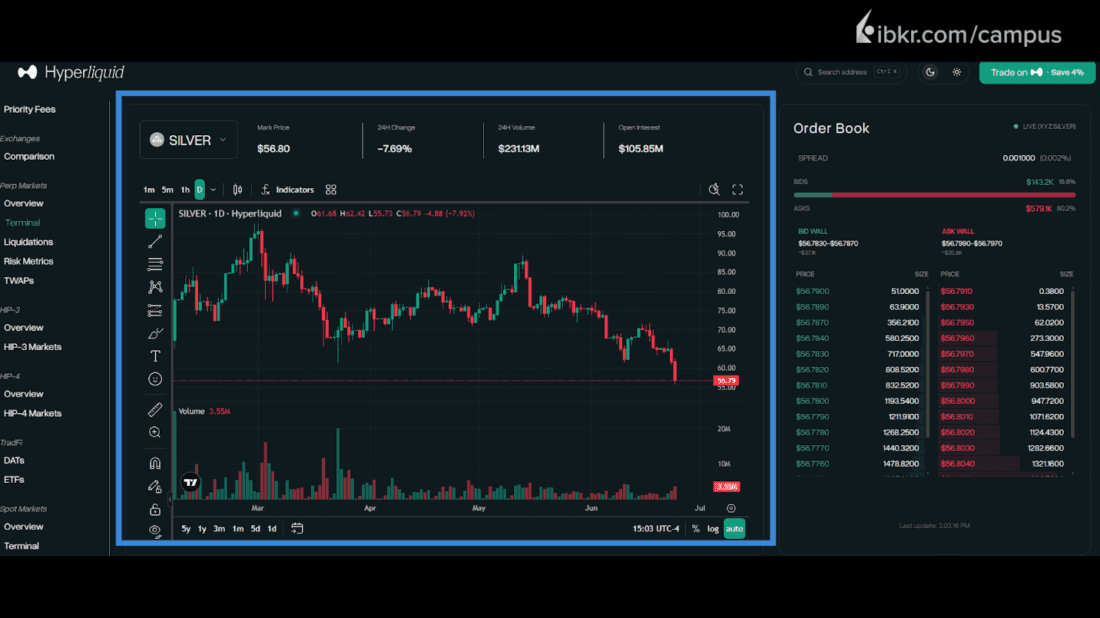
Source: Hyperliquid
So, what we’ve seen is that Hyperliquid has really built a product so that the volumes can also be invested through the token buybacks. And this is something that investors really understand: the share buybacks of any companies that are incredibly profitable to reinvest. Because if you’re rebuying, again, the share of the specific product. So that’s why, for us, we’ve seen that, one, it’s a community-based product.
It’s a product that actually was built right after the collapse of FTX. And FTX was basically the archetype of what not to do in crypto, right? So, financial fraud, operating with a black box, where basically no one really knows whether it’s customers’ or operating funds, and it was clearly one of the biggest frauds that we’ve ever seen after Bernie Madoff in 2008, right?

Screenshot from the podcast video
So, that’s why Hyperliquid really tried to build, essentially, a product that lets users see, in a transparent way, 24/7, the order books around the world. They can also own the assets in a self-custody way. Some investors prefer to own, of course, through an ETF, or through an exchange, a centralized platform. But we’ve seen that Hyperliquid was really the response right after FTX. That was the largest fraud that we’ve ever seen in crypto. That really led the community to feel that they can own the product, that they can participate to have exposure to first crypto assets and then eventually over to financial assets and different market classes.
And that’s why they built a very strong community from the get-go and then led to build this juggernaut that they are today. So, I do think that the power of community, the power of the people, the power of democratizing access to financial assets the way Hyperliquid has done structurally and economically, has been really powerful, and especially a powerful response after FTX.
Steven Levine
And it brings up for me all of this potential in terms of what it could actually become, more so than it is today. For example, this weekend trading and price discovery opportunity. I mean, at this point, at least to my imagination, it seems to be the heart of all this hype behind Hyperliquid: A major geopolitical event happens on a Saturday night, you think Hyperliquid. Do you think … something happens on a weekend, and the potential for Hyperliquid would be that it becomes the first venue for global price discovery. Like, you know, traditional traders eventually watching Hyperliquid the same way, say, equity traders watch overnight futures.
Adrian Fritz
That’s absolutely correct. And, I mean, markets don’t stop on the weekend. And news also doesn’t stop on the weekend. And obviously traders and markets still want to express their feelings and their sentiment. And they finally found a venue where they can do this with high liquidity and best execution. And that’s why you see that success. And, also, even traditional venues or media outlets that are quoting or looking at Hyperliquid prices, just to gauge the potential market opening on a Monday.
I think we could all agree that sooner or later everything will be traded 24/7. I think it’s also becoming consensus that tokenization and RWAs are the real deal. Of course, we can discuss and argue about the timeline. But I think Hyperliquid is one of the first examples that brings it all together – that allows you to trade 24/7 and kind of bridges blockchain technology with real-world assets.
Steven Levine
I was thinking about other reasons to trade on weekends. I don’t think they’re offered just yet on Hyperliquid, but I’m thinking, well, hey, agricultural commodity futures. I mean, extreme weather, crop disease, they don’t know that it’s Saturday.
You know, they don’t say, ‘Hey, wait, let’s not disrupt markets right now. The CME is closed. Let’s not do it.’ No. You’re going to have disease. You’re going to have hurricanes and drought and all this kind of thing. So, I’m thinking speculators like hedge funds might benefit from continuous markets. Do you think there’s a case to be made for tokenized real-world assets to trade them on weekends?
And in terms of, say, for example, the pre-IPO market… yes, I’ve heard other media outlets … I think Bloomberg … talking about how much open interest there was in SpaceX before SpaceX actually launched its IPO. Same with the price discovery—not price discovery—but there was a valuation basically that could be gained from all of the trading on Hyperliquid in the pre-IPO market.
Adrian Fritz
That’s correct. I think the beauty of that story here is, again, just the access. When we look at the SpaceX example, for the first time ever, even a trader from the Philippines could participate in the price discovery for a pre-IPO stock. And I think that’s what it really comes down to. Private markets were usually limited and only accessible to well-connected institutional investors, while here, once again, 24/7, you were able to participate in that financial story.
Steven Levine
Yeah. It’s incredible. I think that goes also to Eli’s comments about the democratization of the markets. It really opens things up for everyone, in that sense, at least to have access to computers that allow them to do it. I suppose that’s going to be important.
But do you think that this kind of thing actually improves price discovery, or do you think that this is all really just another layer of speculation? I mean, does it act at the end of the day like prediction markets?
I’m thinking there it’s like a sort of feedback loop. The sentiment of the population, or a sample of the population, starts to affect others’ decisions and behaviors. We see that sometimes in the way polls do on political office positions. You see somebody is thought, or has the sentiment, to get into office at a greater degree than someone else. And so that speculation kind of drives broader sentiment. Do you think that this is doing that as well?
Adrian Fritz
I would say initially, ‘yes’. I think every new market begins with speculation. But also speculation is a mechanism through which price discovery actually happens. So, obviously nothing is perfect. However, I think it just showcases the financial innovation that is behind a platform like that. How it’s ultimately embraced by regulators or by traditional financial institutions remains to be seen. But once again, I think it just showcases the disruptive power of this technology.
Steven Levine
It makes me think of what might be five years in the future. I mean, that’s what, like 2031? Sounds like a big number, but that’s only five years from now. And I’m thinking, well, you know, there’s a lot of talk still about the CLARITY Act. It’s not yet fully passed. They’re still working it out, it seems. I don’t know when they’ll get it done by. It seems like as soon as it inches closer, there’s some other gripe that the banking system has about it. I’m not quite sure what direction or how long. And I think you said that earlier, Adrian, about the timeline for tokenization of real-world assets.

Screenshot from the podcast video
But let’s say that in five years Hyperliquid is still around, and it’s competing with other crypto exchanges. Let’s say everything else is equal, although I don’t think it’s going to be equal either. I’m assuming it’s not very likely there’s going to be no change in the CME or Nasdaq.
But do you think Hyperliquid—do you really think that…. I think you’ve mentioned it earlier, and I think you said that it is the future of finance…this model. I’m sure it’s really too early to tell if it’s actually going to be Hyperliquid, but it seems to have this compelling model. Maybe it’s like a first draft or something, or a prototype someone else expands on. Do you think it gets bought by a traditional player? What do you think happens to it five years from now?
Eliézer Ndinga
My take is that five years from now we’re going to see more neobanks and traditional banks leveraging platforms like Hyperliquid and blockchain rails to offer 24/7 trading for assets to start with. We’ve seen, of course, the CME being forced to do that after seeing the success of Hyperliquid.
So, I wouldn’t be surprised to put it past all these institutions to feel like they’re behind a little bit compared with what we’ve seen on Hyperliquid. To give you numbers, a couple of weeks ago, when the CME launched 24/7 trading for crypto futures and options on Bitcoin, Ethereum, and Solana, they generated $50 million in volume over the weekend.
Hyperliquid, for the same assets, generated over $9 billion—orders of magnitude more than the CME. Of course, the CME is a juggernaut. It is the benchmark for futures of commodities and stocks, etc. But we can definitely tell that investors around the world and institutions are going to really take blockchain rails incredibly seriously, to be able to embrace the new technology the same way they embraced internet protocols to essentially provide international communications for their very own systems and businesses, and then eventually consumers as well.
So, what we are seeing today is that Hyperliquid is the successful financial story that we’ve seen thus far but has learned from the past mistakes and hiccups that we’ve seen in the past that were clear failures of decentralized exchanges.
And one is because the technology wasn’t ready, quite frankly, Steven. Right. When you think about the early days of the blockchain space, it’s very similar to the internet in the ’90s. In the ’90s, pages were loading for ten minutes. Opening an email from one person to another was taking even hours sometimes to load. And we’ve seen the same patterns and growing pains for blockchain rails.

Screenshot from the podcast video
In the early days, when people tried to launch Hyperliquid in 2017, 2018, blockchain systems were processing 5 to 10 transactions per second, right? So, it’s incredibly slow compared to SWIFT or compared to the Visas of the world processing 2,000 transactions per second, for example, specifically for Visa. It’s such a long way from that.
And that’s why, to me, I do think that as blockchain rails, the same way with Moore’s Law, improve and disrupt over time and become more efficient, we’re going to see institutions leveraging Hyperliquid. And I think that would be my unconventional take on where the future is.
Adrian Fritz
On my side, I would echo that. I really don’t know if Hyperliquid will be the winner and if it will still be around in 2031. Of course, there’s a lot of risk you’ve got to take into account as well with regards to regulation, competition ramping up. It’s a new technology. Smart contract risk. So, I really don’t know if it will be the winner.
What I do know, though, is that the financial infrastructure is changing. And I think Hyperliquid, as of today, is one of the most interesting experiments anywhere in capital markets today. And I think for anyone working in the financial industry, it should be a good kind of case study on what’s to come in the future.
Steven Levine
Yeah. It’s incredible. And the more I hear about the comparison to early technologies during the internet stages in the ’90s or even early 2000s, I never thought that they would actually solve this bandwidth problem. And I would watch these videos. I always thought they would just buffer forever. I would never watch an actual video. I didn’t think YouTube
Eliézer Ndinga
—likewise. We’ve come such a long way.
Steven Levine
I know. It’s incredible. Now we can watch TV with the internet and watch Netflix, and it’s almost like I’m just watching network TV back from 1984 or something or cable. It’s incredible how they do get solved and they do transform basically everything. And now you can watch it on your phone. I mean, that’s not something I think we ever imagined before the ’90s or during the ’90s. It’s incredible.
Is there anything else that you’d like to add before we sign off?
Eliézer Ndinga
I do think that for investors, even though in the U.S. we are not allowed to invest through Hyperliquid on the platform, I think it’s really interesting to see how the platform looks, at least from the outside, reading the news about it. We have tremendous research on Hyperliquid that we wrote about for the last couple of years. You can find out more on Hyperliquid at 21Shares.com/insights. We also have a newsletter as well, so feel free to sign up.
But it’s always great to be on the pod with you, Steven.
Steven Levine
Oh, absolutely. The same. And your piece on Hyperliquid was incredibly, super informative. It really led into all of these questions that I had, and it answers a lot as well. So, a really, really great picture of Hyperliquid and its comparison to the CME.
And this was really, really great. I think that this really draws also a very nice picture for Hyperliquid and what it might mean today and for the future.
Eli, Adrian, thank you so much again for taking the time to do this. So many developments, so fast, in this crypto space. It’s incredible. I do hope you’ll be back. I hope you’ll join us again.
Adrian Fritz
With pleasure. Anytime, Steven.
Steven Levine
It’s absolutely great. In the meantime, for our listeners, you can learn more about 21Shares, again, at 21Shares.com.
You can also read more commentary and market analysis, including on the crypto markets, at IBKR Traders’ Insight. A lot of great content there. You can also learn about the future of finance through the crypto commentary.
You’ll also find more information about Interactive Brokers’ crypto offerings at IBKR.com.
And for a full list of financial education resources, visit the IBKR Campus, where, as always, all of our educational material is provided to the public at no cost.
And until next time, I’m Steven Levine with Interactive Brokers.
Thanks for joining us.
LEARN MORE
21Shares – Hyperliquid runs an exchange Wall Street recognizes
Open an IBKR Account / Start a Free Trial
Getting Started with Cryptocurrency
Cryptocurrencies – Tech, Tokens, and Unique Traits (Bitwise, May 15, 2026)
Crypto Trends Signal a Seismic Shift in TradFi (21Shares, Apr 14, 2026)
Combating Crypto Skepticism (WisdomTree, Dec 8, 2025)
The GENIUS of Stablecoins (Abra, Dec 1, 2025)
The analysis in this material is provided for information only and is not and should not be construed as an offer to sell or the solicitation of an offer to buy any security. To the extent that this material discusses general market activity, industry or sector trends or other broad-based economic or political conditions, it should not be construed as research or investment advice. To the extent that it includes references to specific securities, commodities, currencies, or other instruments, those references do not constitute a recommendation by IBKR to buy, sell or hold such investments. This material does not and is not intended to take into account the particular financial conditions, investment objectives or requirements of individual customers. Before acting on this material, you should consider whether it is suitable for your particular circumstances and, as necessary, seek professional advice.
The views and opinions expressed herein are those of the author and do not necessarily reflect the views of Interactive Brokers, its affiliates, or its employees.
Trading in digital assets, including cryptocurrencies, is especially risky and is only for individuals with a high risk tolerance and the financial ability to sustain losses. Eligibility to trade in digital asset products may vary based on jurisdiction.
Stablecoins and Tokenized assets are not legal tender, are not insured by the FDIC or any government agency, and may lose value; they carry risks including issuer insolvency, regulatory changes, operational failures, and potential inability to redeem for fiat currency. By transacting in stablecoins, you acknowledge and accept these risks.
Cryptocurrency based Exchange Traded Products (ETPs) are high risk and speculative. Cryptocurrency ETPs are not suitable for all investors. You may lose your entire investment. For more information please view the RISK DISCLOSURE REGARDING COMPLEX OR LEVERAGED EXCHANGE TRADED PRODUCTS.













Join The Conversation
For specific platform feedback and suggestions, please submit it directly to our team using these instructions.
If you have an account-specific question or concern, please reach out to Client Services.
We encourage you to look through our FAQs before posting. Your question may already be covered!