
- Solve real problems with our hands-on interface
- Progress from basic puts and calls to advanced strategies
Interactive Options Course
Lesson 4 of 13
Contributed By: 
The following is a summary of a video recording and may contain errors in spelling or grammar. Although IBKR has edited for clarity no material changes have been made.
Hello everyone. I’m Nicholas Grous. I’m Director of Research, Consumer Internet and Fintech team here at ARK.
Today I’ll be joined with Varshika who is our amazing research associate, and we’ll be walking through the AI consumer operating system section of big ideas. This section is going to focus on transforming search, discovery, transactions and the economics of e-commerce itself and how we believe we are entering into a new agentic world when it comes to AI.

So, I’ll take you right into the first slide here. We believe that the consumer operating system is changing. we’ve gone from command era to web era to mobile era and now we’re entering into the agentic era. This was really kicked off by the launch of ChatGPT back in 2022. But as we’re seeing the evolution of AI, we believe we are moving from a world from query to answer to query to action and this is the agentic era in a nutshell.
We look at this system and what is happening here and we think that there are two primary verticals within the consumer space where these companies can create massive revenue opportunities for themselves but also disrupt the current incumbency and the way that business is conducted and the primary two are really on e-commerce and advertising.
Varshika is going to take you into e-commerce in the next few slides, but first I just want to press upon how big of an opportunity we believe this is and it’s partly driven by how fast these agents and chat bots have been adopted.
If you look at this slide and you look at the graph on the left-hand side, you can see that the AI adoption versus just the internet adoption itself we’re pacing well ahead of where we were a few years after the internet.
When you look at how fast the adoption of chat bots has been you’re talking about almost 20% penetration nearing in on 20% penetration just after three years versus it almost took the internet itself around seven years to reach the same level of penetration. So, this is happening extremely fast. You need to keep your head on a swivel and that’s why Varshika is going to take you through the e-commerce section, I will come back in to close it off around what we think is happening on advertising.
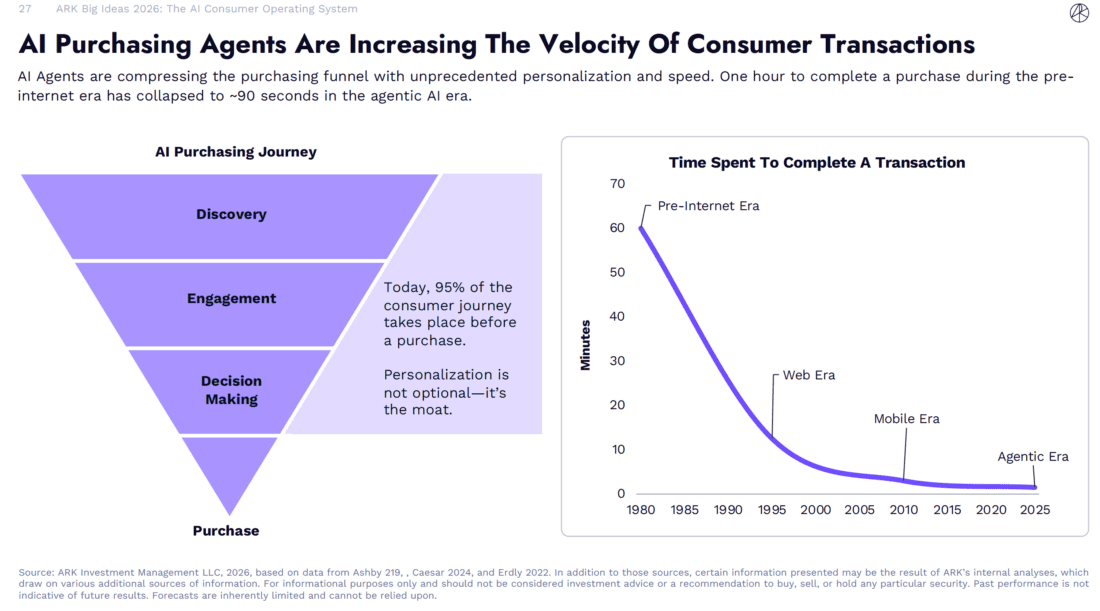
So, 2025 was really the year that Agentic Commerce came into life. And we’ve been, if you’ve been here for a little bit, we’ve been talking about AI purchasing agents. And I think we we’re seeing that AI purchasing agents have really been able to sort of compress this consumer shopping journey as it goes from discovery, engagement, decision-making to purchase.
A majority of that journey actually occurs before a purchase even takes place. And that’s where AI comes like AI purchasing agents can come in with a great level of personalization are able to help the consumer makes the decision that’s right for them and as a result these AI agents are also reducing the speed reducing the time it takes to complete a transaction. So, if you think about the pre-internet era when you maybe had to go into a shopping mall or a department store to make a purchase that entire transaction would take you maybe about an hour. The time to complete a transaction has been steadily decreasing ever since the advent of the internet and I think with the agentic era transactions can occur in as little as 90 seconds.
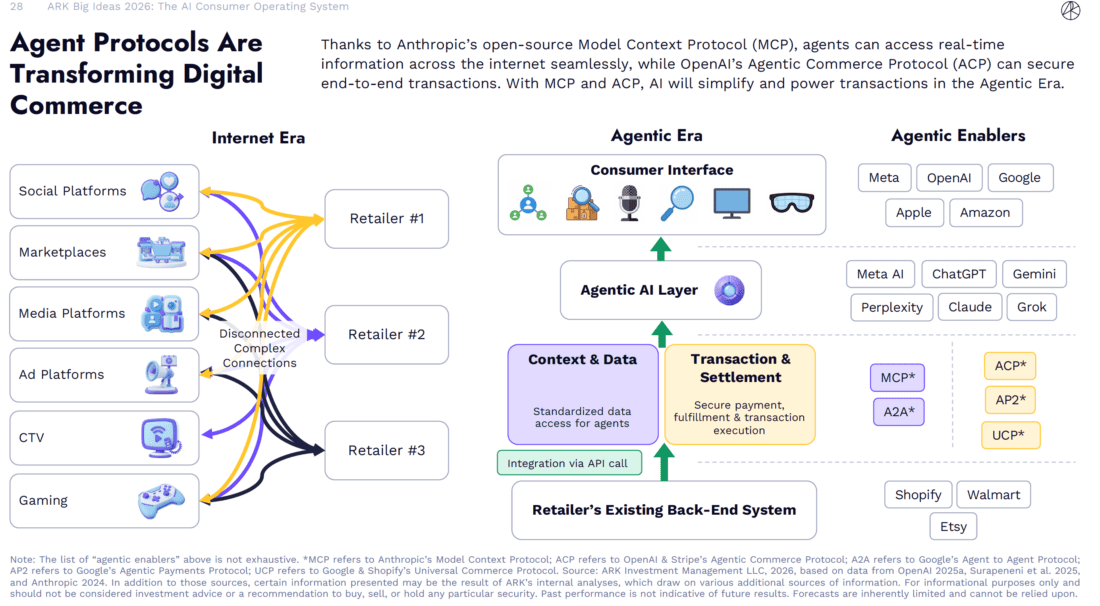
I think agentic protocols are what’s going to make AI commerce a reality. And I think the key to all of this and the key to unlocking Agentic Commerce really is the are the retailers who are going to be connecting their back-end systems to these protocols to give them the necessary context and data.
So, on the context front I think you have MCP which stands for Model Context Protocol from Anthropic that’s really giving these agents the necessary context and data that they need and standardizing and this protocol as a whole is really standardizing what data access looks like for these agents.
And then specifically to the commerce side you have ACP which is Agentic Commerce Protocol from OpenAI and Stripe and then you have UCP which is Universal Commerce Protocol call from Google and Shopify and those are really enabling the settlement and transaction for e-commerce.
So these protocols are what’s enabling agents to secure transactions on behalf of the consumer and I think what we’re seeing in the agentic AI era is that you’re the commerce stack has really unified so it’s like from the retailer using these protocols through your agentic layer and then ultimately interacting with the consumer interface whether that’s a chatbot a voice assistant or AI smart glasses.
We’re seeing a very unified stack which has been a big improvement from the internet era where you have retailers that have fragmented connections across marketplaces, social media platforms, CTV, etc.

So, overall, we think that as consumers, delegate more of their commerce activity to AI, we think that AI agents should capture a larger share of digital transactions. So, we think that’s going to go from about 2% in 2025 all the way up to 25% in 2030. And that represents more than $8 trillion of online consumption globally in 2030.
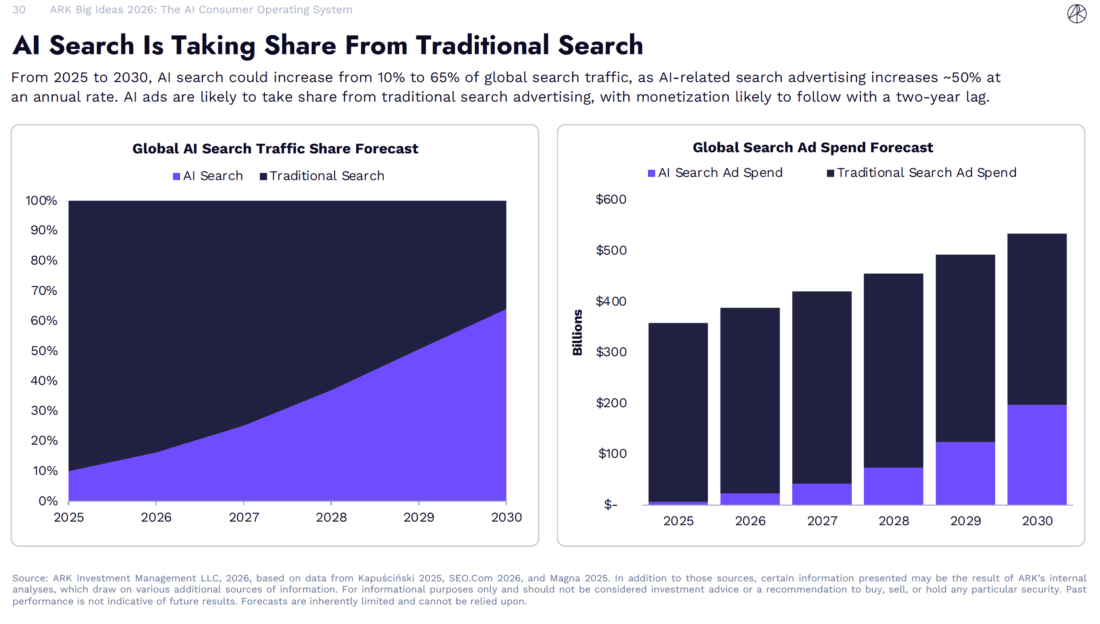
So, the other big opportunity here outside of e-commerce we believe is on advertising. If you look at the advertising landscape today, search is a huge component of that story. Searches around a $350 billion market. Google is a dominant player; you have others with specific verticals within search like Amazon. We really think that the way that AI can scale their advertising business is to disrupt and transfer some of these search advertisements into the AI and agentic world, and so we have a forecast we believe is showing exactly that playing out.
We believe AI search can grow from anywhere from 10% today to around 65% of global search traffic over the next five years, and really what we’ve learned over the years is that advertisers are slow to adopt any new advertising platform.
So, we’ve actually built in a bit of a lag as it comes to monetization. So, it’s not really one-to-one eyeballs don’t necessarily equal dollars at least not in the advertising world. And it takes time for advertisers to adjust to new services deployed. But we do think that over time AI search and the advertising opportunity around it is going to grow. We’ve started to hear from companies like OpenAI that are going to deploy advertising. So, this will be a great first year to test this thesis out in the wild and see how consumers respond to advertising within these chatbot ecosystems. So, we’re really excited about what AI search can mean for the aggregate consumer opportunity.
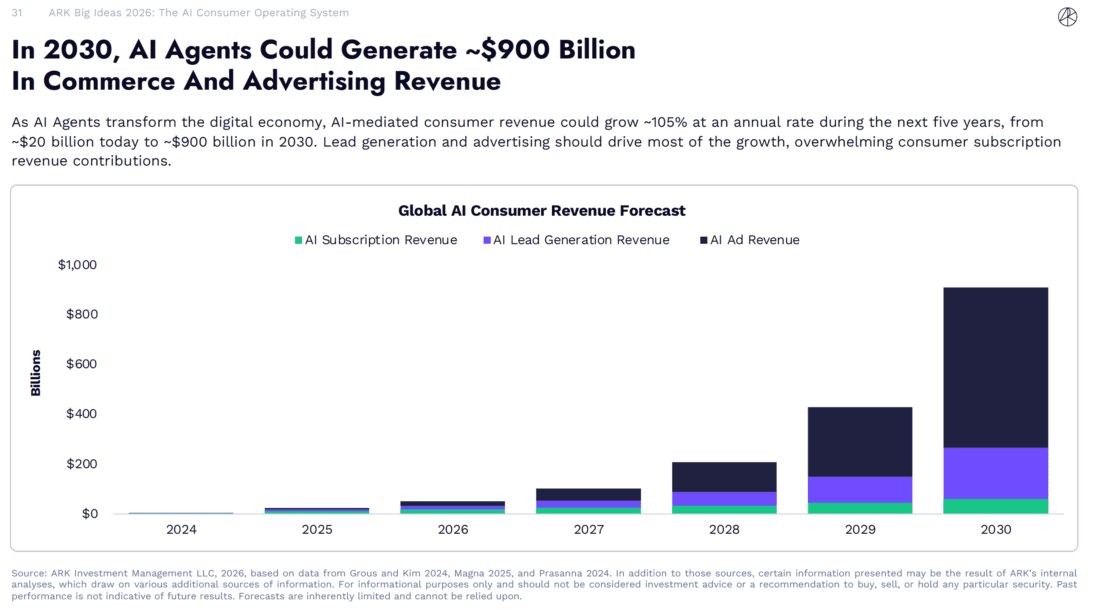
I think the point we want to press on everyone is that when you look at the main monetization vehicles for AI today, right now it’s solely centered around subscriptions. So direct monetization at least on the consumer end you have some consumption-based models on the enterprise side and a bit of consumption-based monetization on the consumer but a lot of this is very much direct monetization.
Now, we think charging a consumer a subscription is going to be a continued way to monetize the opportunity. But if you play out the amount that these these companies can charge, we think that there’s a much larger opportunity in indirect monetization. And this comes from a take rate on commerce as well as the advertising opportunity I just spoke about. And this is we’re drawing from historical precedent. When you look at other large platforms at scale, think of social media companies.
Yes, they have some direct monetization, but the majority of users are operating on these platforms in a free and premium model. And so, the way that you drive large scale revenue, we believe, is through these indirect monetization opportunities such as AI search, advertising as well as e-commerce. And so, we believe that this market is going to grow from around $20 billion today to around $900 billion in 2030 led by these indirect monetization opportunities and as you can think of AI lead generation tying very much into the advertising opportunity because advertising and commerce go hand in hand. We think that those two together really present the large, at large the opportunity for consumer monetization within what we believe is now a new consumer operating system.
We think we are really headed toward this future faster than most believe and that we are going to have a drastically different human to computer interfacing within the next few years. I think what we’re seeing just in these past few weeks alone point towards this agentic future is happening here and now. So, we’re very excited to have put this research out. We would love feedback. If you can comment we’ll definitely take in all of this, we want to hear from you about anything that you’re seeing. Hopefully you’ve enjoyed this section of Big Ideas and stay tuned for more. This space is moving faster than any other space, we’ve ever covered. So, it’s exciting times, but thank you for tuning in.
Information posted on IBKR Campus that is provided by third-parties does NOT constitute a recommendation that you should contract for the services of that third party. Third-party participants who contribute to IBKR Campus are independent of Interactive Brokers and Interactive Brokers does not make any representations or warranties concerning the services offered, their past or future performance, or the accuracy of the information provided by the third party. Past performance is no guarantee of future results.
This material is from ARK Invest and is being posted with its permission. The views expressed in this material are solely those of the author and/or ARK Invest and Interactive Brokers is not endorsing or recommending any investment or trading discussed in the material. This material is not and should not be construed as an offer to buy or sell any security. It should not be construed as research or investment advice or a recommendation to buy, sell or hold any security or commodity. This material does not and is not intended to take into account the particular financial conditions, investment objectives or requirements of individual customers. Before acting on this material, you should consider whether it is suitable for your particular circumstances and, as necessary, seek professional advice.










Join The Conversation
For specific platform feedback and suggestions, please submit it directly to our team using these instructions.
If you have an account-specific question or concern, please reach out to Client Services.
We encourage you to look through our FAQs before posting. Your question may already be covered!