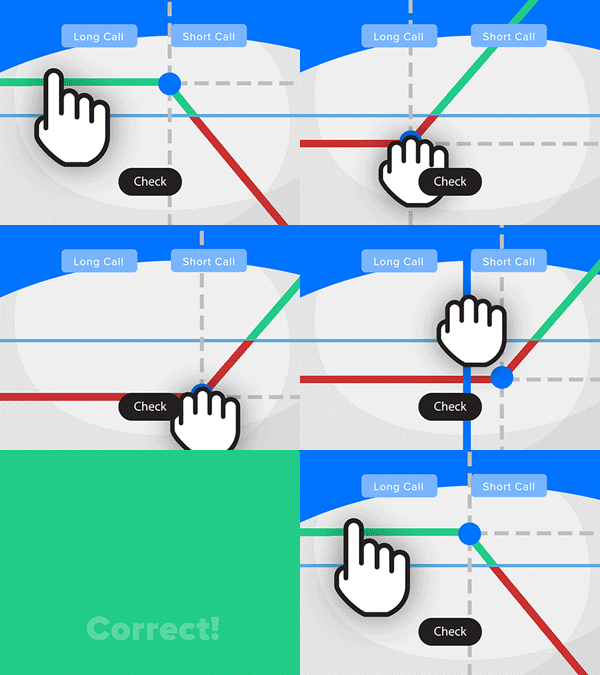
- Solve real problems with our hands-on interface
- Progress from basic puts and calls to advanced strategies
Interactive Options Course
Latest Webinars

Posted November 17, 2025 at 10:15 am
The AI-fueled transformation of big tech is entering dangerous territory, with surging capital expenditures threatening to erode profit margins, dismantle asset-light models, and reduce once-high-growth giants like the Magnificent Seven into utility-like low-return entities.
That’s the view of Kai Wu, founder of Sparkline Capital, who recently highlighted that Wall Street’s AI darlings are shifting toward a riskier, capital-heavy model that has historically underdelivered for investors.
AI investment is in full swing. U.S. tech giants are expected to drop nearly $400 billion in capex this year, with total AI-related spending projected to hit $5.2 trillion by 2030, according to McKinsey.
At first glance, Wall Street is loving it.
Last month, Oracle Corp. (NYSE:ORCL) jumped 36% on the day after its OpenAI data center deal.
But are those gains sustainable? “While the market has rewarded this spending so far,” Wu wrote in his report, “we find that historical capital expenditure booms have typically resulted in overinvestment, excess competition, and poor stock returns.”
Despite the hype, the revenue just isn’t there—yet. Wu estimates that current AI-related revenues sit around $20 billion, which means they’ll need to grow 100-fold by the end of the decade to justify this kind of investment.
And that’s assuming adoption speeds up.
Just as telecoms overspent on fiber optics in the late ’90s, Big Tech may be falling into the same trap. Wu draws a direct comparison: “The parallels to past technology buildouts are hard to ignore.”
Since the release of ChatGPT, JPMorgan data shows that AI stocks have contributed 75% of S&P 500 returns, 80% of earnings growth, and 90% of capital spending growth.
The Magnificent Seven — Apple Inc. (NASDAQ:AAPL), Microsoft Corp. (NASDAQ:MSFT), Amazon.com Inc. (NASDAQ:AMZN), Meta Platforms Inc. (NASDAQ:META), Alphabet Inc. (NASDAQ:GOOGL), Nvidia Corp. (NASDAQ:NVDA) and Tesla Inc. (NASDAQ:TSLA) — now make up 35% of the S&P 500, a concentration surpassing the dot-com era.
For years, they were known for their nimble, asset-light models that delivered huge returns.
But that’s changing fast.
According to Wu, “the AI arms race is transforming Big Tech from asset-light to asset-heavy, a model we find associated with inferior returns.”
Capital expenditures by these companies have surged from 4% of revenue in 2012 to 15% today. Meta, Microsoft and Google are expected to spend between 21% and 35% of revenue on infrastructure, levels more typical of old-school utilities than Silicon Valley growth machines.
“The Magnificent Seven’s capital intensity is quickly approaching that of utilities,” Wu warned.
All that spending is starting to drag on profitability. Wu estimates that depreciation costs alone could climb from $150 billion to $400 billion over the next five years, and that’s before factoring in short-lived tech lifespans.
And as he points out, some of the funding behind the AI boom is looking a little circular.
“Nvidia recently invested $100 billion in OpenAI, providing capital that OpenAI could use to buy Nvidia chips,” Wu wrote. A week later, OpenAI signed a deal with AMD. The result? A tangled web of AI companies funding one another’s spending sprees.
Wu compares the current race to a classic game theory trap: “While the optimal move is for firms to mutually agree to moderate their AI investments… each firm is incentivized to unilaterally ramp up investment.”
Even if it destroys profit margins, none of the big players can afford to pull back without risking irrelevance.
Meta’s Mark Zuckerberg said it plainly: “If we end up misspending a couple of hundred billion dollars… that is going to be very unfortunate. But… the risk is higher on the other side.”
Meanwhile, Google co-founder Larry Page took it a step further: “I’m willing to go bankrupt rather than lose this race.”
Historically, it’s not the infrastructure builders who come out on top—it’s the users.
Wu points out how 85% of fiber optic cables laid during the dot-com era went unused, but that overbuild paved the way for companies like Netflix and Facebook to thrive.
“Excess supply drives down prices, effectively resulting in a subsidy from the builders to their customers,” Wu said.
He’s betting the same could happen in AI.
This dynamic — where each firm feels compelled to outspend rivals — creates a self-destructive arms race. Though the AI infrastructure is promising, its economics remain uncertain, and investors may be overestimating future gains.
Wu suggests shifting focus to “AI early adopters”—companies that stand to benefit from AI without footing the bill for infrastructure.
Think Walmart Inc. (NYSE:WMT), Caterpillar Inc. (NYSE:CAT), JPMorgan Chase & Co. (NYSE:JPM), Sony Group Corp. (NYSE:SONY), Siemens AG (OTC:SIEGY), and Roche Holding AG (OTC:RHHBY).
These firms, he says, offer lower capital requirements and better valuations.
Meanwhile, AI infrastructure stocks—led by megacaps like Nvidia, Amazon, and Microsoft—have seen their valuation premiums balloon from 32% to 137% since 2015.
That kind of stretch doesn’t leave much room for error. “Investors should heed the lessons of history,” Wu wrote. “Aggressive capital spending has generally led to poor stock returns.”
Meanwhile, AI infrastructure stocks—led by megacaps like Nvidia, Amazon, and Microsoft—have seen their valuation premiums balloon from 32% to 137% since 2015. That kind of stretch doesn’t leave much room for error.
“Investors should heed the lessons of history,” Wu wrote. “Aggressive capital spending has generally led to poor stock returns.”
—
Originally Posted November 17, 2025 – Magnificent Seven Will Become Low-Profit Tech Utilities, Analyst Warns
© 2022 Benzinga.com. Benzinga does not provide investment advice. All rights reserved.
Information posted on IBKR Campus that is provided by third-parties does NOT constitute a recommendation that you should contract for the services of that third party. Third-party participants who contribute to IBKR Campus are independent of Interactive Brokers and Interactive Brokers does not make any representations or warranties concerning the services offered, their past or future performance, or the accuracy of the information provided by the third party. Past performance is no guarantee of future results.
This material is from Benzinga and is being posted with its permission. The views expressed in this material are solely those of the author and/or Benzinga and Interactive Brokers is not endorsing or recommending any investment or trading discussed in the material. This material is not and should not be construed as an offer to buy or sell any security. It should not be construed as research or investment advice or a recommendation to buy, sell or hold any security or commodity. This material does not and is not intended to take into account the particular financial conditions, investment objectives or requirements of individual customers. Before acting on this material, you should consider whether it is suitable for your particular circumstances and, as necessary, seek professional advice.
Related Articles














Join The Conversation
For specific platform feedback and suggestions, please submit it directly to our team using these instructions.
If you have an account-specific question or concern, please reach out to Client Services.
We encourage you to look through our FAQs before posting. Your question may already be covered!