
- Solve real problems with our hands-on interface
- Progress from basic puts and calls to advanced strategies
Interactive Options Course

Posted August 25, 2026 at 1:27 pm
Yesterday, I had two column ideas in mind. Although I touched upon my concerns about the Treasury’s recent intervention into the market for its long-dated bonds, I opted for the more timely topic of the failure of US-Canada trade talks. While I don’t regret that decision, I had planned to delve more deeply into the topic of the bond market today. That will still be the case, but the discussion has now been shaped by famed investor Stanley Druckenmiller’s op-ed in this morning’s Wall Street Journal.
Put simply, Druckenmiller’s piece is rather scathing. It was intended to cut much more deeply than a critical opinion by a prominent hedge fund manager might otherwise do so. Stanley Druckenmiller founded Duquesne Capital in 1981 and ran it until he closed it in 2010. More importantly, he was the lead portfolio manager at George Soros’ Quantum Fund from 1988 to 2000. During that time, he was at Soros’ right hand when they “broke the Bank of England” in 1992. This legendary trade occurred when the BOE tried to prop up the sagging pound to avoid withdrawal from the first European Exchange Rate Mechanism (something that seems quaint in the post-Brexit environment), but succumbed to market pressure, abetted by Soros’ huge short position. Those who were short pounds profited immensely.
Treasury Secretary Scott Bessent joined Soros Fund Management (SFM) in 1991. While he later rose to head the firm’s London office, he clearly took a back seat to Soros and Druckenmiller in 1992’s windfall, but also had to learn valuable lessons from that experience. It has been widely reported that Bessent was a protégé of Druckenmiller’s and that the two talked regularly, if not daily. It is impossible to read today’s op-ed without considering why a long-time mentor would choose to publicly chastise a former protégé so virulently and publicly.
The thrust of Druckenmiller’s criticism is that the current intervention is at best a temporary measure that not only fails to address the root cause of the recent rise in long-term rates but also blunts the message from “the only fiscal disciplinarian the U.S. has left.” For that reason, he characterizes the long-term Treasury yield as the “most important price in the world.” Put simply, Druckenmiller is unhappy with the path of fiscal policy and is dismayed that his former protégé is undertaking cosmetic measures that run counter to market messages that might force Congress and the administration to improve the situation. This is a message that he clearly preferred to deliver with maximum public effect.
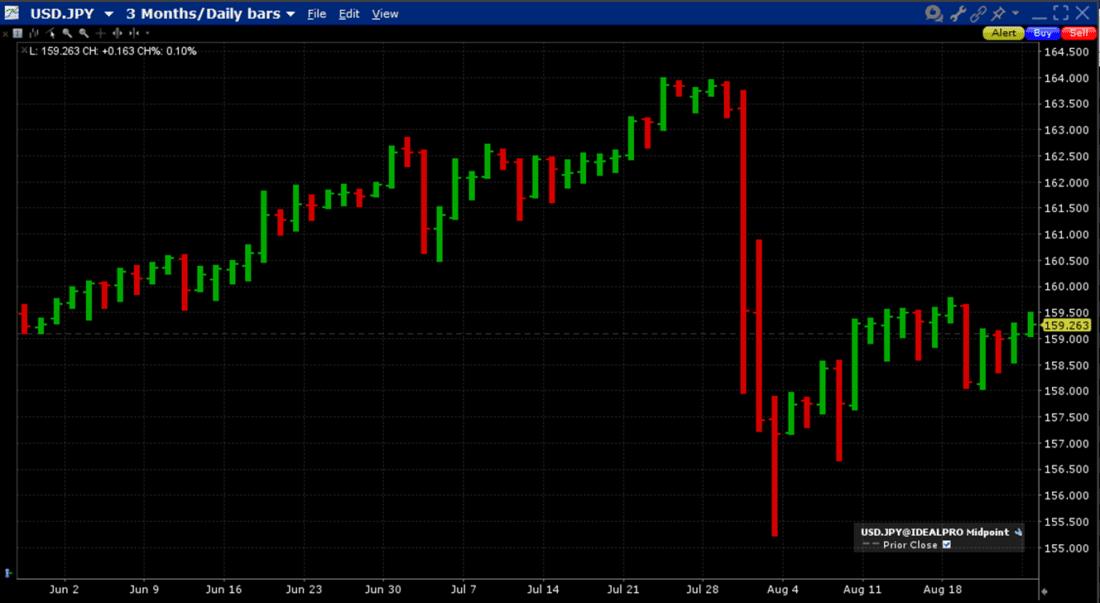
While researching some of the facts for this piece, two interesting facts jumped out at me.
JPY/USD, 3-Months, Daily Bars
Source: Interactive Brokers
In yesterday’s piece, I made an analogy linking intervention to fighting a powerful tide, writing:
If the tides are moving in one direction or another, it takes an awful lot to shift them. I experienced this firsthand while kayaking in the Bay of Fundy last week. Unless you’re paddling furiously and continuously, the tides, whether monetary or market, will take you wherever they’re going, whether you like it or not.
This is at the root of Druckenmiller’s critique. He is asserting, quite understandably, that rising deficits are creating huge tidal forces that are futile to fight unless major changes to fiscal policy are undertaken to shift them. (I will add my opinion that the immense capital requirements of AI companies are adding to that wave.) These are people with immense first-hand experience in how major market forces work, and it is clear that a mentor is trying to remind his long-time protege of that.
New to Interactive Brokers?
Open AccountAlready an Interactive Brokers Client?
Request Trading PermissionThe analysis in this material is provided for information only and is not and should not be construed as an offer to sell or the solicitation of an offer to buy any security. To the extent that this material discusses general market activity, industry or sector trends or other broad-based economic or political conditions, it should not be construed as research or investment advice. To the extent that it includes references to specific securities, commodities, currencies, or other instruments, those references do not constitute a recommendation by IBKR to buy, sell or hold such investments. This material does not and is not intended to take into account the particular financial conditions, investment objectives or requirements of individual customers. Before acting on this material, you should consider whether it is suitable for your particular circumstances and, as necessary, seek professional advice.
The views and opinions expressed herein are those of the author and do not necessarily reflect the views of Interactive Brokers, its affiliates, or its employees.
There is a substantial risk of loss in foreign exchange trading. The settlement date of foreign exchange trades can vary due to time zone differences and bank holidays. When trading across foreign exchange markets, this may necessitate borrowing funds to settle foreign exchange trades. The interest rate on borrowed funds must be considered when computing the cost of trades across multiple markets.
Short selling is an advanced trading strategy involving potentially unlimited risks and must be done in a margin account.
Trading on margin is only for experienced investors with high risk tolerance. You may lose more than your initial investment. For additional information regarding margin loan rates, see ibkr.com/interest
Hedge Funds are highly speculative, and investors may lose their entire investment.
Municipal Bonds are only available from Interactive Brokers for IBKR LLC, IBKR Canada, IBKR Hong Kong, IBKR Australia and IBKR Singapore entities.
Spot currencies are not available at IBKR Singapore.
Related Articles

















Join The Conversation
For specific platform feedback and suggestions, please submit it directly to our team using these instructions.
If you have an account-specific question or concern, please reach out to Client Services.
We encourage you to look through our FAQs before posting. Your question may already be covered!