
- Solve real problems with our hands-on interface
- Progress from basic puts and calls to advanced strategies
Interactive Options Course

Posted October 9, 2026 at 1:15 pm
Stocks are advancing for the first session in three as a bullish OpenAI report counters the negative impacts of rising oil prices and climbing Treasury yields. The buoyant sales projections from the firm are strengthening the corporate earnings outlook for semiconductors and the Mag7, dominant areas of the market whose near-term success depends on the development, adoption and integration of the modern technology. The resulting optimism is additionally helping equities overcome a near record low on UMich consumer sentiment, which featured increasing inflation expectations that are a separate factor lifting interest rates. Heavier fuel costs are resulting from Middle East violence consisting of a Houthi attack on Riyadh’s airport that is offsetting the impact of President Trump stating that the US won’t attack Iran before the midterm elections, a message that initially weighed on crude charges before they reversed north. Against this backdrop, shorter-dated fixed income maturities are underperforming duration, as speculators are increasingly piling into the long end of the curve while Fed watchers consider a loftier estimate of neutral. Still, the four major equity benchmarks are gaining amidst 10 of the 11 principal sectors participating in today’s recovery. The greenback, commodities and cryptocurrencies are appreciating across the board, prediction markets are catching bids and volatility protection instruments are seeing lighter premiums due to the risk-on mood here on Wall Street.
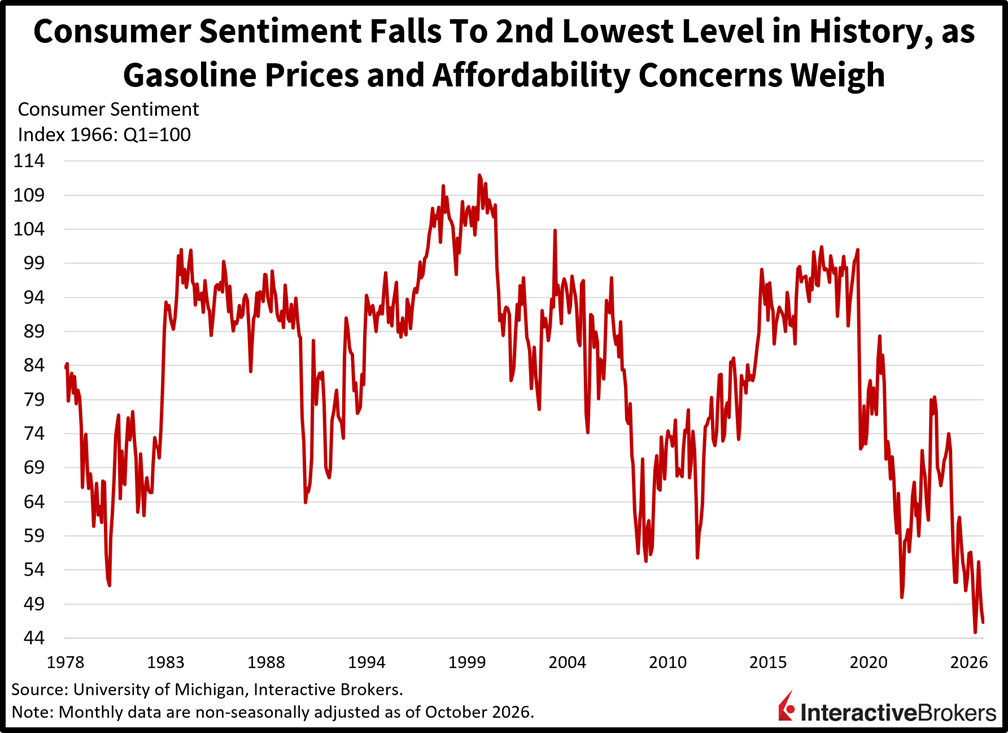
Household moods fell in October to near a record low with various categories of consumers’ views being consistent with the weakest figure in five months. The University of Michigan’s (UMich) Consumer Sentiment Index printed a 46.1 headline number that missed the 47.6 estimate and sank from September’s 48.1. The current conditions gauge plunged to its worst level in history of 44.7, arriving beneath the 50.5 expectation and the 50.9 from the previous period. The future outlook indicator actually increased, though, from 46.3 to 47.3, and beat the projected 45.9. Inflation expectations over the next 1 and 5 years rose from 4.6% and 3.4% to 4.7% and 3.5%, their strongest prints since May. Overall, softening views of the economy, cost-of-living pressures, depressed purchasing intentions for big-ticket items and elevated interest rates generated the sharp decline, however, folks did feel a little better about business opportunities and the growth of their personal finances in the coming quarters.
Wall Street is finishing the week in the green as it gears up for big inflation data in the coming days that’ll feature the Consumer and Producer Price indices as well as the beginning of earnings season. The cost numbers aren’t poised to offer alleviation, as annualized accelerations are expected on both fronts; however, investors would overlook those hot statistics if oil can plunge back to $80 on West Texas Intermediate amidst possible progress pertaining to Middle East tensions. Corporate profits have the potential to keep trumping everything, meanwhile, as they have continued to power the charging bull even as yields have soared over 100 basis points since March’s lows. Participants will seek to reward firms that are weathering tighter financial conditions and fragile shopper pocketbooks as well as those companies that are providing fresh evidence of how AI will bolster their bottom lines for years to come. I’m expecting ongoing bifurcations and concentrations to persist, as analysts continue separating the winners from the losers in equities, with heavy declines poised to hurt businesses that are struggling with pricing concessions and margin compression against the backdrop of stressed household budgets. And the deepest pullbacks could occur with names that face challenges adopting, integrating and monetizing AI, as those are especially vulnerable to a worsening outlook.
Canada’s economy lost 63,300 jobs last month, which pushed the unemployment rate to 6.5%, a 0.1 percentage point climb from August, according to Statistics Canada. The print was a surprise with economists anticipating a net addition of 9,000 individuals punching timeclocks. While it was one of the worst months of the year for job losses, the unemployment rate stayed below the year-to-date high of 6.9%. On a concerning note, the decline in payrolls follows the loss of 41,700 jobs in August. While September was the first month in which the US imposed 50% import tariffs on about 5% of Canada products, many of the recent job losses, occurred in non-cyclical categories. Indeed, the worst carnage was educational services, health care and social assistance workers.
Hourly wages in Canada were up 2.3% in September, which matched the economist consensus. The wage growth accelerated from August’s 2% increase.
Household spending in Japan continued to contract on a year-over-year (y/y) basis in August and was nearly flat when compared to cash register transactions in July, according to data from the country’s Ministry of Internal Affairs. On a positive note, lethargy at cash registers was slightly less severe than in recent months even with real wages falling 0.9% y/y with an increase in the costs of living eroding consumers spending clout. August sales sank 3.1% y/y, marking the ninth consecutive month of contraction. It was only slightly better than the economist consensus estimate for spending to plunge 3.5% following the 3.6% July drop. On a month-over-month basis, total transactions were up only 0.1%, which missed the estimate for a repeat of July’s 0.5% m/m ascent. Within the y/y print, household outlays for energy and water headed south by 5.2% while culture and recreation spending was down 4.3%. Households also trimmed food and beverage purchases by 1.4%.
Orders for machine tools in Japan were up 60.4% y/y in September, continuing a period of strong sales following the preceding month’s 64.7% advance, according to the Japan Machine Tool Builders Association, or JMTBA. Impressively, orders have been growing for approximately 14 months.
New to Interactive Brokers?
Open AccountInformation posted on IBKR Campus that is provided by third-parties does NOT constitute a recommendation that you should contract for the services of that third party. Third-party participants who contribute to IBKR Campus are independent of Interactive Brokers and Interactive Brokers does not make any representations or warranties concerning the services offered, their past or future performance, or the accuracy of the information provided by the third party. Past performance is no guarantee of future results.
This material is from IBKR Macroeconomics, an affiliate of Interactive Brokers LLC, and is being posted with its permission. The views expressed in this material are solely those of the author and/or IBKR Macroeconomics and Interactive Brokers is not endorsing or recommending any investment or trading discussed in the material. This material is not and should not be construed as an offer to buy or sell any security. It should not be construed as research or investment advice or a recommendation to buy, sell or hold any security or commodity. This material does not and is not intended to take into account the particular financial conditions, investment objectives or requirements of individual customers. Before acting on this material, you should consider whether it is suitable for your particular circumstances and, as necessary, seek professional advice.
Futures, event contracts, and forecast contracts are not suitable for all investors. Before trading these products, please read the CFTC Risk Disclosure. For a copy, visit our Warnings and Disclosures Page.
Trading in digital assets, including cryptocurrencies, is especially risky and is only for individuals with a high risk tolerance and the financial ability to sustain losses. Eligibility to trade in digital asset products may vary based on jurisdiction.
Related Articles
















Join The Conversation
For specific platform feedback and suggestions, please submit it directly to our team using these instructions.
If you have an account-specific question or concern, please reach out to Client Services.
We encourage you to look through our FAQs before posting. Your question may already be covered!