
- Solve real problems with our hands-on interface
- Progress from basic puts and calls to advanced strategies
Interactive Options Course

Posted October 6, 2026 at 11:50 am
The article “Buying Complex Retail Investment Products May Not be a Great Idea” was originally published on Alpha Architect blog.
Complexity is often presented as a natural consequence of financial innovation. Markets evolve, products become more sophisticated, and investors gain access to increasingly customized risk-return profiles. But complexity can also serve another purpose; it can make products harder to compare. When investors cannot easily compare alternatives, competition may become less effective at pushing prices down. This paper introduces a more strategic interpretation of financial complexity. Issuers may deliberately redesign investment products when competitive pressure increases, shifting toward structures that are harder for investors to evaluate and compare. The result is a subtle but important mechanism. More competition does not necessarily produce better outcomes for investors. It may instead encourage issuers to create more complex products that preserve margins while transferring additional, and potentially misunderstood, risk to retail investors.
Competition Can Increase Product Complexity
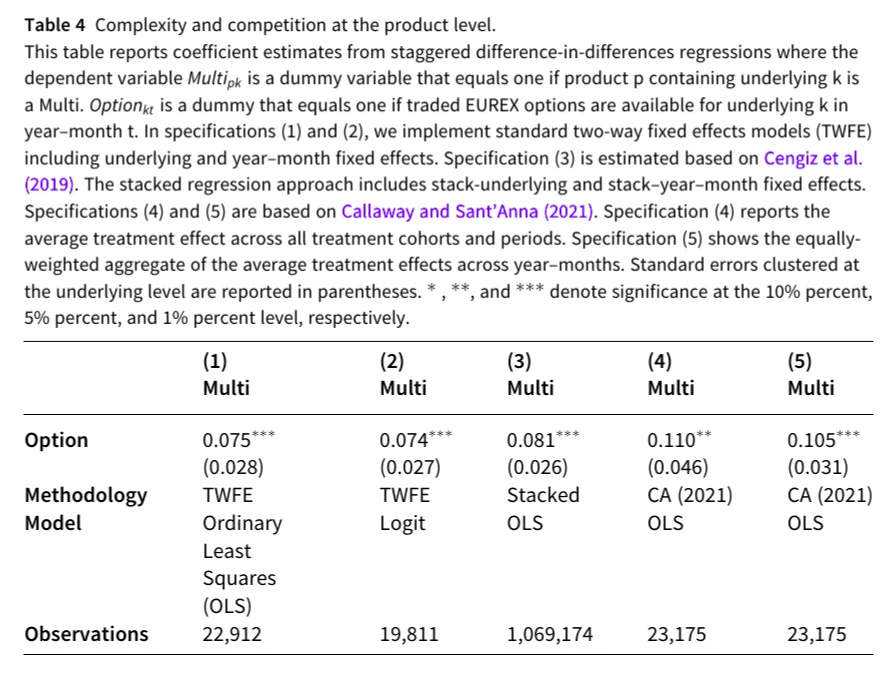
The paper studies the Swiss market for yield enhancement products, focusing on barrier reverse convertibles with either one underlying asset, called Singles, or multiple underlying assets, called Multis. As competition intensified, issuers increasingly shifted toward Multis. These products are harder to compare because issuers can create many different combinations of underlying securities. The evidence suggests that complexity is not simply the result of investor demand or financial innovation. It can be a strategic response designed to reduce direct product comparability and weaken price competition.
Complex Products Generate Higher Markups and Lower Returns
Complexity appears profitable for issuers but costly for investors. Multis have annualized markups approximately 4 percentage points higher than Singles and generate realized returns approximately 2.1 percentage points lower. Average excess returns are negative for both types of products, but substantially worse for Multis. While markups on simpler Singles decline as competition increases, markups on Multis remain high.
Comparability Improves Investor Terms
The authors identify “twin products,” products issued around the same time with identical underlying assets and maturities. When comparable products exist, competition becomes more effective. Multis with comparable alternatives offer better terms and lower markups. Yet only 29% of Multis have a preceding twin product, compared with 68% of Singles. This supports the idea that issuers can use complexity to create differentiation and avoid the direct comparisons that would otherwise put pressure on margins.
Investors Underestimate the Risks Embedded in Complexity
Why are investors willing to buy more expensive and riskier Multis? The authors use a laboratory experiment to investigate the mechanism. Participants accurately estimate the probability of a barrier event for simple products but underestimate that probability for Multis by approximately 6.2 percentage points. They also value Multis more highly relative to their fair value. The distortion becomes larger among more overconfident participants. The evidence suggests that investors struggle to evaluate multidimensional risk, particularly the interaction between multiple underlying assets in a worst-of payoff structure.
Less Sophisticated Investors Are More Exposed to Complexity
Investor sophistication plays an important role in determining who benefits from competition. Investors holding competitively priced simple products tend to be wealthier, hold more diversified portfolios, and achieve better portfolio-level returns, Sharpe ratios, and alpha. Less sophisticated investors appear more susceptible to complex products. The resulting market segmentation allows competition to improve pricing for sophisticated investors while issuers continue extracting rents from less sophisticated investors through complexity.
Do Not Treat Complexity as Evidence of Sophistication
A more complicated investment product is not necessarily a better investment product. Advisors should ask whether additional features provide genuine economic benefits or simply make pricing and risk more difficult to evaluate.
Compare Economic Exposure, Not Just Headline Features
Structured products often emphasize coupons, barriers, or other attractive headline characteristics. But investors should evaluate the complete payoff distribution, including downside risk and issuer markup. Two products offering similar coupons may generate very different risk-adjusted outcomes.
Pay Particular Attention to Worst-of Structures
Adding multiple underlying assets may appear to offer diversification, but the products studied in this paper work differently. When the payoff depends on the worst-performing security, adding additional underlying assets can actually increase the probability of adverse outcomes. The usual intuition that more assets automatically mean greater diversification therefore does not apply.
Make Comparability Part of Product Due Diligence
One of the strongest lessons from the paper is that comparability itself has economic value. When investors can compare similar products, issuers face greater pressure to offer better terms. Advisors should therefore seek comparable alternatives whenever evaluating structured products and be cautious when a product appears unusually difficult to benchmark.
“Financial products do not become better simply because they become more complicated. This study shows that complexity can sometimes be deliberately introduced because it makes products harder to compare. When comparison becomes difficult, competition between providers becomes less effective. The important question is therefore not how sophisticated a product looks. It is whether the additional complexity actually improves your investment outcome after considering costs, risks, and realistic alternatives”
This table displays estimates of regressions of the likelihood of a relation between a prospective advisor and a prospective client and measures of their social distance. An observation in this sample is a client/advisor combination.
The results are hypothetical results and are NOT an indicator of future results and do NOT represent returns that any investor actually attained. Indexes are unmanaged and do not reflect management or trading fees, and one cannot invest directly in an index.
We investigate the role of strategic security design in the market for retail investment products. Focusing on a dominant yet understudied design feature, we provide evidence consistent with issuers’ strategic increase of product complexity to mitigate price competition. Complexity facilitates product differentiation, thereby impairing investors’ ability to compare products. Because more complex products entail greater markups, imply higher tail risk, and are first-order stochastically dominated by simpler products, the empirically observed rise in market complexity increases uncompensated risk-taking, particularly among less sophisticated investors. Overall, our findings indicate that complexity is shaped by issuers’ deliberate design choice to preserve product rents.
The views and opinions expressed herein are those of the author and do not necessarily reflect the views of Alpha Architect, its affiliates or its employees. Our full disclosures are available here. Definitions of common statistics used in our analysis are available here (towards the bottom).
This site provides NO information on our value ETFs or our momentum ETFs. Please refer to this site.
Information posted on IBKR Campus that is provided by third-parties does NOT constitute a recommendation that you should contract for the services of that third party. Third-party participants who contribute to IBKR Campus are independent of Interactive Brokers and Interactive Brokers does not make any representations or warranties concerning the services offered, their past or future performance, or the accuracy of the information provided by the third party. Past performance is no guarantee of future results.
This material is from Alpha Architect and is being posted with its permission. The views expressed in this material are solely those of the author and/or Alpha Architect and Interactive Brokers is not endorsing or recommending any investment or trading discussed in the material. This material is not and should not be construed as an offer to buy or sell any security. It should not be construed as research or investment advice or a recommendation to buy, sell or hold any security or commodity. This material does not and is not intended to take into account the particular financial conditions, investment objectives or requirements of individual customers. Before acting on this material, you should consider whether it is suitable for your particular circumstances and, as necessary, seek professional advice.












Join The Conversation
For specific platform feedback and suggestions, please submit it directly to our team using these instructions.
If you have an account-specific question or concern, please reach out to Client Services.
We encourage you to look through our FAQs before posting. Your question may already be covered!