- Solve real problems with our hands-on interface
- Progress from basic puts and calls to advanced strategies
Interactive Options Course
Posted October 7, 2026 at 12:59 pm
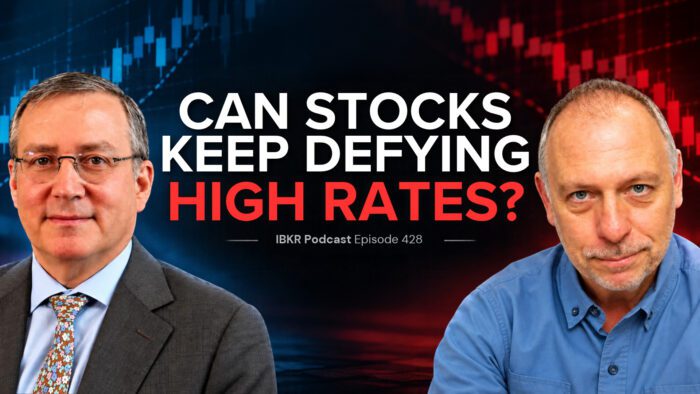
Stocks continue to push higher even as interest rates climb, but how long can that divergence last? Andrew Wilkinson and Interactive Brokers Chief Market Strategist Steve Sosnick discuss rising global yields, AI-driven market concentration, pressure on banks, and why the market may be more fragile beneath the surface.
The following is a summary of a live audio recording and may contain errors in spelling or grammar. Although IBKR has edited for clarity no material changes have been made.
Interactive Brokers Chief Market Strategist Steve Sosnick joins me for this week’s recording. Welcome back to the show, Steve.
Thank you so much, Andrew. It’s great to be with you.
Now let’s set the scene a little bit here. The rally in stocks continues and the tightening cycle at the Fed has become part of the conversation. So now that we’re in October, the FOMC’s got the bit between its teeth, and yet there are still fresh market highs for some indices. It seems to me, Steve, the global bond market has the problem.
So why and how high can interest rates go from here in the bond market?
How high is a very open question because I think as residents of the US and with the Treasury bond market being the world’s largest bond market, we’re very focused on US Treasuries, possibly sometimes to the exclusion of other markets. But I ran some data which I put in a piece at the end of last quarter basically showing that the US was not alone.
Certainly, France is much worse. They’ve got some issues of their own. But when I look at global economies, whether it’s Japan, whether it’s Germany, whether it’s the UK — I didn’t list everything — but if we threw in Australia and, and basically pretty much pick your world economy, it had higher rates.
That’s telling us that this is a global issue. The magnitude of each individual rise in yields is of course subject to its own domestic reality and own domestic conditions, but the global condition of inflationary pressures stemming from energy prices, of higher deficits being seen pretty much worldwide, and the immense needs of the private sector for capital, it’s a competition for money.
And bottom line is, like with anything else, if demand goes up and supply doesn’t change too much, the price goes up. The price of money is the interest rate. How high can that go? There’s a lot of factors there. You tell me when deficits are gonna ease, you tell me when geopolitical factors will allow inflation to ebb, you tell me if the AI build-out is gonna stop any time soon.
These are all factors in it. But to put things in perspective: while these are among the highest rates we’ve seen in the 21st century, the rates we’re seeing now are actually quite normal by historical standards. The issue becomes [that] a lot of money was raised [recently].
We’ve become a much more financially oriented society, much more of a debt reliant society in the past 25 years, which occurred when rates were very low. If you want to incentivize the use of something, make it cheap. Money was cheap, people borrowed it. The problem is a lot of those loans now need to be refinanced or repaid, or backing collateral that has slipped. That’s gonna present some problems.
That ultimately does work to dampen interest rates, but that’s a very painful way to dampen interest rates. So, the level is an open question. The direction seems to be established at least for now, though I think I laid out the reasons why the factors could either stay in place or change.
How long do you think stocks can continue to defy high interest rates?
Stocks can continue to defy interest rates for as long as the leading stocks are perceived to be in an environment where the levels at which they borrow money are below the levels at which they can invest money. And I think — I don’t have it right in front of me, but The Wall Street Journal actually used this as their Money Quote on Monday — which was basically, as long as you think that the payoff from AI development is going to be essentially infinite, what does it matter what interest rate you’re borrowing at?
Right? So, if I’m, insert AI company name here, I’ll use Google just because it’s the one that occurs to me right now. If I’m Alphabet and I need to borrow billions and billions of dollars. And this is coming from a company that used to be a huge cash flow generator that is now borrowing money for its investments, now [going] cash flow neutral to negative. Which, by the way, goes back to the first question about one of the things that’s influencing interest rates.
But if I’m borrowing money to be putting that to work for. If I’m putting that to work for an investment that is perceived to be high double digits or infinite, I don’t know, put a number on it.
Well, I don’t know what some of this is gonna be worth. But if you’re perceiving that the rewards from AI investment are going to be ultra-lucrative, what does it matter whether it costs you an extra 50 basis points more, whether it costs you 1% more, whether it costs you 5% more? You’re pretty much price inelastic at that point.
And so, what it also means is, as long as the stock market is dominated by AI companies, and at this point, the level of concentration at the top is enormous, record highs. Depending on your measure, it’s either as high as it was in the internet bubble or way, way, way, way past it.
There are different ways to look at it, whether it’s by strict market cap, it’s sort… In terms of top 10 stocks, it’s about where it was in ’99, 2000. If you use an index called the HHI — and I don’t remember who the Hs are, it’s like Hershman and Hershleifer or something like that but I don’t have it in front of me [note: it’s the Herfindahl-Hirschman Index] — we are well beyond that.
So, what does this mean? The good part of that right now is if we are concentrated in these names that are borrowing loads of money, but that we perceive will have far higher ROI than the amount they’re borrowing, well, this can last a very long time. At some point, you’ve got to wonder whether external pressures start to weigh on these factors, whether that’s the credit issue, whether it’s deficits, whether it’s credit, whether it’s refinancing.
There are a million other things. But this is why stocks have been able basically to shrug off the interest rate hikes. Most stocks are not shrugging it off, but the stocks that dominate the indices are shrugging it off, and as a result, you can still see the S&P 500 [SPX], or NDX [Nasdaq 100], or pick your favorite top-heavy market cap weighted index, and you can still see it thrive even in a difficult interest rate environment.
And just a reminder for the audience, if you do want to keep exploring, have a look at the Interactive Brokers Campus for more podcasts, market insights, webinars, and educational resources that are designed to help you better understand the markets and the tools available to you at Interactive Brokers. Learn more at IBKRCampus.
Steve, you’ve been following the banking sector for, I don’t know, 30 years maybe. Why have many banking stocks done relatively poorly in a rising rate environment? The reason I ask you that question is because when interest rates go up, financials normally do well, don’t they?
It depends. Remember, the problem a lot of times is we paint financials with a broad brush. So, there are financials that benefit from interest rates. Those that have custody over their clients’ assets tend to do better during higher interest rate environments.
They’re holding these assets and they hold a lot of cash to back them. That cash needs to be invested in safe short-term securities. Higher short-term rates go pretty much straight to the bottom line. I could think of some examples, one of which I’m not allowed to name on this podcast, that have told us very specifically that if rates go up by 25 basis points, it means X dollars to their bottom line.
Then you have the large cap banks, you know, the money center banks, so to speak. They are involved in all sorts of different businesses, so it’s not linear as to how this affects them. Right now, they’re benefiting. Remember I said all these companies are out there borrowing huge amounts of money, many of them doing it with public debt. Guess who’s underwriting that debt? These big banks. Guess who’s trading that debt? These big banks, among others, of course.
So, their bottom lines are being boosted by investment banking and trading revenues, and so they’re not necessarily interest rate sensitive. But of course, if rates get so high — yes, I gave the facetious example before that they’ll borrow money at, you know, double-digit rates if they can invest it more profitably — there is a limit to that. At some point, their investment banking divisions get impaired by higher rates.
Then, of course, you have sort of your more basic banking business, which is done by your money center banks and by your regional banks. They are more or less in the business of borrowing short and lending long. We saw at one point last quarter, a huge compression in the spread between longer term rates and shorter term rates.
So basically the, the business is… If you’re in the business of borrowing money at, call it Fed funds rates or T-bill rates or, or very low interest rates, and then lending it out longer term for mortgages or corporate loans at something priced off of the 10-year security, the tighter that spread gets, the less money you’re making on those loans.
And it got down to about… It was inverted for a period of time during the last couple of years. We’ve since bounced out of that. We’ve been sort of, call it 50 basis points-ish for a while. We got down to about 10 basis points at one point a couple of weeks ago. We’re back sort of around 40 basis points last time I looked.
It’s a more normal shaped yield curve, but it’s not particularly steep. In that situation, what we’ve seen in many cases was a parallel rise in the yield curve, or actually acceleration even at the short end. That’s not necessarily great for the basic banking business that we’re talking about.
So, there’s a lot of different moving parts, and bottom line is that tech is sucking the oxygen out of everything else. In September, only two sectors were up: technology and communication services, which is technology under a different wrapper. That’s it. Everything else was down.
Quarter to date, when I looked at the third quarter, there were four sectors that were up. The best was energy because that was very front-loaded at the beginning of the quarter, when oil prices jumped. Healthcare was up because defensive stocks had their brief moment and healthcare stocks were beaten up. The other two were the same two technology sectors.
So, everything else stinks. I guess the other bottom line about that is that anything consumer-facing truly stinks, and a lot of your banks are consumer-facing. Consumers are stretched. And, the level of interest rates is keeping them from… They’re not going out and buying houses necessarily as aggressively.
They’re not doing home improvement necessarily as aggressively ’cause it’s all gotten more expensive. Buying a car is, car loans are more expensive. So, all this stuff is putting a damper on the banking activity. I think there are several different factors. I don’t hate the banks, but this is why, and we’ll learn next week what they have to say for themselves because they typically kick off earning season. I think JP Morgan [JPM] is a week from… We’re taping this on the 6th. I think it’s a week from today, the 13th.
Steve, are those big divergences in the stock market a significant problem, do you think?
They can be. And the issue here is, the divergences, um… I like to think of it as we’re playing this big game of Jenga, and, you know you could build the tower really high, but at some point, you need a solid foundation. If you keep pulling out little blocks from the bottom of the foundation, at some point it makes the… And been putting them at the top of the tower, which is really basically what we’re doing… taking them out of the bottom, putting them up at the top, it inherently makes it unstable.
It’s probably not a coincidence that the periods that showed the greatest market concentration were either the internet bubble era. There was also a lot of high concentration just ahead of the global financial crisis. So yes, these can be precarious times for stock markets.
And I’m gonna assert that as long as the market – again, it all comes back to this — as long as the market believes that AI is the panacea for all types of profits, this can prolong itself for a while.
At some point, if it’s perceived that this is not a profitable activity, that basically we’re just \ spending billions and billions of dollars for something that will eventually add to corporate profits, or eventually add to productivity in society, but not necessarily at the pace we’ve hoped or on chips or data centers that are going obsolete before they can become truly profitable, that will present a bit of an issue here.
And so, if we’re in a situation now where if the top stocks topple, where do you go? And that becomes the real issue for stock markets.
Right now, momentum, inertia, all that is helping and pointing in the right direction. But it increases the fragility, and that’s why I keep coming back to that Jenga analogy.
Brilliant. Steve Sosnick, thank you very much for joining me
My pleasure, Andrew. Talk again soon
Steve is Interactive Brokers’ Chief Market Strategist. You can read more on the Interactive Brokers campus, which is under the Education menu, and you’ll see Steve’s insights under Traders’ Insight. Thanks for joining me, and don’t forget to like and subscribe wherever you download your podcasts from.
Bye for now.
Useful links: Quarterly Data in this piece: Yay! The Jobs Report Stinks! | Traders’ Insight
WSJ Money Quote, Monday October 5th, 2026
New to Interactive Brokers?
The analysis in this material is provided for information only and is not and should not be construed as an offer to sell or the solicitation of an offer to buy any security. To the extent that this material discusses general market activity, industry or sector trends or other broad-based economic or political conditions, it should not be construed as research or investment advice. To the extent that it includes references to specific securities, commodities, currencies, or other instruments, those references do not constitute a recommendation by IBKR to buy, sell or hold such investments. This material does not and is not intended to take into account the particular financial conditions, investment objectives or requirements of individual customers. Before acting on this material, you should consider whether it is suitable for your particular circumstances and, as necessary, seek professional advice.
The views and opinions expressed herein are those of the author and do not necessarily reflect the views of Interactive Brokers, its affiliates, or its employees.












Join The Conversation
For specific platform feedback and suggestions, please submit it directly to our team using these instructions.
If you have an account-specific question or concern, please reach out to Client Services.
We encourage you to look through our FAQs before posting. Your question may already be covered!