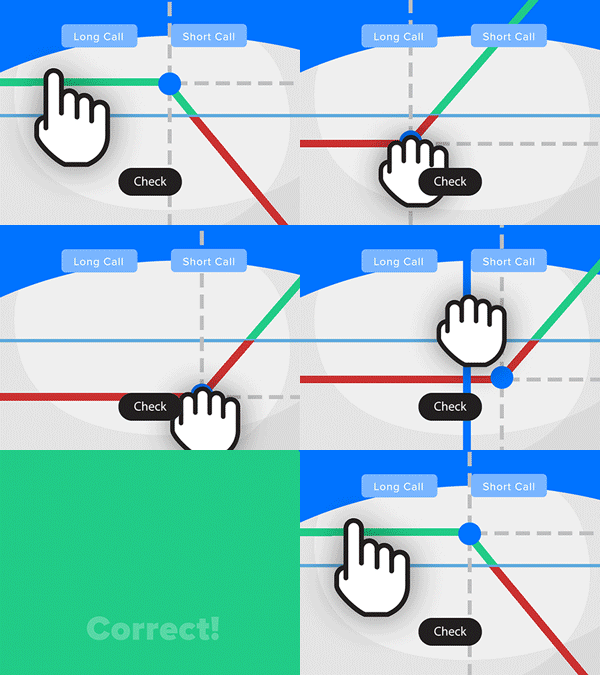
- Solve real problems with our hands-on interface
- Progress from basic puts and calls to advanced strategies
Interactive Options Course
Posted October 27, 2026 at 1:23 pm
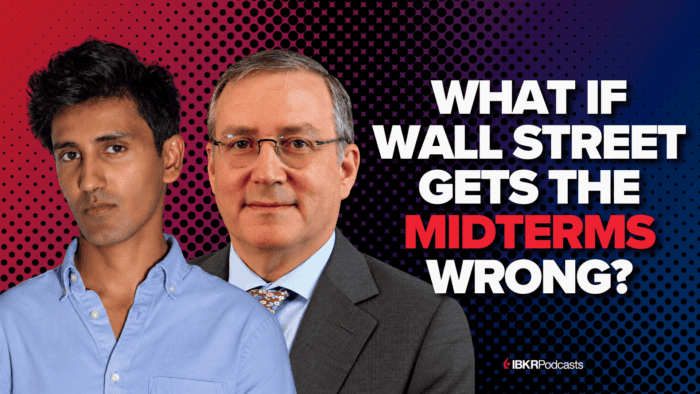
What if Wall Street is betting on the wrong election outcome? With the 2026 midterms fast approaching, Democrats are eyeing a congressional comeback, President Trump’s economic agenda hangs in the balance, and prediction markets are making some bold calls.
But how much can investors really trust the odds? Interactive Brokers’ Chief Strategist Steve Sosnick joins IBKR Podcast Producer Vrushabh Doshi to break down the stakes, revisit past election surprises, and explore what a political shake-up in Washington could mean for markets. Could the biggest surprise come after the votes are counted? Stay tuned to find out.
The following is a summary of a live audio recording and may contain errors in spelling or grammar. Although IBKR has edited for clarity no material changes have been made.
Hello, and welcome back to another episode of the IBKR Podcast. I’m Vrushabh Doshi, and I’ll be your host today. Some of you might be wondering who I am. I’m actually the podcast producer here at Interactive Brokers, so I’m usually the one behind the scenes putting these episodes together. But as something of a political junkie myself, I couldn’t resist jumping in for this one.
We’re just about a week away from the midterm elections, and there’s quite a bit at stake, not just politically, but potentially for markets as well. So we’ve invited none other than Steve Sosnick, the Chief Strategist here at Interactive Brokers. Many of you have obviously seen Steve on the news, on CNBC, Yahoo Finance, Fox Business. You’ll see him all over the place. Steve, welcome back to the show.
Thank you so much, Vrush. I’m glad to be part of your maiden voyage, as it were.
It is an honor to have you for my first one. So we’ve got a fascinating election on our hands. It seemed like six months ago, the idea of Democrats taking back both chambers of Congress was pretty far-fetched. But obviously, there are cost-of-living issues, the Iran war, tariffs, and a whole host of other issues that voters seem to have a lot of feelings about.
And the question is, will this be reflected next week in the elections? As of this morning, the major prediction markets are putting the Democrats’ chances of winning the Senate at somewhere around 65%, and the House obviously appears even more likely to flip.
So let’s start there. Steve, if the prediction markets are increasingly expecting Democrats to take both chambers of Congress, how much of that outcome do you think Wall Street has already priced in?
I think it’s priced in a lot of it. I think the idea of a blue House has been priced in for some time. And that situation, the market doesn’t really mind. Typically, markets have never really minded the idea of a bit of gridlock. Markets have typically done well over time with a divided Congress versus the president. I don’t think the market had, or even has yet, completely factored in the idea of a Democratic Senate. And that does change things a bit more because it will make it much more difficult for the president to get people approved. The Senate has some unique responsibilities vis-à-vis the House in terms of approving judges and cabinet members.
This could get a lot stickier in terms of the Senate approving justices and the like. I don’t see some of the people who the president has approved now necessarily having gotten through a Democratic Senate. I don’t know that people with similar mindsets would have an easy time getting through a Democratic Senate.
Which means you have temporary agency heads all around and just ongoing difficulties that way.
There are some who really kind of dreaded the idea of a blue wave if it meant too much democratic socialism. I’m not sure that really occurs. I’m not sure that America’s ready to lurch from one direction to the other. I think it’s more of a lurch back to the middle.
The best analogy I saw was, I think his name is Charlie Cook from the Cook Political Report, who termed this not so much a blue wave as a red undertow.
People are miserable. When people are miserable, they blame the party that’s in power. Right now, you’ve got Republicans across the board and a very unpopular president.
And so I think that means people moving away from the incumbent party toward the out-of-office party doesn’t necessarily mean that people are in full agreement with the Democrats’ platform. But I think it’s more of a sign of disapproval with the way things are going, and you see that from consumer sentiment numbers.
Well, Steve, on that note, let’s jump back four years. There was a much-anticipated red wave during the 2022 midterm cycle. If I recall, President Biden was dealing with high inflation, there were concerns about the economy, and his approval ratings were similarly low.
Republicans were expecting a massive victory, but the red wave turned out to be more of a ripple, I think. They narrowly took the House, and Democrats managed to hold the Senate.
So now, four years later, we’ve got a Republican president facing familiar economic frustrations. And this time, it’s obviously Democrats hoping to flip Congress.
So are investors at risk of making the same mistake of treating political predictions as foregone conclusions? And what happens to markets when election results don’t match expectations?
Well, we’re taping this on Monday morning. Brazil gives us a very important case study of that right now.
Brazil has a different mechanism for electing its leadership. You have to get over the 50% threshold, whereas in the U.S., in most states, you don’t have to get over 50%. You just have to be first past the post.
In the presidential election, it’s the Electoral College, so you do have the obvious possibility, because it’s happened recently, of a president winning the Electoral College but not winning the popular vote.
So it’s a little bit different. But when Bolsonaro won the first round, which he was predicted to do, it became sort of a foregone conclusion that he would win the full election when it was just a two-person runoff to get to 50%.
And markets reacted accordingly.
Now again, the difference, I think, in their system between left and right is far more stark, even than ours. And I’m not going to by any means say that I’m an expert in how Brazil governs. Believe me, I’m not going to go out on a limb there.
But basically, the markets rallied very sharply when it looked like a more right-wing government was going to be in power. And as we’re speaking, Brazilian markets are crashing because polls and prediction markets were wrong. It was a very surprising upset.
So can things change? Yes. I think some of this will have to do with where we are at this point. Again, the prediction markets are very solid about the House, and pretty much everything I’ve read makes it seem almost impossible that the House doesn’t change leadership.
But boy, things can change in a hurry in this country, obviously, and they do. But that one seems a little more difficult.
The Senate, as you noted, was looking pretty much like the Republicans would hold serve. Now it doesn’t. I think a lot of that has to do with degree.
Remember, even if it ends 50/50, it’s still a Republican Senate because the vice president is a Republican, and he holds the deciding vote. But what it also means is, I think in either direction, you’re not going to get past a filibuster-proof margin. I think that’s essentially all but impossible.
So in that sense, you still have a situation where you’re going to have to have consensus in the Senate. It’s just more a matter of degree.
But I think, in either sense, it’s really how the parties choose to govern. What do they see their mandate to be? Is it to bring the country back toward the center? I think the markets will be okay with that.
Whether or not that’s something the prediction markets can really capture is another question. If it’s to lurch to a very left, Democratic socialist-leaning agenda, I don’t know that markets will be quite as okay with that.
But I don’t know that polls or prediction markets are able to capture that. In the case of prediction markets, I trust their wisdom. They’re not always right, as we just learned in Brazil. Nothing is always right. But I think a zero-to-100 scale with a binary outcome doesn’t necessarily capture the nuance.
And that’s okay. Someone asked me last week—I was actually at a prediction markets conference. I spoke at one on Friday, and I’ve obviously been up to my armpits in discussions about prediction markets. It was an excellent experience.
Off camera, someone asked me, “What is the role of pollsters in a world where prediction markets dominate?”
And I said, “There’s still room for both,” in the sense that there’s more analysis that’s required.
I think polling has issues, and there are some very prominent pollsters, one of whom I’ve actually known since college and who’s still a close friend of mine, who have come out and said, “Republicans don’t answer polls to the same degree Democrats do.”
So you then have to interpret polling data. With prediction markets, we don’t know if there’s specifically a political bias among those who trade prediction markets. I haven’t the slightest idea.
They’re new, so we’re going to have to sort through all this. It’ll take some time. As with anything else, there’s a lot more nuance. But obviously, the more tools we have to get us through that nuance, or to get us to a point of understanding, the better we are.
Well, okay. In that case, let’s pretend that the 65% chance is on the low end. Hypothetically, if the Democrats do win the Senate, what does that mean for President Trump’s economic agenda for the next two years?
I think he’s going to have to have his veto pen ready because he’s not necessarily going to like what comes out of this. Certainly, he’s really not going to like what comes out of the House.
But again, the Senate, because of the filibuster rule, tends to need something that’s more bipartisan, that’s a bit more palatable to both parties.
Someone was just asking me before we took this call about the action in drone stocks recently, how they rallied on expectations of more defense spending, and they’ve sold off fairly sharply as it looks like political winds have changed because maybe the Defense Department won’t get everything it wants.
The question I was asked was, were they in a bubble? And I said it’s always difficult to separate enthusiasm from a bubble. I’m not going to say one way or the other.
I think they did get a lot of money into a small industry, so the valuations got stretched.
But I think that’s illustrative of the way the market thinks. These stocks were banking on the idea of ever-increasing defense spending. I think it’s not necessarily wrong to think that they are elemental to the way warfare is conducted in the 21st century.
But I think industries that have relied upon governmental contracts or governmental largesse are going to require some retrenchment.
I think there are going to be some very difficult questions being asked about spending, Social Security, and tax cuts.
Take, for example, the Social Security debate, which somebody’s got to have at some point. It’s the third rail of American politics, but at some point, somebody’s going to have to risk stepping on it.
Right now, with Social Security, those with high incomes have a cap on the amount of income that’s subject to Social Security tax. Do you remove that cap, as was done for Medicare several years ago?
I don’t know. That’s going to be an interesting debate, and I think the nature of that debate changes based on whether it’s Democrats or Republicans.
Do you means-test for Social Security? Somebody who’s earning a lot of money, might you throttle back Social Security payments?
The argument on one hand is, “I’ve paid into this all my working life. Don’t take this away from me.”
The counterargument is, you weren’t paying into it. It’s not like your 401(k). All the Social Security taxes I’ve paid throughout my life have gone to my parents’ generation, to people who were no longer working.
And while I have the expectation and the hope that I’ll see something, I think these are all questions that are fair to ask, and I think they need to be asked.
And I think the answers that come from Congress are going to be different from a Democratic Congress than a Republican Congress. Not necessarily radically different, but that’s something that’s going to polarize people.
And so you have the interesting situation where, yes, Congress in some ways is supposed to be a check and balance on the executive branch. In many ways, does the executive branch, does the president, act as a check and balance on Congress using the veto pen?
It’s going to be very different if this comes to pass. I don’t know that it’s market different, though. It’s politically different.
I think, in general, these are not necessarily… A lot of times, the question I ask whenever there’s geopolitics, and this is on the politics side, not the geo side, is: What does this mean for Microsoft’s bottom line?
Think of your favorite companies and how this impacts them. I think that’s a useful exercise anytime you’re talking about geopolitics. How does this influence certain companies that you’re involved in?
The market’s not great at these big, broad effects that have secondary linkages. The market’s very good at how it affects the bottom line of companies.
So if you think in those terms, it’s very important, but it’s not necessarily market-moving day one, minute one.
Well, there’s a fairly well-established historical pattern of stocks performing pretty strongly in the year following midterm elections. Is there a good reason for that, or is it one of those market stats that sounds more meaningful than it really is?
I think some of each. The market performed great the year after the last two midterm elections because they got throttled after the midterms, right?
Well, actually, I shouldn’t say that. In 2022, we got throttled before the midterms and then sort of bounced. The bottom was around early November of 2022.
That was probably more to do with the Fed than politics because the Fed had been raising rates. They’d signaled that they were less likely to do so. Also, it’s probably not a coincidence that that’s literally the time ChatGPT was introduced. So I think the market shifted focus.
2018 was a rotten year for markets, and we ended that year ugly. Big sell-off. There was a lot of year-end selling in that one.
So we started the following year in the hole, dug our way out of it, and worked our way through it.
And then, at the end of 2019, the Fed had to step in and basically bail out the repo markets, which was taken as a big monetary shot in the arm. And that led us to extraordinarily exuberant markets until COVID hit.
So politics has some role, but I think, yes, it’s history. But when it’s something that happens every four years, it’s not exactly high-frequency data. It’s not something that happens every week or every month.
And obviously, circumstances and the players change to a large extent. So take it for what it’s worth.
Yes, the third year of the presidential cycle is usually a good one. But that’s probably also because the second year is usually the worst.
We have not really shown any signs of this being a bad year from an index point of view. We’ve been showing some cracks recently, but hardly a break in the investment thesis.
A lot of the next year’s returns have to do with the prior year’s ending point. So let’s see how that goes. I’m not going to read too much into it.
I’ve written this many times: Seasonality is a very fickle friend.
Interesting. Okay, one final question before you go, Steve. Is there one thing that you’re going to be looking out for on election night or in the days afterward that investors should be paying attention to?
Steve Sosnick
Yeah. I think on election night, I’m going to be looking to see, if there is in fact a blue wave or a red undertow, well, I guess for starters, is it a blue wave or a red undertow?
Are people just moving away from the party in power, or are they moving toward the Democrats? Or are they just saying, “You know what? We’ve had enough of the group that’s running the country right now. Let’s try the other guys.”
Or are we really enthusiastic about changing the politics and going in a much more left-wing direction in the country?
My gut tells me it’s more of a shift back to the middle and a rebuke of the party that’s in power.
Again, let’s go back to consumer sentiment. A lot of people are miserable. When people are miserable and the current president has very low approval ratings, that’s the way it tends to go.
It’s more of a vote away from the status quo than a vote toward a different status quo. So let’s see how that goes.
The other thing, quite frankly, is there’s some disquieting talk about how elections are going to be conducted and how the counting is going to go.
A lot of the talk this weekend was, in many ways, almost a preemptive move to invalidate the results in Alaska if they favor the Democrat, despite it having been adjudicated under state law.
If there’s a widespread effort to try to repudiate the will of the people in these elections, that’s something that I think markets will not bear.
And I do think international investors will react very negatively because one of the great things about America is our stable system of government and the checks and balances and all that.
And I think there’s a feeling that if that is hindered, that’s not going to be popular among internationals, let’s put it that way.
Well, if the election is indeed as spicy as you’re suggesting, we might have to have a follow-up episode in the coming weeks. So anyway, we’ll stay tuned and see what happens.
Steve Sosnick, Chief Strategist at Interactive Brokers, thanks so much for joining me on my inaugural episode of the podcast.
Thank you so much. And when you’re a big-time podcaster, you can point back to this, and I’ll be the guy who got you kicked off. Got started, not kicked off. That’s the wrong way to put it. Who got your podcasting career kicked off.
I appreciate it. And to the audience, you can find IBKR Podcasts wherever you download your podcasts, including Spotify, Apple Music, and YouTube.
Also, feel free to check out IBKR Campus. There’s plenty of educational material there, including webinars, articles, lessons, and our podcasts as well. It’s all great information.
And Steve, we’ll see you next time.
Sounds great. And everybody, get out and vote. Just do that. Let’s have a good, clean, fair election with a lot of participation.
Indeed. Get out and vote. We’ll end it there.
Okay.
All right, Steve. We’ll see you.
Thanks, Vrush. Bye-bye.
The analysis in this material is provided for information only and is not and should not be construed as an offer to sell or the solicitation of an offer to buy any security. To the extent that this material discusses general market activity, industry or sector trends or other broad-based economic or political conditions, it should not be construed as research or investment advice. To the extent that it includes references to specific securities, commodities, currencies, or other instruments, those references do not constitute a recommendation by IBKR to buy, sell or hold such investments. This material does not and is not intended to take into account the particular financial conditions, investment objectives or requirements of individual customers. Before acting on this material, you should consider whether it is suitable for your particular circumstances and, as necessary, seek professional advice.
The views and opinions expressed herein are those of the author and do not necessarily reflect the views of Interactive Brokers, its affiliates, or its employees.
Futures, event contracts, and forecast contracts are not suitable for all investors. Before trading these products, please read the CFTC Risk Disclosure. For a copy, visit our Warnings and Disclosures Page.
Event Contracts are only available to eligible clients, 21 years and older, of Interactive Brokers LLC, Interactive Brokers Canada Inc., Interactive Brokers Hong Kong Limited, Interactive Brokers Ireland Limited and Interactive Brokers Singapore Pte. Ltd. ForecastEx Forecast Contracts on US election results are only available to eligible US residents.
Displayed outcomes and prices are based on real-time market sentiment from ForecastEx LLC, an affiliate of IB LLC, as well as other CFTC-registered DCMs, including Kalshi and CME. For more information, see ibkr.com/realfex Note: Real-time market sentiment updates are only active during exchange open trading hours. Updates to current market sentiment for overnight activity will be reflected at the open on the next trading day. This information is not intended by IBKR as an opinion or likelihood of a potential outcome.
This is commentary on economic, political and/or market conditions within the meaning of CFTC Regulation 1.71, and is not meant provide sufficient information upon which to base a decision to enter into a derivatives transaction.
Interactive Brokers LLC is a CFTC-registered Futures Commission Merchant and a clearing member and affiliate of ForecastEx LLC (“ForecastEx”). ForecastEx is a CFTC-registered Designated Contract Market and Derivatives Clearing Organization. Interactive Brokers LLC provides access to ForecastEx Forecast Contracts for eligible customers. Interactive Brokers LLC does not make recommendations with respect to any products available on its platform, including those offered by ForecastEx.











Join The Conversation
For specific platform feedback and suggestions, please submit it directly to our team using these instructions.
If you have an account-specific question or concern, please reach out to Client Services.
We encourage you to look through our FAQs before posting. Your question may already be covered!