- Solve real problems with our hands-on interface
- Progress from basic puts and calls to advanced strategies
Interactive Options Course
Posted October 22, 2026 at 12:09 pm
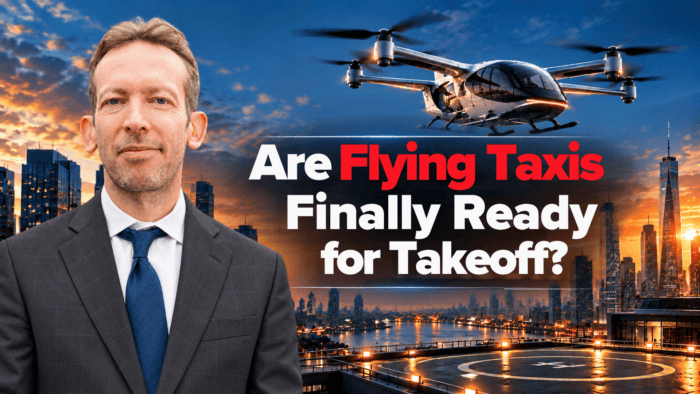
Could flying taxis transform urban transportation and become the next major investment opportunity? Interactive Brokers’ Andrew Wilkinson speaks with Alexander Gunz of Heptagon Capital about the emerging eVTOL industry, the technology driving its growth, and the regulatory, economic, and infrastructure challenges standing between flying taxis and widespread adoption.
The following is a summary of a live audio recording and may contain errors in spelling or grammar. Although IBKR has edited for clarity no material changes have been made.
Welcome to this IBKR podcast. I’m Andrew Wilkinson. Today we’re discussing a technology that could fundamentally reshape urban transportation: electric vertical takeoff and landing aircraft, better known as eVTOLs or flying taxis.
What was once the stuff of science fiction is now attracting investment, regulatory attention, and significant technological development. Joining me is Alexander Gunz of Heptagon Capital, whose latest thematic research explores the growing case for eVTOLs and the potential opportunities and challenges ahead.
Alex, as always, welcome back to the program.
Absolute pleasure to be here, Andrew, and it is indeed a super exciting topic, so I’m sure we’ll cover a lot of ground.
It certainly is. And your article is available at heptagon.com, and we’re gonna base a lot of today’s discussion around that. But I do encourage people to go and read this excellent research.
So, Alex, for investors who hear the term flying taxi and think of a futuristic helicopter, what exactly is an eVTOL? And why has this technology suddenly become viable now?
I actually quite like the term flying taxi, Andrew, and I guess really the best or simplest way to think about this is that it’s effectively an Uber with rotors that will fly in the air.
But almost like if we take a step back, you know, the concept of flight is clearly something that’s always interested us as humans, really since the dawn of imagination. Think about the myth of Icarus, and specifically when it comes to flying taxis, when Ford was at its apogee maybe 100 years ago, Henry Ford was among the early pioneers of this concept. And really fast-forward to today, you characterized literally what an eVTOL stands for, i.e., an electric vertical takeoff and landing aircraft. It’s a bit of a mouthful for everyone. That’s why I quite like flying taxis. Others call it urban air mobility.
And the reason why we’ve moved from Icarus, we’ve moved from science fiction, we’ve even moved from Henry Ford’s prototypes into something where you can on occasion see in the skies in Manhattan, maybe even on the outskirts of London, and maybe when things are more back to normal in the Middle East, in China too, I should add, you can actually see prototypes in the sky.
And the main reason why these prototypes are available today and it’s all become possible is, as with so many other technologies that we’ve discussed on this program, in this format, in our published work on our company’s website, as you noted, is that costs have come down and the technology has improved.
And most fundamentally with regard to eVTOLs, the density or the bang for your buck, if you will, you get from a battery pack that you can actually install in one of these vertical takeoff and landing aircraft, it’s come down by about 50% in the last five years, which means that the cost and indeed the power, the ability to get you from A to B, has improved massively.
Your recent research, Alex, makes the case that flying taxis could become a major investment theme. What’s the core argument that makes you optimistic about the industry’s future?
I think we’ve touched on part of it already, Andrew, i.e., technology and cost. The two go hand in hand, and logically we’ve seen this with everything, say, from launching payloads into space that we discussed earlier on in your program to, let’s say, even something fairly ubiquitous like solar panels. As cost comes down, the industry scales.
So that’s one side of the equation, and I guess what I’d also add in on the technology side, you know, we can’t really do a conversation like this without referencing AI. AI’s been massively helpful in this industry, as much as anything when you’re prototyping new aircraft types, when you’re sort of running simulations and so on. And I guess really just to round out the technology point fully for listeners, whereas five years ago, if you wanted to build an eVTOL prototype, it might have cost you somewhere between $5 and $10 million. Today, that’s come down to about $1 to $3 million, which means the economics are obviously more viable.
So that’s one part of the story, as I said. The second part of the equation is really this idea of regulation/technological supremacy. As everyone will be aware, there is a sort of quasi-Cold War, if I can say that, going on between the US and China at the moment in many, many different aspects.
And really the idea is that if you can dominate this new form of transport, you can set the global standards, you can define the global supply chains, and there is also a sort of semi-military angle here. A lot of the technology that’s being used in eVTOLs has logical applicability into the drone space as well. Then this is an avenue that I think countries, and by extension their regulators, are very, very keen to promote. So what we’ve seen in the US in the last couple of years has actually been a fast-tracking of legislation in order to make this industry more viable. Equally, when China released its last five-year plan, the idea of urban air mobility was categorized as being one of the key strategic priorities for the country.
So really, just to summarize for the benefit of listeners, it’s a combination of factors: technology and cost, plus regulation and political desire for supremacy.
So Alex, if the technology succeeds, what transportation problem does it solve, and how large could the market opportunity ultimately become?
It solves a really major transportation problem, in our opinion, and this really defines the size of the market. And really the simplest way to explain it is that if we think about transport today, and if you’re in either London, where I’m based, or in Manhattan and you want to get from the center of town to the airport, as everyone will be aware, it’s a very complicated and time-consuming process.
It’s roughly an hour from Manhattan to JFK, let’s say, for argument’s sake. The reason why it’s so complicated is because your journey is defined by a 2D grid. Everything happens in two dimensions, and if you want to expand the size of that 2D grid, it is expensive and time-consuming, i.e., you either need to think about widening roads or building better rail networks.
The sheer attraction or the opportunity set, if you will, with urban air mobility is that you’re opening up another dimension. In other words, transportation moves from being 2D to actually becoming 3D because you can actually go up in the air now.
We used the expression in our report—we’re not the only people to have said this—is that the sort of thousand meters that exists basically between the ground we all walk on and then heading upwards, it’s arguably humankind’s most underutilized resource.
So, you know, that one hour that we talked about, for argument’s sake, Manhattan to JFK, Central London to Heathrow, that can shrink to 10 minutes with an eVTOL. That’s the prize. If you look at, to answer the second part of your question, if you look at the projections, the work we’ve done, the work that consultants have done, that investment banks have done, you fast-forward 10 years and the industry, all other things being equal, could be worth something in the order of $30 billion.
That, I might stress, could even, if anything, be a conservative estimate in the sense that once you’re actually getting true substitution across those verticals we talked about, away from road, away from rail, into the sky, if you actually start incorporating logistics into this as well, so you think about how many couriers there are at the moment delivering food, delivering Amazon packages, whatever it might be, then that sort of TAM figure, the addressable market figure that we talked about, maybe it’s not $30 billion, maybe it’s 10 times that size.
As you look across the industry today, Alex, which types of companies are best positioned to benefit from the rise of flying taxis?
I guess I’d begin, Andrew, with the caveat that, you know, it’s sort of easy, in inverted commas, to call out themes, harder to identify beneficiaries, particularly at such a nascent stage of the industry. A few observations, though, that I think will hopefully resonate and make sense for listeners would be as follows.
Number one, if you look at the US, and the same is probably true of China as well, the industry has already gone through a degree of consolidation. So in the US, there are two major listed companies. They’re sort of dominating the space, and really crucially, why, despite the fact they’re loss-making, we have confidence that they have the scope to succeed is because they’ve partnered with airlines, so the ability to hand off at one end of the journey, and they’ve also partnered with auto manufacturers in order to get that knowledge, that advantage in terms of the supply chain, the critical parts.
So that’s one group of companies, the actual eVTOL listed players. The second category of companies that we think could clearly benefit would be the demand aggregators. An obvious name here would be a business like an Uber. And the simple idea is, just like we’ve talked about again on this program in the past and, you know, how the world may change with autonomous vehicles, actually having more supply, a business like Uber would contend, will actually grow demand. And this is, you know, a very common argument the platform aggregators make. It’s a view that we agree with. And I think that’s an important angle to consider.
The third part is really, again, a topic we discuss on this program, an area we like to play when we think about investing, is to consider the metaphorical shovel makers.
So there will clearly be a huge supply chain attached to scaling urban air mobility. It’s not just physical components, but one area that we think is underappreciated both as an opportunity for investing, and we may well come on to talk about this as a risk in terms of determining the success of the industry, is actually managing airspace. So in other words, if you are a business that develops software for air traffic control management, I would contend that you could be potentially very well placed to benefit from more traffic in the skies.
What then are the biggest obstacles that we’re gonna have to overcome before flying taxis become a common part of everyday transportation?
I think the answer, Andrew, is much less about, does the technology work? There’s not really a debate in that respect. It’s much more about how quickly adoption broadens from here, and I’d say there are a handful of factors that listeners need to consider.
You know, number one, I’d begin with regulation, and admittedly, as we touched on earlier, regulation is being fast-tracked at the moment. But if I am the FAA, the Federal Aviation Authority that is in the US, or an equivalent body in another geography, this is still a totally unprecedented area, and regulation will obviously proceed at the pace it does. We’ve seen in other industries it can be a potential bottleneck.
Number two, and linked very closely to this idea of regulation, is the concept of safety. Again, I recall we discussed this when we talked about autonomous vehicles, but clearly if you have one high-profile accident, and it would obviously be much higher visibility, if you will, in an eVTOL sense than in a car sense, then that could set the industry back some way.
The third factor I’d talk about is just very simply economics. As we said, it’s less about the technology, but designing something in a lab as opposed to scaling it in the real world, as we all know, are two very different things. So batteries, when they’re being used constantly and your vehicle is sort of traveling from a vertiport, if you will, a heliport downtown to the airport and back again 20 times a day, the rate of battery degradation is still unclear.
Equally, I imagine in many financial models, the biggest cost item, just like, say, it is for an Uber today, is actually the physical human driver. If, for whatever reason, the regulation is slow in sanctioning autonomous eVTOLs, then again, that can have a very big impact on the economics.
The final factor I’d call out is just simply the practicalities. We touched on the issue of just how you physically manage airspace. Clearly, air traffic control at the moment contends with airplanes at a higher altitude, but at that lower altitude you’ll have eVTOLs competing with conventional helicopters, you’ll have them competing with drones as well, and how you manage that airspace efficiently remains to be seen. Related to that is the final point I’d like to make on this topic, apologies for the length, and it’s simply just how you scale all of the related infrastructure.
So think about it like this: if this dream is going to become true, the idea is moving people out of a city center to an airport, let’s say, very quickly, or from an airport to a sports stadium. Those are sort of classic use cases. But the very areas you’re looking to move people out of tend to be incredibly dense at the moment with people, with buildings. If you’re constructing a vertiport, it’s not simply just putting a nice pad on top of a skyscraper. You need an area where you can drop people off, pick them up.
You need charging stations, as we talked about, for eVTOLs. You need integration, say, by an airport into that part of the physical infrastructure. And this aspect of the industry, whilst crucial, is perhaps not being fully costed or appreciated, to our mind, at present.
So from the perspective of an investor who’s interested in this theme, are there milestones over, say, three to five years that’ll tell us whether the industry’s truly gaining traction, Alex?
Two things I’d highlight, Andrew. I mean, number one, most simply, I’d say to everyone is just watch the skies. And, you know, the more trials that work and work viably, the greater confidence we can have.
A couple of quick observations. The region where there appeared to be most progress was actually the Middle East because you have, as we touched on, a lot of space there, a lot of disposable income as well. And clearly events since late February have derailed progress a little bit in that respect. Hopefully, things get back to normal in that region soon.
Another interesting milestone is project forward to the Los Angeles Olympics. They’re less than two years away, and as you’ll know, as many of our listeners will know, Olympics are often used by any country as a way of showcasing how cool they are, how advanced they are, how they’re leaders in a certain area.
And based on comments that the Trump administration have made very publicly, they want eVTOLs to be part of the LA story, and that was the point about the idea that you land at LAX and then you can get transported in an eVTOL right to the stadium. So that would be an important use case to watch for. The other obvious thing, and related to those prior comments, would simply be the idea of cost. I.e., today, if you wanted, hypothetically, let’s say in Dubai in six months’ time or even in New York and London, to trial an eVTOL, the cost of actually doing it is akin or very similar to riding in a helicopter.
That’s far out of reach for the vast majority of people. If that cost actually, say, comes down to that of an Uber Lux, which is the projection of the industry, is perfectly possible on a five-year view, then I think you’ll actually see usage growing quite significantly.
If you fast-forward 10 years then, Alex, what does success look like for the eVTOL industry, and what would convince you that flying taxis have become a meaningful part of the global transportation network?
I think we’ve answered most of this already, Andrew, but I’d really sort of summarize it in three words. It’s a function of regulation, safety, and practicality. And if we can deliver on all of those aspects, then, as mentioned, the technology clearly works. If the economics work as well and taking an eVTOL is as normal as taking a taxi or a train, then I think the industry can be considered a success.
I’m certainly super excited about taking an eVTOL. Not sure about you, but that’s really gonna be the key test. Will the average person be happy taking an eVTOL? And for me, I’ve certainly got my hand up already.
Yeah, I can’t see why I would not. I’m excited by the prospect of it. In fact, a guest on another podcast, also based in London, has used them from central Manhattan over to JFK. Swears by them.
Yeah. No, I mean, it’s just like the notion, we talked about this on a prior podcast, you know, when I was in California and had a chance to use the Waymo for the first time, I had absolutely no fear of doing it. And I think the idea of being willing to embrace technology if it solves fundamental problems is absolutely core to, you know, how we as a species progress and also, you know, how we in the world of investing think about sort of translating ideas into practical action.
Where’s your money right now? When will you take your first flying taxi? Will it be London, New York, Los Angeles, Dubai, Hong Kong?
As soon as I possibly can. But, you know, based on what I know today and where my travel might most likely take me, I would imagine it would be on the West Coast of the US.
Very good. It’ll be exciting to see whether flying taxis become one of the defining transportation developments of the coming decade. Thank you very much to Alex Gunz of Heptagon Capital for joining me today.
Always a pleasure. Thank you, Andrew.
All right. And thanks to our listeners for tuning in to this IBKR podcast. For more market insights, investment themes, and educational content, don’t forget to visit IBKR Campus, and wherever you download your podcast from, don’t forget, you can always subscribe to future casts from there.
Bye for now.
New to Interactive Brokers?
The document is provided for information purposes only and does not constitute investment advice or any recommendation to buy, or sell or otherwise transact in any investments. The document is not intended to be construed as investment research. The contents of this document are based upon sources of information which Heptagon Capital believes to be reliable. However, except to the extent required by applicable law or regulations, no guarantee, warranty or representation (express or implied) is given as to the accuracy or completeness of this document or its contents and, Heptagon Capital, its affiliate companies and its members, officers, employees, agents and advisors do not accept any liability or responsibility in respect of the information or any views expressed herein. Opinions expressed whether in general or in both on the performance of individual investments and in a wider economic context represent the views of the contributor at the time of preparation. Where this document provides forward-looking statements which are based on relevant reports, current opinions, expectations and projections, actual results could differ materially from those anticipated in such statements. All opinions and estimates included in the document are subject to change without notice and Heptagon Capital is under no obligation to update or revise information contained in the document. Furthermore, Heptagon Capital disclaims any liability for any loss, damage, costs or expenses (including direct, indirect, special and consequential) howsoever arising which any person may suffer or incur as a result of viewing or utilising any information included in this document.
The document is protected by copyright. The use of any trademarks and logos displayed in the document without Heptagon Capital’s prior written consent is strictly prohibited. Information in the document must not be published or redistributed without Heptagon Capital’s prior written consent.
Heptagon Capital LLP, 63 Brook Street, Mayfair, London W1K 4HS
tel +44 20 7070 1800
fax +44 20 7070 1881
email london@heptagon-capital.com
Partnership No: OC307355 Registered in England and Wales Authorised & Regulated by the Financial Conduct Authority
The analysis in this material is provided for information only and is not and should not be construed as an offer to sell or the solicitation of an offer to buy any security. To the extent that this material discusses general market activity, industry or sector trends or other broad-based economic or political conditions, it should not be construed as research or investment advice. To the extent that it includes references to specific securities, commodities, currencies, or other instruments, those references do not constitute a recommendation by IBKR to buy, sell or hold such investments. This material does not and is not intended to take into account the particular financial conditions, investment objectives or requirements of individual customers. Before acting on this material, you should consider whether it is suitable for your particular circumstances and, as necessary, seek professional advice.
The views and opinions expressed herein are those of the author and do not necessarily reflect the views of Interactive Brokers, its affiliates, or its employees.













Join The Conversation
For specific platform feedback and suggestions, please submit it directly to our team using these instructions.
If you have an account-specific question or concern, please reach out to Client Services.
We encourage you to look through our FAQs before posting. Your question may already be covered!