
- Solve real problems with our hands-on interface
- Progress from basic puts and calls to advanced strategies
Interactive Options Course
Posted November 17, 2025 at 10:30 am
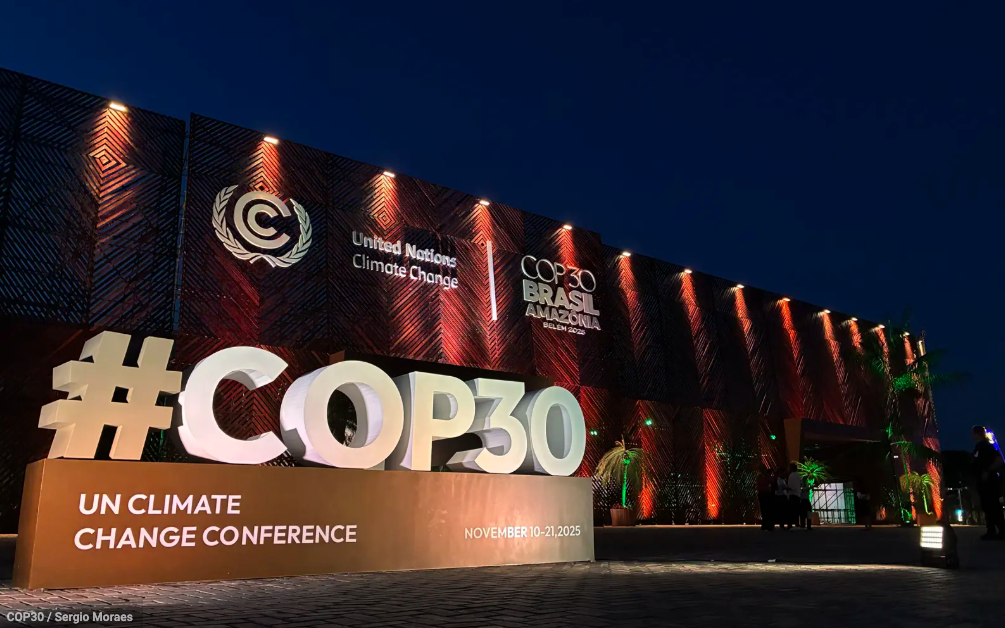
From Sergio Moraes via climatechampions.net
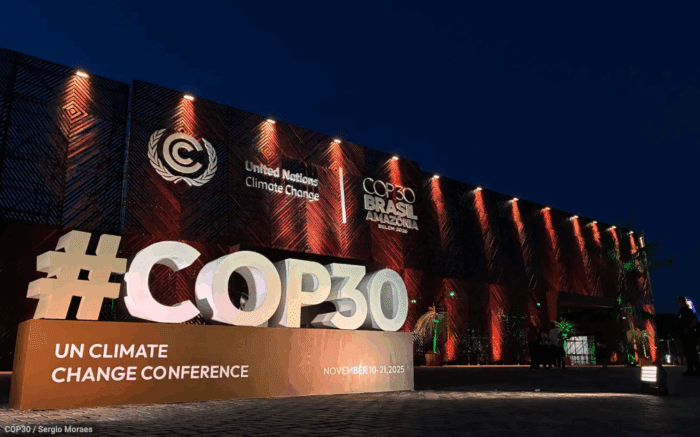
The 30th United Nations Climate Conference of the Parties (COP) is underway this week in Belém, Brazil, where nearly 60,000 attendees, including governments, NGOs, and activists, are gathering to discuss and negotiate greenhouse gas emissions-reduction efforts under the United Nations Framework Convention on Climate Change.
This year’s COP 30 marks the 10-year anniversary of the COP that produced the Paris Agreement (negotiated at the 2015 COP held in Paris).
The Paris Agreement sought to limit the long-term rise in global surface temperature to “well below” 2°C (3.6°F) above pre-industrial levels, with a preference for limiting it to 1.5°C (2.7°F) above pre-industrial levels.
Over the past decade, greenhouse gas emissions from high-income countries have declined slightly, but economic development in middle-income countries and the associated increase in their emissions have pushed global greenhouse gas emissions up (illustrating why emissions reductions have been such a tough sell).
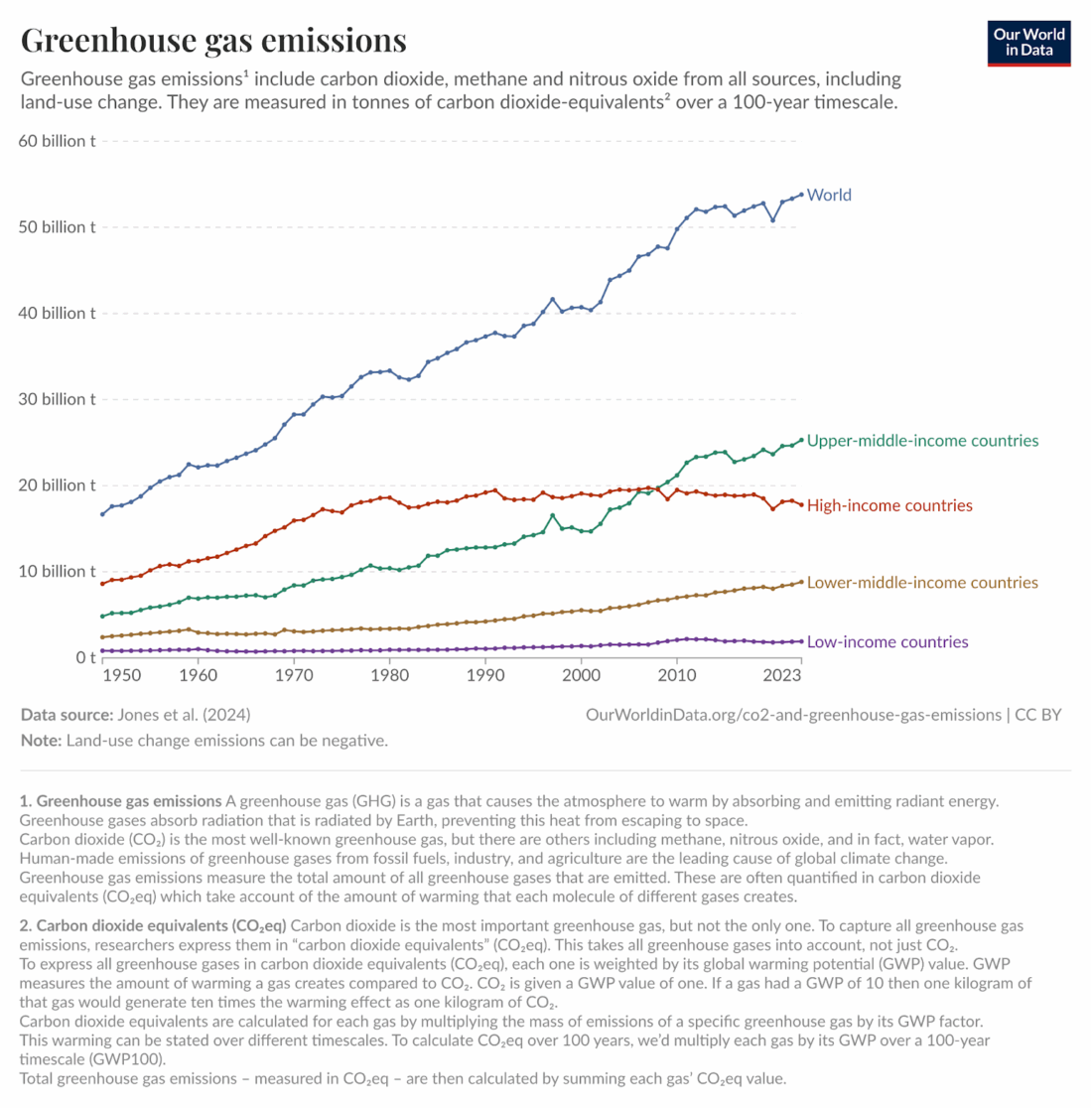
From Our World in Data.
Despite these recent trends, projections indicate that global greenhouse gas emissions are in the process of plateauing, though they are not declining at a rate anywhere near what would be required to limit long-term global warming to 1.5°C.
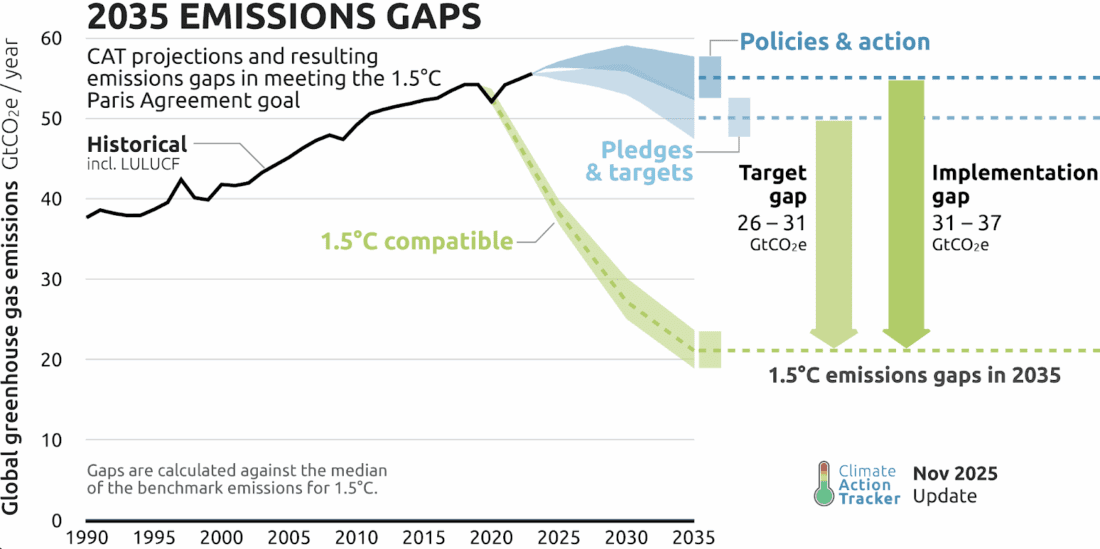
From climateactiontracker.org.
This year’s COP has seen this reality become more mainstream. The stage for this was set a couple of weeks before the meeting when Secretary General of the UN António Guterres said in an interview, “Let’s recognise our failure…The truth is that we have failed to avoid an overshooting above 1.5°C in the next few years.”
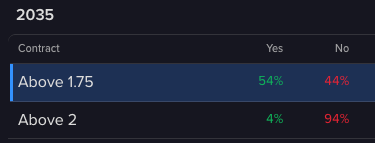
This reality is reflected in ForecastEx’s prediction market on when global temperature limits might be breached for the first time at the annual timescale. The market currently shows better than even odds that global temperatures will breach 1.75°C in the next decade.
From IBKRForecastTrader.
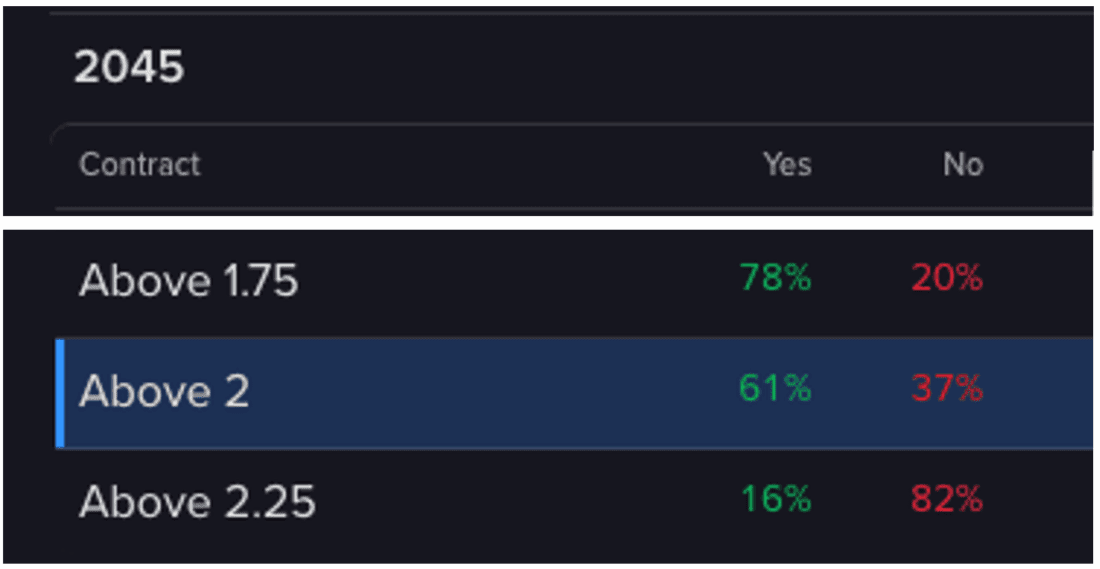
The primary temperature limit in the Paris Agreement was 2.0°C. While markets indicate that this limit is very unlikely to be breached in the next decade, it becomes much more likely over the subsequent decade. The market currently stands at 61% on whether a year will be above the 2.0°C threshold by 2045.
From IBKRForecastTrader.
These numbers are roughly in line with the odds that I initially calculated for these markets, and thus they reflect an expectation that emissions will roughly follow a SSP2-4.5 “middle-of-the-road” world with moderate economic growth, uneven development, and only moderate top-down climate policy.
That analysis suggested that the odds of breaching 2.0°C by 2045 were 72% on the SSP2-4.5 emissions trajectory, 26% on the SSP1-2.6 emissions trajectory, and 100% on the SSP5-8.5 emissions trajectory.
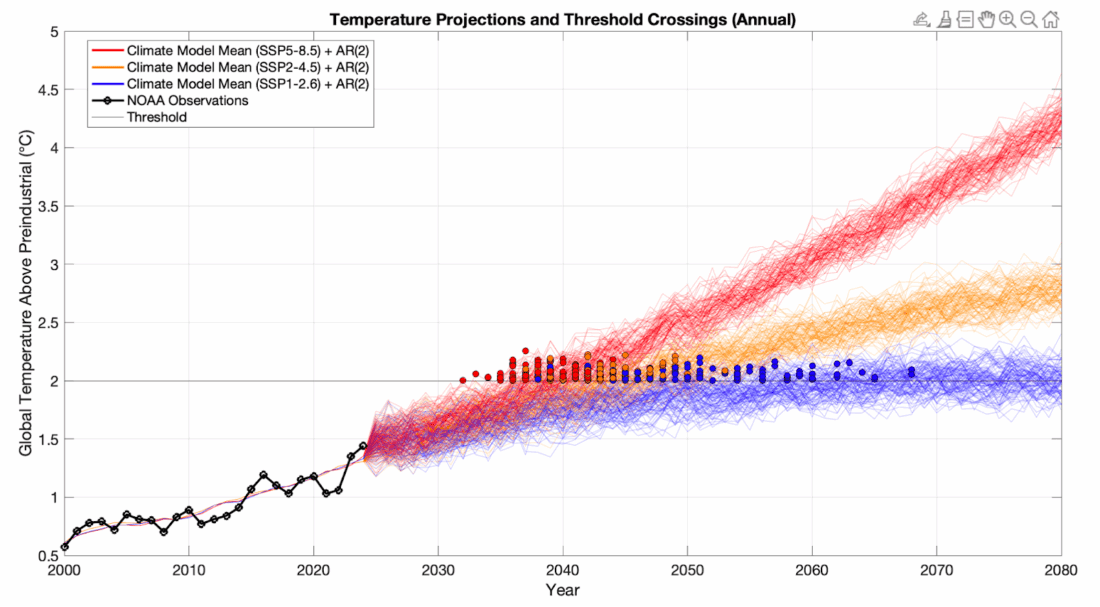
Produced in MATLAB (annual version of the 5th figure from “How Quickly Will The Globe Warm? Paris Agreement Forecast Contracts”).
So, most market participants believe we will surpass the Paris Agreement’s 2.0°C limit within the next 20 years, which raises the uncomfortable question of whether these COP climate talks will continue to perpetually center global temperature limits in their framing.
Global temperature is a downstream outcome of atmospheric greenhouse gas concentrations, which in turn are a downstream outcome of global greenhouse gas emissions, which in turn are a downstream outcome of (among other things) energy generation and technology. ForecastEx also has markets for these upstream elements, such as atmospheric CO₂ concentrations, global CO₂ emissions, and, more specific, but still relevant, US renewable energy generation.
If the past is predictive, during COP30, governments will announce new pledges, financing mechanisms, and emissions targets. But how will we know whether these proclamations meaningfully change the expectations for future trajectories of energy, greenhouse gas emissions, greenhouse gas concentrations, and global temperature?
Prediction markets can cut through the noise and uncertainty by aggregating the beliefs of participants who have financial incentives to assess likely outcomes objectively. If, following a major COP agreement, the market-implied probability of breaching 2 °C by 2045 drops, that would signal confidence that the new policies will make a real difference. If it stays flat, that would indicate that, despite the headlines and declarations, the collective judgment is that the world’s temperature path remains largely unchanged.
I’m not holding my breath, but I’ll be watching with interest.
New to Prediction Markets?
Open a Prediction Markets AccountThe analysis in this material is provided for information only and is not and should not be construed as an offer to sell or the solicitation of an offer to buy any security. To the extent that this material discusses general market activity, industry or sector trends or other broad-based economic or political conditions, it should not be construed as research or investment advice. To the extent that it includes references to specific securities, commodities, currencies, or other instruments, those references do not constitute a recommendation by IBKR to buy, sell or hold such investments. This material does not and is not intended to take into account the particular financial conditions, investment objectives or requirements of individual customers. Before acting on this material, you should consider whether it is suitable for your particular circumstances and, as necessary, seek professional advice.
The views and opinions expressed herein are those of the author and do not necessarily reflect the views of Interactive Brokers, its affiliates, or its employees.
Interactive Brokers LLC is a CFTC-registered Futures Commission Merchant and a clearing member and affiliate of ForecastEx LLC (“ForecastEx”). ForecastEx is a CFTC-registered Designated Contract Market and Derivatives Clearing Organization. Interactive Brokers LLC provides access to ForecastEx Forecast Contracts for eligible customers. Interactive Brokers LLC does not make recommendations with respect to any products available on its platform, including those offered by ForecastEx.
This is commentary on economic, political and/or market conditions within the meaning of CFTC Regulation 1.71, and is not meant provide sufficient information upon which to base a decision to enter into a derivatives transaction.
Related Articles













Join The Conversation
For specific platform feedback and suggestions, please submit it directly to our team using these instructions.
If you have an account-specific question or concern, please reach out to Client Services.
We encourage you to look through our FAQs before posting. Your question may already be covered!