
- Solve real problems with our hands-on interface
- Progress from basic puts and calls to advanced strategies
Interactive Options Course

Posted December 17, 2025 at 10:30 am
A generation ago, a single income could support a family, buy a house and pay for a vehicle or two in the driveway.
Today, even two high earners are struggling to purchase a new home.
According to a recent report from Bankrate, a household earning $80,000 a year is now priced out of 75% of all new homes on the market. A family now needs to earn at least $113,000, and in some major metros, it’s closer to $200,000.
Meanwhile, the homeownership rate has slipped to a six-year low, with further declines expected next year. Families are being squeezed from every angle.
The point I want to make here is that the so-called affordability crisis isn’t just about the cost of homes or other assets. It’s about the cost of money.
Take a look at the chart below. It compares the purchasing power of the U.S. dollar since 1915 to the price of gold over the same period.

What it shows is that the greenback has lost over 95% of its purchasing power. Gold, by contrast, has exploded, especially during periods of fiscal and economic strain.
Politicians and pundits may blame greedy corporations or inefficient supply chains, but here’s the truth: when a government runs endless deficits and finances them with fiat created out of thin air, the currency itself becomes the source of the problem.
We can trace it all back to 1971 when President Nixon suspended the dollar’s convertibility into gold. As I shared with you before, that was the day the U.S. traded fiscal discipline for a floating exchange rate.
Once the tether to gold was severed, spending exploded. Government debt soared from less than 40% of GDP to well over 120% today.

In short, when money becomes untethered from reality, everything priced in dollars becomes harder to afford.
And that takes us back to housing.
The next chart might surprise you. It shows the ratio of the median price of a new home divided by the price of gold. Essentially, it tells you how many ounces of the precious metal it takes to buy a typical American home.

We all know that, in dollar terms, housing is expensive right now. According to the Census Bureau, the median price for a new home in August was $413,500, a nearly 5% jump from the price in July. Remember, that’s the median price, meaning half of all available homes for sale are even more expensive.
But the chart shows housing priced not in dollars but in gold, and you’ll notice three instances when the median home cost roughly 100 ounces: 1980, 2011 and 2025.
This tells me the affordability crisis isn’t necessarily being driven by runaway home prices, but by the continued weakening of the dollar as well as the cost of borrowing.
Examining housing through a gold lens exposes what the consumer price index (CPI) and political messaging hide—namely, the real culprit is the currency.
That’s why I, along with many others, consider gold to be real money. It doesn’t lie, and it doesn’t get revised by government bureaucrats. It doesn’t depend on congressional budget committees or Federal Reserve projections.
Think about that next time you hear about a housing bubble. The real bubble may be the debt-fueled system we’re using to measure value.
This isn’t just an American problem, of course.
The chart below, taken from a Deutsche Bank report, shows average annual inflation for 152 countries since 1971. Not one major economy has kept inflation below 2% over the past half-century. Most countries have averaged between 4% and 10%, but some—Argentina, Brazil, Turkey—have suffered a “near-total currency collapse,” according to Coin Bureau.
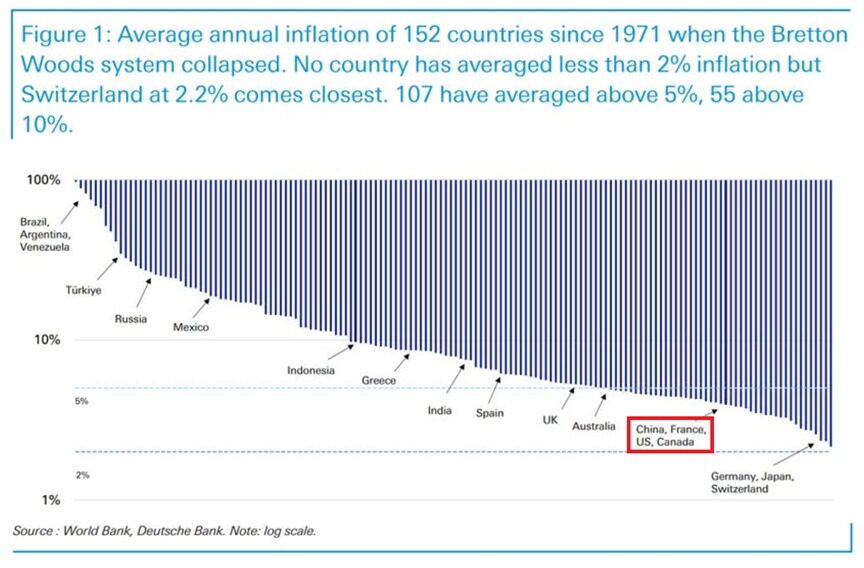
Once again, gold is real money, whereas fiat is temporary.
President Donald Trump calls the affordability crisis a hoax. In truth, the lack of affordability is real for many families right now, but the cause isn’t home builders or landlords or banks. The cause is the steady erosion of fiat’s purchasing power. Gold is simply the mirror reflecting the truth.
—
Originally Posted December 15, 2025 – Why Housing Looks Expensive in Dollars but Cheap in Gold
All opinions expressed and data provided are subject to change without notice. Some of these opinions may not be appropriate to every investor. By clicking the links above, you will be directed to a third-party website. U.S. Global Investors does not endorse all information supplied by these websites and is not responsible for their content.
The Consumer Price Index (CPI) is a measure of the average change over time in the prices paid by consumers for a representative basket of consumer goods and services. The CPI measures inflation as experienced by consumers in their day-to-day living expenses.
All opinions expressed and data provided are subject to change without notice. Holdings may change daily.
Some of these opinions may not be appropriate to every investor. By clicking the link(s) above, you will be directed to a third-party website(s). U.S. Global Investors does not endorse all information supplied by this/these website(s) and is not responsible for its/their content.
About U.S. Global Investors, Inc. – U.S. Global Investors, Inc. is an investment adviser registered with the Securities and Exchange Commission (“SEC”). This does not mean that we are sponsored, recommended, or approved by the SEC, or that our abilities or qualifications in any respect have been passed upon by the SEC or any officer of the SEC.
This commentary should not be considered a solicitation or offering of any investment product.
Certain materials in this commentary may contain dated information. The information provided was current at the time of publication.
Some links above may be directed to third-party websites. U.S. Global Investors does not endorse all information supplied by these websites and is not responsible for their content.
Please consider carefully a fund’s investment objectives, risks, charges and expenses. For this and other important information, obtain a fund prospectus by clicking here or by calling 1-800-US-FUNDS (1-800-873-8637). Read it carefully before investing. Foreside Fund Services, LLC, Distributor. U.S. Global Investors is the investment adviser.
Information posted on IBKR Campus that is provided by third-parties does NOT constitute a recommendation that you should contract for the services of that third party. Third-party participants who contribute to IBKR Campus are independent of Interactive Brokers and Interactive Brokers does not make any representations or warranties concerning the services offered, their past or future performance, or the accuracy of the information provided by the third party. Past performance is no guarantee of future results.
This material is from US Global Investors and is being posted with its permission. The views expressed in this material are solely those of the author and/or US Global Investors and Interactive Brokers is not endorsing or recommending any investment or trading discussed in the material. This material is not and should not be construed as an offer to buy or sell any security. It should not be construed as research or investment advice or a recommendation to buy, sell or hold any security or commodity. This material does not and is not intended to take into account the particular financial conditions, investment objectives or requirements of individual customers. Before acting on this material, you should consider whether it is suitable for your particular circumstances and, as necessary, seek professional advice.
U.S. Spot Gold trading through IB LLC accounts is only available to legal residents of the United States that do not reside in Arizona, Montana, New Hampshire, and Rhode Island.
Futures are not suitable for all investors. The amount you may lose may be greater than your initial investment. Before trading futures, please read the CFTC Risk Disclosure. A copy and additional information are available at ibkr.com.
Related Articles

















Join The Conversation
For specific platform feedback and suggestions, please submit it directly to our team using these instructions.
If you have an account-specific question or concern, please reach out to Client Services.
We encourage you to look through our FAQs before posting. Your question may already be covered!