
- Solve real problems with our hands-on interface
- Progress from basic puts and calls to advanced strategies
Interactive Options Course

Posted April 17, 2026 at 10:30 am
Despite a confluence of economic shocks in the first quarter, markets have held up remarkably well, but cracks appear to be forming beneath the surface.
Like the title from the Oscar-winning movie, Everything, Everywhere All at Once, the first three months of 2026 featured a mind-boggling confluence of geopolitical and economic events. A partial list includes the arrest and extradition of Venezuela’s President to the United States, further threats regarding Greenland, IEEPA tariffs being overturned by the Supreme Court, AI breakthroughs that triggered massive declines in software equity valuations, continued problems in the private credit market, the four-year anniversary of the Russia/Ukraine conflict, an ongoing DOJ investigation into Fed Chair Jerome Powell, a partial government shutdown of DHS/TSA, and, as if all of that were not enough, a complex and disruptive war with Iran. Still, despite the constant chaos, markets somehow held up relatively well in the first quarter. But beneath the surface, cracks appear to be forming. Markets can discount each event in isolation but absorbing them all at once is another matter. Below we take a closer look at some of the most consequential moments and themes of 2026.
The operation in Venezuela appears to have been an unqualified military success, but thus far the economic impact has been negligible and the longer-term prospects are far from certain. While Venezuela is reputed to have the world’s largest oil reserves, a combination of sanctions, corruption, and lack of investment has caused the amount of Venezuelan oil exported globally to decline rapidly over the last several years. Despite the arrest of Maduro, moves to entice U.S. oil companies to upgrade Venezuelan drilling infrastructure have been met with an icy rebuff. Venezuela’s heavy sour crude is an ideal feedstock for many refineries on the U.S. Gulf Coast, so there clearly is potential to increase future exports. However, estimates by Rystad Energy put the needed investment at $150 billion over the next 10-15 years, which has been a tough sell given the previous losses experienced by U.S. companies in Venezuela and concerns about policy instability. We believe it will be at least a few years before we see a material increase in oil production.
Likewise, although the Supreme Court’s reversal of the IEEPA tariffs was a landmark decision that affirmed the limits of presidential authority, it did little to change the reality on the ground. The first set of Trump tariffs were put in place just under a year ago, and companies have been adjusting and planning based on that framework. If the ruling had its intended effect, we would already be seeing businesses revert to traditional supply chains, but that is not happening. Instead, across-the-board replacement tariffs were immediately announced by the Administration (though they may take longer to implement). This prompted some countries and economic blocs to negotiate new agreements, while others have ceased negotiating until there is more clarity. Regardless, higher tariffs seem to be the new normal and are being priced in by the markets. Companies have been raising prices, and inflation will likely remain well above the Fed’s 2% target. We are keeping an eye out for any further changes.
AI has been another big headline maker over the last 12 months, particularly recently with further advancements in Anthropic’s Claude and Open AI’s ChatGPT. The revenue generated from LLMs to date pales in comparison to the enormous amount of capital being invested to develop them. The chart below shows the CapEx being spent by the major hyperscalers for data centers and the computing infrastructure needed to handle the forecasted growth of AI.
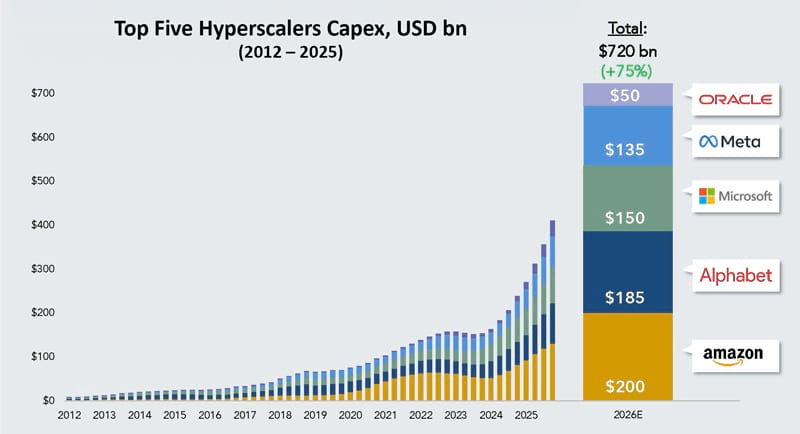
Anecdotally, we have not heard on earnings calls that these companies are achieving large economic returns to date. Granted it is early stages, but returns will need to justify these capital costs. The big concern for us is the funding of this CapEx, which originally relied on equity and free cash flow, but has morphed into massive piles of debt. A significant amount of money has been raised in the investment grade and private credit markets, but billions of dollars have been issued in the convertible and high yield markets as well. Companies like Meta and Microsoft have recently engaged in large, bespoke arrangements with both public and private lenders, which brings new risks to the market that we have been carefully avoiding.
Separately, nobody yet knows whether AI will save money and generate profitable growth for businesses and/or how it will ultimately impact the labor force. Will there be massive layoffs and rising unemployment due to the replacement of workers, as Citrini Research and Dario Amodei, the founder of Anthropic, have hypothesized? Or is it just another efficiency layer built on top of existing systems – a force multiplier that allows workers to be more efficient and increase productivity? Only time will tell, but the turmoil of day-to-day headlines is something investors have to parse.
A related topic that started making regular headlines late last year is the ongoing trouble in the private credit market. As the chart below shows, the asset class has grown extremely rapidly since its inception in 2002.
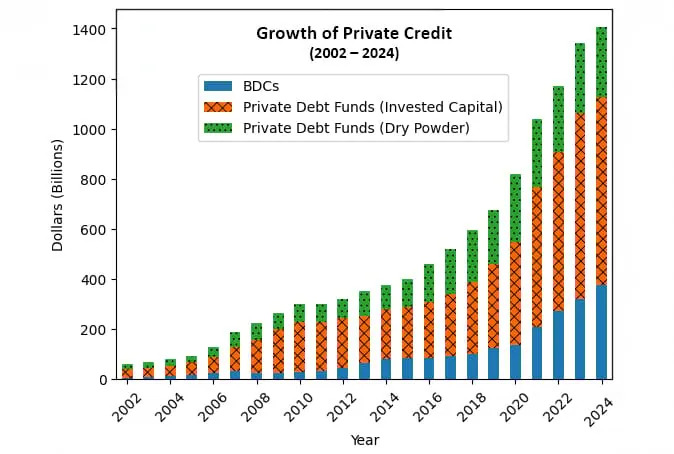
As you might expect, fast growth like this often leads to fast (read: careless) lending, which inevitably leads to credit problems. In fact, there have been many stories in the past several months about private credit borrowers negotiating liability management exercises – a.k.a. distressed exchanges – where lenders are taking the ownership keys from the sponsors due to missed payments or covenant breaches. In some cases, these businesses are struggling badly enough that the new owners even write down their investments shortly after acquiring them. J.P. Morgan High Yield credit strategists estimate that from 2010 to 2023, 50% of distressed exchanges eventually defaulted again. Something to keep an eye on.
Industry concentration is another major risk in private credit. Matt Mish, a Credit Strategist at UBS, estimates that 24% of public Business Development Company (BDC) holdings are in technology and 30% are in business services. For comparison, exposure in the traditional high yield market is 7.3% and 5.7%, respectively. He believes both sectors are disproportionately susceptible to, at a minimum, the perception of AI disruption, and at worst, an existential threat. Prior to the AI boom, software leveraged buyouts (LBOs) were easily able to obtain financing in the BDC, private credit, and leveraged loan markets (deliberately bypassing the high yield market) because they were seen as safe borrowers due to their attractive business models, particularly high switching costs and expanding profit margins.
However, software companies are now seen as highly vulnerable because LLMs like Anthropic’s Claude can develop applications at nearly zero expense, rapidly eroding the competitive advantage that defined the industry for a generation. It is no wonder we have seen a significant uptick in nervous investors trying to withdraw capital from these less liquid vehicles. Many non-publicly traded private credit funds have had to either limit quarterly withdrawals from investors or sell off pieces of their portfolio at discounts to meet redemptions. UBS estimates private credit defaults could reach a high of 15% and leveraged loans 10%, which is significantly higher than the historical default rate for high yield bonds (typically 3%-5%). How long this takes to materialize is a big unknown, but we do know the bankruptcy cycle is often long tailed.
However, we do not believe the troubles in BDCs and private credit funds are a systemic risk for the markets or the banking system, but rather an idiosyncratic risk for investors in those specific funds. One bright spot is that there is very little overlap between the borrowers in the private credit/leveraged loan market and the rest of the high yield market. The withdrawal demand from private credit investors and the forced selling may take several quarters to subside, and it may be several years before we know the true impact of AI disruption on the debt markets and overall economy. This is all part of the growing pains of a relatively new industry.
Finally, and most importantly, on February 28th, the United States and Israel attacked Iran, throwing more chaos into world markets and the global economy. After hitting all-time highs in January and February, the Dow Industrial and S&P Indices are now down on the year. Oil is hovering around $100 per barrel as the Strait of Hormuz is essentially closed. About 20% of the world’s liquified natural gas and 25% of the world’s oil originates in the region and must pass through the Strait. In addition, about one-third of seaborne fertilizer for farming also travels through the Strait. Depending on what crops they grow, farmers could be in planting season just as fertilizer prices are spiking, triggering higher food costs among other unintended consequences.
In times of global uncertainty, demand for U.S. Treasuries usually increases due to the so-called “flight to safety” trade, but during this war, Treasury yields have moved higher as worries about both inflation and excessive borrowing (because of the cost of the conflict) are reducing demand. Pundits have now pivoted away from Fed cuts to the possibility of a rate hike. While it has only been a few weeks, we are already seeing reverberations. Damage to gas and oil infrastructure in neighboring Middle East producers, and subsequent shutdowns of production, could take a long time to recover as chemical plants and oil fields do not turn on overnight. In fact, in some cases, it can take months, or longer, before they can return to full production capacity. United Airlines recently announced a 5% cut in its flight schedule for the second and third quarters due to fuel costs, and the company is estimating that oil could rise to $175/barrel and not return to $100/barrel until the end of 2027. Since the war started, jet fuel prices have almost doubled.
War in the Middle East only adds to the list of concerns the Federal Reserve has to work through. January and February data showed the economy had been neither running too hot nor too cold – sort of a Goldilocks economy. CPI for January and February was relatively benign and showed a minor slowing over the last 12 months but is expected to spike soon due to the war and rise in energy prices. Job openings appear to have risen in January versus December (contrary to the concerns about AI labor disruption) and were also higher than January 2025. Average unemployment claims have been hovering around 210,000 and are not yet showing a longer-term pickup due to announced or anticipated layoffs. As the economists at High Frequency Economics commented, “Claims are well within the recent range over the last two years…There is nothing to worry about in this report.” Payroll data has been slightly more volatile in the last few months, but when averaged out, it has been somewhat listless. Both pending home sales and the National Home Builders survey show slight improvements, while new home sales have been mostly flat. Balancing all this with the added Treasury financing for the war, as well as the existing federal deficits, will be a tough job for the Fed.
In summary, the combination of heightened economic and geopolitical uncertainty feels unprecedented to us, and we have been observing the markets for over three decades. Thus, we are sticking with our defensive posture until some of these crosscurrents resolve themselves. We continue to maintain a healthy amount of liquidity and are comfortable with our duration and portfolio positioning for the current environment.
—
Originally Posted on April 14, 2026 – Q2 Strategic Income Outlook: Everything Everywhere All at Once
Information posted on IBKR Campus that is provided by third-parties does NOT constitute a recommendation that you should contract for the services of that third party. Third-party participants who contribute to IBKR Campus are independent of Interactive Brokers and Interactive Brokers does not make any representations or warranties concerning the services offered, their past or future performance, or the accuracy of the information provided by the third party. Past performance is no guarantee of future results.
This material is from Osterweis Capital Management and is being posted with its permission. The views expressed in this material are solely those of the author and/or Osterweis Capital Management and Interactive Brokers is not endorsing or recommending any investment or trading discussed in the material. This material is not and should not be construed as an offer to buy or sell any security. It should not be construed as research or investment advice or a recommendation to buy, sell or hold any security or commodity. This material does not and is not intended to take into account the particular financial conditions, investment objectives or requirements of individual customers. Before acting on this material, you should consider whether it is suitable for your particular circumstances and, as necessary, seek professional advice.
Futures are not suitable for all investors. The amount you may lose may be greater than your initial investment. Before trading futures, please read the CFTC Risk Disclosure. A copy and additional information are available at ibkr.com.
Related Articles
















Join The Conversation
For specific platform feedback and suggestions, please submit it directly to our team using these instructions.
If you have an account-specific question or concern, please reach out to Client Services.
We encourage you to look through our FAQs before posting. Your question may already be covered!