
- Solve real problems with our hands-on interface
- Progress from basic puts and calls to advanced strategies
Interactive Options Course
Posted May 22, 2026 at 10:45 am
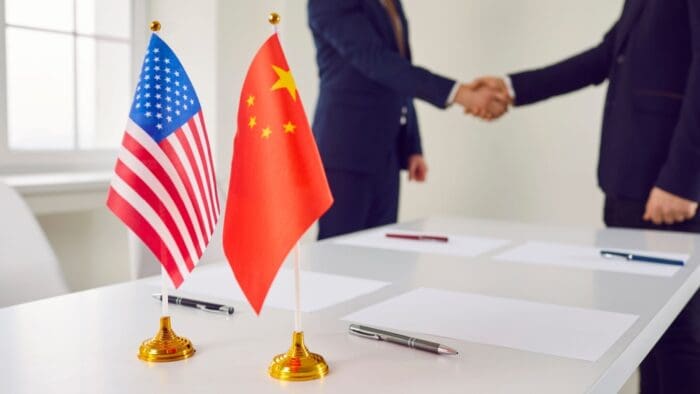
US President Trump concluded his May 13 to 15 visit to Beijing, the first by a sitting US president in nearly a decade, and markets were watching closely for signs of a structural reset in the world’s most consequential bilateral relationship. What they got instead was managed stability: warm optics, directional language, and incremental commitments that fall well short of the breakthrough many had hoped for. For investors, the visit reinforces rather than resolves two of the most compelling structural themes in global markets right now: the fracturing of critical mineral supply chains and the growing strategic value of agricultural trade flows.
What the Summit Delivered
On the surface, the tone was constructive. Both presidents exchanged praise, Trump described the bilateral relationship as on track to become “better than ever”, and Xi confirmed a return visit to the White House in September. The summit was focused on constructive strategic stability and a commitment to step up communications, language that deliberately signals de-escalation without committing to anything concrete.
The most tangible deliverables that emerged were in trade. China signalled openness to substantial purchases of soybeans, beef, energy products and Boeing aircraft. President Trump cited potential orders of 750 aircraft and GE engines. US Treasury Secretary Scott Bessent indicated that both sides are exploring tariff reductions beginning with around $30bn of non-critical trade. China also renewed import licences for hundreds of US beef plants, and discussions are under way on a “board of investment” to facilitate Chinese investment in non-sensitive US industries.
One stronger than expected outcome was on Iran: both sides explicitly agreed that Iran cannot acquire nuclear weapons, and that the Strait of Hormuz must remain open. Chinese officials signalled opposition to any tolls in the Strait and expressed interest in increasing US oil purchases to reduce reliance on that geopolitical chokepoint over time, a clearer convergence of interests than most observers anticipated.
Why the Summit was a disappointment
Strip away the diplomatic theatre, and the structural tensions remain firmly intact. Technology policy which arguably was the most consequential dimension of the relationship, produced no meaningful progress. Earlier reports had suggested the US cleared around ten Chinese firms to buy Nvidia H200 AI chips, but Scott Bessent was explicit that there is no immediate news on expanded access to advanced semiconductors. That omission matters enormously as technology transfer and export controls are at the heart of the US-China rivalry, and the visit did nothing to resolve them.
Taiwan, meanwhile, hardened rather than softened. Xi described it as the “most important issue” anchoring the relationship and warned of “serious consequences” if mishandled. Trump said he made no commitments on Taiwan and that US policy has not changed. The asymmetry of stakes on this issue means it will continue to act as a ceiling on how far the relationship can normalise.
Perhaps most telling is the broader structural backdrop. China’s share of global nominal Gross Domestic Product (GDP) has been declining since 2021, evident from the chart below, reversing three decades of catch up with the US.
Figure 1 – China is no longer catching up with the US
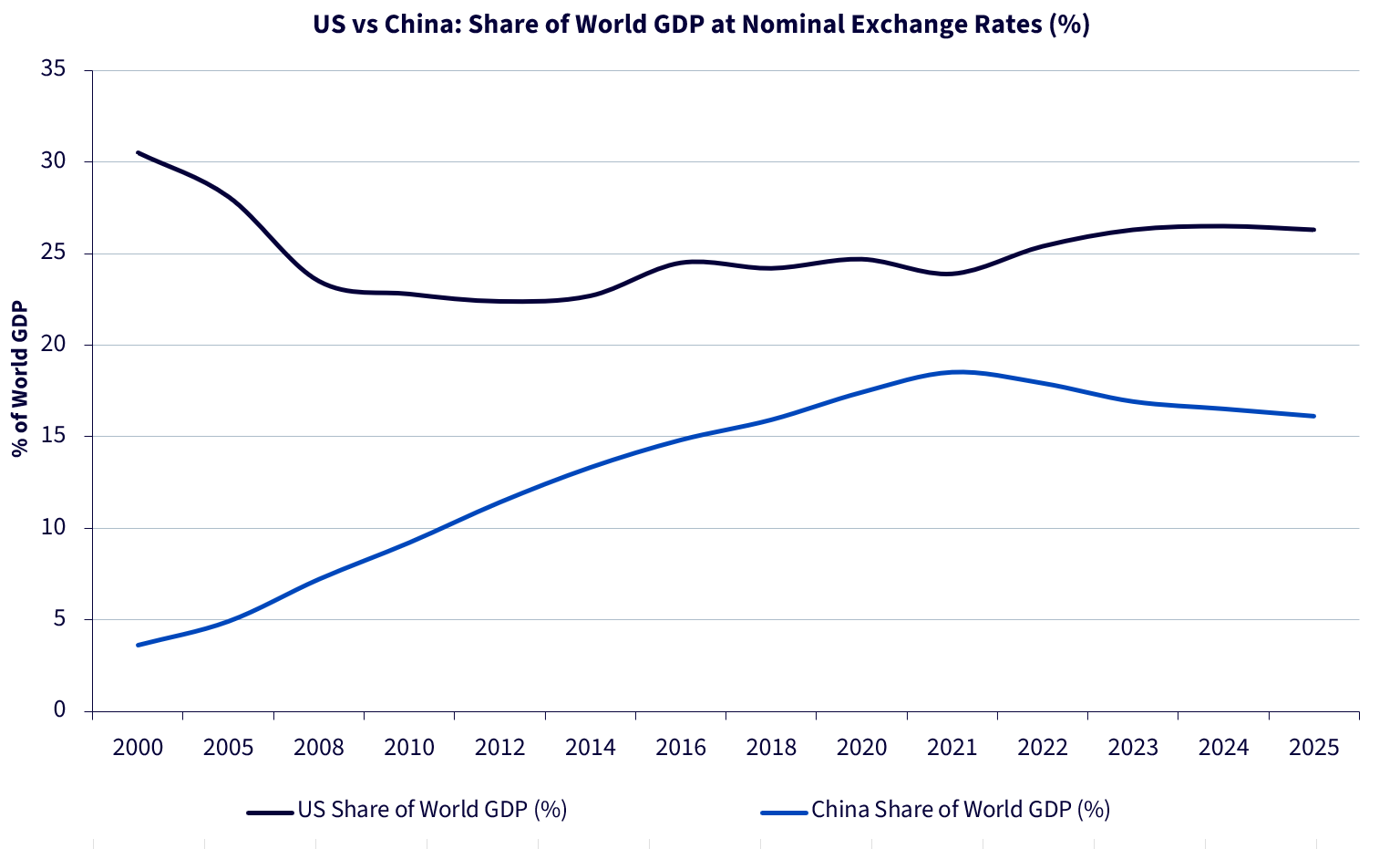
Source: WisdomTree, International Monetary Fund (IMF) as of 31 December 2025. Historical performance is not an indication of future performance and any investments may go down in value.
This is not simply a currency story: it reflects an inefficient use of resources, an industrial strategy optimised for military-technological parity with the US rather than domestic welfare.
In a nutshell, the Trump-Xi visit established a floor under the relationship but raised no ceiling. The bilateral reset investors were hoping for spanning across reopening technology flows, easing export controls or restoring investment confidence – did not materialise.
The case for investing in Strategic Metals and Rare Earth Miners
The most glaring omission from the Beijing summit was any agreement on critical minerals. China maintains near-total dominance over the processing of rare earth elements and strategic metals, materials essential to electric vehicles, defence systems, renewable energy infrastructure, and semiconductor manufacturing. The absence of any framework agreement on mineral trade, export controls or supply chain access means the strategic imperative for Western governments and companies to diversify away from Chinese supply remains completely unaddressed.
The case for investing in Agricultural Commodities
China’s purchase commitments on agricultural goods were among the more concrete deliverables to emerge from the summit, with Trade Representative Jamieson Greer indicating potential commitments to substantial purchases of soybeans and beef. But investors should be careful about reading this as a resolution of agricultural trade risk. Purchase commitments are politically motivated and historically volatile, they can be scaled back as quickly as they are made.
The structural case for agricultural commodity exposure is not dependent on the arc of US-China trade diplomacy. Global food security concerns, energy-linked input cost pressures (fertiliser, fuel) on the back of the Iran war, and climate-driven supply disruption remain powerful secular drivers.
Conclusion
The Trump–Xi summit delivered what most seasoned observers expected: de-escalation without transformation. The diplomatic relationship has stabilised, but the structural fault lines — in technology, critical minerals, Taiwan, and industrial policy remain unchanged. For investors, the lesson is that geopolitical normalisation is not imminent, and portfolios that are positioned for a fragmented, multipolar world remain better placed than those betting on a bilateral reset. RARE and AIGA offer two complementary expressions of that view, one capturing the supply chain diversification imperative in strategic metals, the other providing durable exposure to the agricultural commodity complex in an era of persistent global uncertainty.
—
Originally Posted May 22, 2026 – Beijing Without Breakthroughs: What the Trump–Xi Summit Means for Investors
This material is prepared by WisdomTree and its affiliates and is not intended to be relied upon as a forecast, research or investment advice, and is not a recommendation, offer or solicitation to buy or sell any securities or to adopt any investment strategy. The opinions expressed are as of the date of production and may change as subsequent conditions vary. The information and opinions contained in this material are derived from proprietary and non-proprietary sources. As such, no warranty of accuracy or reliability is given and no responsibility arising in any other way for errors and omissions (including responsibility to any person by reason of negligence) is accepted by WisdomTree, nor any affiliate, nor any of their officers, employees or agents. Reliance upon information in this material is at the sole discretion of the reader. Past performance is not a reliable indicator of future performance.
Please click here for our full disclaimer.
Jurisdictions in the European Economic Area (“EEA”): This content has been provided by WisdomTree Ireland Limited, which is authorised and regulated by the Central Bank of Ireland.
Jurisdictions outside of the EEA: This content has been provided by WisdomTree UK Limited, which is authorised and regulated by the United Kingdom Financial Conduct Authority.
Information posted on IBKR Campus that is provided by third-parties does NOT constitute a recommendation that you should contract for the services of that third party. Third-party participants who contribute to IBKR Campus are independent of Interactive Brokers and Interactive Brokers does not make any representations or warranties concerning the services offered, their past or future performance, or the accuracy of the information provided by the third party. Past performance is no guarantee of future results.
This material is from WisdomTree Europe and is being posted with its permission. The views expressed in this material are solely those of the author and/or WisdomTree Europe and Interactive Brokers is not endorsing or recommending any investment or trading discussed in the material. This material is not and should not be construed as an offer to buy or sell any security. It should not be construed as research or investment advice or a recommendation to buy, sell or hold any security or commodity. This material does not and is not intended to take into account the particular financial conditions, investment objectives or requirements of individual customers. Before acting on this material, you should consider whether it is suitable for your particular circumstances and, as necessary, seek professional advice.
Investments in certain commodities (precious metals) may be subject to significant price volatility and often involve risks related to market fluctuations, liquidity constraints, geopolitical events, and changes in global economic conditions that could adversely affect their value.
Related Articles

















Join The Conversation
For specific platform feedback and suggestions, please submit it directly to our team using these instructions.
If you have an account-specific question or concern, please reach out to Client Services.
We encourage you to look through our FAQs before posting. Your question may already be covered!