
- Solve real problems with our hands-on interface
- Progress from basic puts and calls to advanced strategies
Interactive Options Course
Posted July 22, 2026 at 12:30 pm
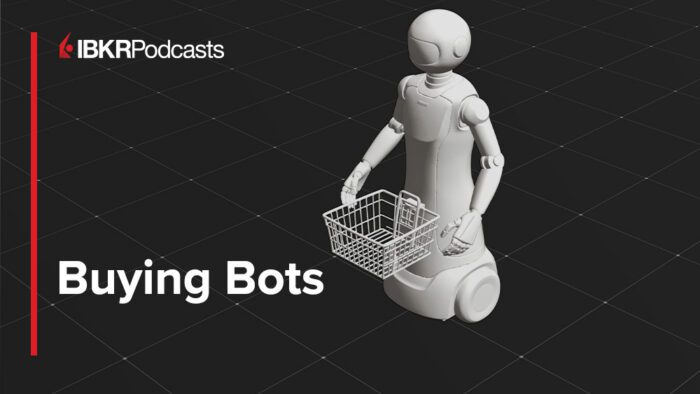
Would you let an AI assistant make purchases on your behalf? In this IBKR Podcast episode, Alex Gunz of Heptagon Capital joins IBKR’s Andrew Wilkinson to explore the rise of agentic commerce, the risks to consumers and brands and what this shift could mean for the future of shopping.
The following is a summary of a live audio recording and may contain errors in spelling or grammar. Although IBKR has edited for clarity no material changes have been made.
If, like me, you’re not a fan of retail therapy and prefer to spend less time shopping this podcast might be for you. Agentic commerce is on its way, which means that you could take a piece of software to search for things that you want at a price you define and at a quality that you determine. Well, so says today’s guest. Welcome back to the podcast, Alex Guntz, Fund Manager at Heptagon Capital in London.
Hi, Andrew. Thanks so much for having me on the show, and I’m in a very similar boat to you in terms of finding shopping a chore. So that’s why partly we’re, I guess, here today to discuss the merits of agentic commerce.
Well, for listeners who may be unfamiliar with the concept, how would you define agentic commerce in simple terms?
So I guess there are two ways of answering that question, Andrew. Number one is let’s just think about what an agent is. Ultimately, it’s just a piece of software, so the debate is really moving from where we do the shopping to who does the shopping, and that really feeds into the second point. You know, I would characterize agentic commerce, or we’ve named it a-commerce, as really being the third wave, if you will, of shopping and how shopping has evolved. So we began with bricks and mortar, then the internet came along. That was the first wave, and we would sit at our desktops at home. We’d click away.
We’d order. It would be slow and painful, but it worked. Wave two was doing it on a mobile, where everything became better. The iPhone was really the big shift in functionality. And now the third wave, and really this is a practical application of AI, is really getting agents to do it on our behalf.
So what first sparked your interest in this a-commerce, as you call it, and why do you think that it represents a major shift in how people will shop in the future?
I think the best way to characterize it, Andrew, is simply as an evolution of what we’ve been doing already. We touched on this already in terms of thinking it, thinking about it or characterizing it as a third wave, and I guess maybe two different ways to frame this.
Number one is, you know, we’ve been talking about AI for the last three years, certainly on this program and on every other sort of media forum you can imagine. We’re all very familiar with interacting with ChatGPT, with Claude, with Gemini, and so on. So in some ways actually taking it to the next level, and for the owners of the LLMs to be thinking about how can they practically apply and monetize AI shopping, and bear in mind, as our listeners will be aware, consumption accounts for something like 70% of GDP in a country like the States or Great Britain. Shopping seems like a very obvious and logical vertical to see that monetization take place. I guess the second way of framing it is really just the notion of familiarity. So think about it like this. If you’d shown someone an iPhone in 1999 when the internet was just getting started, people would have had no conception of how to use it.
Now it’s absolutely commonplace, and I think we’re arguably at the same cusp today that the things which sound and feel unfamiliar will within five to 10 years be totally normal.
So what’s your opinion here then? People appear comfortable allowing AI to help them plan purchases, but they seem to be much less comfortable letting AI complete the transaction.
Yeah, I think that’s a wonderful and very astute point, Andrew. And I guess the way I’d explain that is that it’s just simply a function of human psychology. So in other words, you know, we as humans are lazy, but we’re also fearful of change. So I think the… What is enticing about the prospect of agentic commerce is that it can actually revolutionize and indeed save time in our lives.
And this could be something as mundane as doing a grocery shop or imagine if, say, you wanted to go to a particular concert and the tickets only go on sale at a certain time. You happen to be in a business meeting or something like that. The agent could obviously go away and buy the tickets with predetermined parameters about price, where you wanted to sit. Or imagine you’re going on vacation. You can’t be bothered to find the taxi company to pick you up at the airport, someone to book you tickets for local attractions. An agent can do that. So the promise, the enticement of agents, is the removal of complexity. That’s really cool. The catch, however, is this idea that today because the technology is new, and like with every new technology really, it’s unproven, it’s untested, and the notion of handing over very personal details, allowing a piece of software, as we described an agent, what it ultimately is, to have our credit card details and potentially for that very valuable thing that we care a lot about, our bank balance, to be potentially misused is, I think, where it, really where this tension arises today.
One of the more provocative points in your article, Alex, is that power may shift away from branding and consumer attention and more towards pricing transparency, data quality, and fulfillment reliability. Why is that?
Just as we described the notion about why we’re perhaps reluctant to hand over payment details to an agent as being sort of grounded in psychology, I think the response to the question you just posed, Andrew, again, can be really looked at through a psychological or economic framework. So think about it like this, you know, anyone studying Economics 101 begins from the premise that all consumers are rational. Now, I think the reality is, as we know, consumers are ultimately not rational. They’re enticed by brands, what their friends like, what’s trending on social media channels they follow. People are attracted by discounts, even if they don’t necessarily appreciate what the original retail price is. All sorts of sort of heuristics or flaws—yeah—that, you know, we’ve all been guilty of, and I think your listeners will certainly recognize that. I guess the point is that, look, if you have an agent, an agent is not programmed, it’s not been designed to be irrational.
It really just cares about searching for all of the, or searching all the available information to find the best deal based around the parameters you’ve given it. In other words, it won’t say, “I particularly like Nike,” let’s say, or, “I like Nike more than Adidas, and therefore, even if the Adidas trainer is better than the Nike one, because I like Nike more, I’ll prioritize that.” And so ultimately, in a world where you have rational thinking, the things that an agent will care about will much more be based around that quality of distribution, the ability to fulfill orders quickly and seamlessly.
So are the potential losers then if agentic commerce goes mainstream?
I think that’s very likely, Andrew. In the piece that we wrote, which will be available, I’m sure, to your listeners, is available on Heptagon Capital’s website already, we’ve tried to lay out a framework for potential winners and losers. And I think potential winners would be, as we’ve often talked about in prior programs, would be almost the metaphorical shovel makers, the people who are providing the plumbing, if you will, to make agentic commerce work, and we may well come on to discuss that later.
But to address your direct point about potential losers, I think without sort of differentiating between specific sectors or industries it could often be or could likely be those companies that have really sought to differentiate themselves based around their brand, and that could be clothing or apparel businesses, it could be luxury businesses, it could be food and beverage businesses. Those would be potentially companies I might call out as being losers in this agentic world.
Why are the payment companies, Visa, MasterCard, American Express, and Stripe positioning themselves so aggressively in this space?
I think we touched on this to a certain extent earlier, Andrew, but the way I would frame it is simply that if the premise for agentic commerce to take off is about building trust, and if we really care about the architecture, the plumbing that makes this work, then there will be certain businesses that have already got a proven track record, if you will, in this respect, that could potentially look to leverage that expertise into a new vertical. So essentially what you need to build, and again we highlighted this in our thematic white paper, is a series of protocols, in other words, some sort of gateway which decides whether to trust or to verify an agent. Another gateway which basically agrees to hand over payment information to an agent. And then there will also be the processing elements as well. And I think if you look at the track record of the payment processors and the fact that we all have been very happy to hand over our financial data to these businesses, they are the effective rails that make the financial network exist already.
And I recall a piece we did previously, Andrew, where we discussed stable coins. You know, these businesses, they’re very, very conscious of not being disintermediated, not being sort of removed from the equation. So therefore, if they can be preemptive, if they can build the architecture… And indeed, you can just go onto any of these large companies’ websites, and they will already talk about offering developer kits, agentic toolkits. And these are essentially sandboxes, if you will, for both tech companies and indeed for retailers to experiment with. And a lot of this is really about this idea of trying to build trust.
Well you also suggest that China is ahead of the United States in terms of practical adoption. What advantages are there in China that have accelerated that adoption?
I guess the correct way to frame this, Andrew, would really be to think about the fact that China has always been a little bit more advanced digitally in the sense of a few factors. There is less legacy infrastructure where there is a greater trust in automation in China. There’s almost been a tacit acceptance that you give up certain sort of liberties if you will, in order to allow for economic growth. So, you know, to frame that in practical terms, we’ve clearly had or there clearly are in China quite a few super apps, if you will. So the likes of these apps designed by Alibaba, by JD.com, and so on.
And the idea is that this is one sort of mega app where already your shopping, your transportation, your bank details are integrated into one platform. So the idea of actually making that conceptual leap and that handover, if you will, of personal information, and that trust in technology, I would contend, we highlighted this again in our piece, that psychologically, structurally as well, where the country is in terms of its technology, just has allowed it to sort of edge ahead, if you will, in this respect of agentic commerce.
There are already kind of prototypes out there, but they don’t necessarily go the whole hog. We’ve got Amazon’s Rufus, Walmart’s Sparky, and similar tools showing impressive engagement metrics according to your article. Which current implementations are most exciting to you and why? And I guess this is a good time to ask you, have you got any anecdotal evidence?
That’s a very pertinent question to be asking, Andrew. And indeed, as part of the work we have done on this topic of agentic commerce, and indeed the work we generally do when we think about future trends at Heptagon, is we publish a weekly blog. And one of our most recent pieces has indeed highlighted some of the experimentation that we’ve undertaken with regard to agents.
And I think, you know, in some ways it’s very similar to what we’ve written about with robotics and it really begins with appropriate alignment of expectations. Today, we’re still in that experimentation phase. In some ways it comes back to the observation we made earlier on in this conversation, that a bit like the internet was 30 years ago, we’re still just experimenting today.
So the variation that you actually have in agentic platforms is today pretty wide. A lot of it is really just thinking about call it an enhanced shopping assistant. But it is really about building trust, building familiarity. So I think where the tools that exist today, particularly Rufus, as we highlighted, are actually really good at helping curate a list of items for you. So you hand off to an agent or a shopping assistant a very specific request. You want a certain pair of trainers at a certain price point for a certain occasion. This is your size. This is when you need it. It’s very, very good about taking a huge selection and sinking it down to a much smaller number.
There is still, however, that handover that’s required, and in some ways this is important. The agent will say, or the assistant will say, “Here is the selection. Here is what I’ve curated. Now you, the human, have to click in order to make the payment.” So this is sort of agentic commerce one point zero. Rufus is actually being folded into Alexa within Amazon. So in some ways you would actually be able to say to a device, “Here is my request. I want, you know, tickets to watch the World Cup semifinal. I want to sit in this row. I don’t want to pay any more than this amount of dollars for a seat to watch a great soccer game.” And it would go away and say, “Okay, this is what I’ve been able to find. Now click here.” Again, if you look at some of the larger platforms, the offering from Gemini, which is obviously Google’s setup, Copilot’s tools, which are part of the Microsoft Suite, they’re also fairly good. Our experience is that retailers in Europe, obviously where I’m based, are perhaps a little bit behind the curve today.
What’s going through my mind right now, Alex, is the wedding planner.
Of course.
Yeah. Imagine that conversation. That might make a funny blog piece. Yeah. So you’re saying that the biggest winners are gonna be the retailers, AI platform providers, payment companies, and logistics firms. Are there companies that we haven’t yet identified that are gonna benefit from this trend?
I think to be clear, Andrew, the way we would characterize it, and as we said, often this is the case when we try and think about investing in future trends, we like to own the metaphorical shovel maker. So I think—
Right…
Payment processors, the rails for transactions, that would be the number one call-out, and then distribution and fulfillment networks, and obviously you have the traditional logistics companies, but almost the second derivative of that, businesses that own warehouses, so effective REITs, real estate investment trusts, and they are actually leasing those warehouses to retailers. They are, to our mind, again, we alluded to this in our piece, clear potential beneficiaries because if it comes back to this debate about agents being rational and caring about fulfillment, caring about that delivery coming to you, the consumer, as quickly and as efficiently as possible, owning strategically located warehouses, we think could be a clear differentiator, and therefore, the owners of those warehouses could be clear beneficiaries.
You wrap up the piece by saying that the agents are coming. Mm-hmm. What should investors, businesses, and consumers be doing today to prepare for that future?
Well above and beyond reading our piece, I guess the much more serious answer to that question would be, look, you know, we’re in an experimentation phase today. It’s about building familiarity. It’s about building trust. And the more quickly you do that, the better placed you will potentially be. You know, we called out earlier on or highlighted where the potential losers may be in this debate. So I think for those businesses, it’s actually really incumbent upon them to think about how to innovate most appropriately and stay relevant in a more agentic age. I guess the final comment I’d leave all your listeners with is really that, look, revolutions take time. Even today, you know, 2026, in a country like the United States, much of Western Europe, it’s only about 30% of all purchases by value are done online today. So in other words, 25 years on from the internet, it’s still only one in $3 being spent online on average.
So then if we’re trying to frame how quickly will we be handing off to agents, yes, it’s gonna change the world, we think, in a massive way, but I think we all need to be mindful about the timeline at which this is going to occur.
Yeah, that’s a really interesting way to wrap it up. I mean, when you think of what we spend physically eating out, it’s a very—
Yeah. Large part of the retail sales report every month. Yet, how much we’re now spending having food delivered by ordering it online. That’s, you know, that’s a good takeaway question. Alex Gunz, portfolio manager at Hector Fund in London, thank you again for joining me. Always a pleasure to have you on the show.
Thanks so much, Andrew. Looking forward to the next one already.
All right. And have a great holiday when you go away in a couple of weeks. And mind the sunshine. And for the audience, thank you for taking the time to join us. And if you enjoyed today’s show, don’t forget to like and subscribe wherever you download your podcast from. Bye for now.
The document is provided for information purposes only and does not constitute investment advice or any recommendation to buy, or sell or otherwise transact in any investments. The document is not intended to be construed as investment research. The contents of this document are based upon sources of information which Heptagon Capital believes to be reliable. However, except to the extent required by applicable law or regulations, no guarantee, warranty or representation (express or implied) is given as to the accuracy or completeness of this document or its contents and, Heptagon Capital, its affiliate companies and its members, officers, employees, agents and advisors do not accept any liability or responsibility in respect of the information or any views expressed herein. Opinions expressed whether in general or in both on the performance of individual investments and in a wider economic context represent the views of the contributor at the time of preparation. Where this document provides forward-looking statements which are based on relevant reports, current opinions, expectations and projections, actual results could differ materially from those anticipated in such statements. All opinions and estimates included in the document are subject to change without notice and Heptagon Capital is under no obligation to update or revise information contained in the document. Furthermore, Heptagon Capital disclaims any liability for any loss, damage, costs or expenses (including direct, indirect, special and consequential) howsoever arising which any person may suffer or incur as a result of viewing or utilising any information included in this document.
The document is protected by copyright. The use of any trademarks and logos displayed in the document without Heptagon Capital’s prior written consent is strictly prohibited. Information in the document must not be published or redistributed without Heptagon Capital’s prior written consent.
Heptagon Capital LLP, 63 Brook Street, Mayfair, London W1K 4HS
tel +44 20 7070 1800
fax +44 20 7070 1881
email london@heptagon-capital.com
Partnership No: OC307355 Registered in England and Wales Authorised & Regulated by the Financial Conduct Authority
The analysis in this material is provided for information only and is not and should not be construed as an offer to sell or the solicitation of an offer to buy any security. To the extent that this material discusses general market activity, industry or sector trends or other broad-based economic or political conditions, it should not be construed as research or investment advice. To the extent that it includes references to specific securities, commodities, currencies, or other instruments, those references do not constitute a recommendation by IBKR to buy, sell or hold such investments. This material does not and is not intended to take into account the particular financial conditions, investment objectives or requirements of individual customers. Before acting on this material, you should consider whether it is suitable for your particular circumstances and, as necessary, seek professional advice.
The views and opinions expressed herein are those of the author and do not necessarily reflect the views of Interactive Brokers, its affiliates, or its employees.













Join The Conversation
For specific platform feedback and suggestions, please submit it directly to our team using these instructions.
If you have an account-specific question or concern, please reach out to Client Services.
We encourage you to look through our FAQs before posting. Your question may already be covered!