
- Solve real problems with our hands-on interface
- Progress from basic puts and calls to advanced strategies
Interactive Options Course

Posted July 24, 2026 at 11:15 am
Artificial intelligence (AI) is reshaping markets and corporate earnings at a pace that has surprised even the most optimistic bulls. Tech hyperscalers are ramping up spending, with AI capital expenditure running well above initial projections for 2026. This surge is flowing directly into corporate balance sheets and contributing to a major earnings rally.
However, one question may not be getting enough attention: Is the massive wave of AI spending adding to inflation, or will it become the disinflationary force that ultimately brings consumer prices back down?
The answer, according to Erik Norland, CME Group Chief Economist, and Cameron Dawson, CIO of NewEdge Wealth, is complicated. The way this plays out will likely shape the investment landscape for the remainder of this decade.
Big tech players that entered the year projecting roughly 30% capital expenditure growth are now tracking closer to 60%-80% for the year. This surge is flowing directly into corporate earnings, with first-quarter growth coming in at 27%, more than double the 12.6% analysts had forecast.
“The biggest driver for markets at the start of 2026 has been the surge in AI CapEx,” says Dawson. “It’s driven a ton of demand for things like semiconductors, tech hardware, power equipment and even broader industrials.”
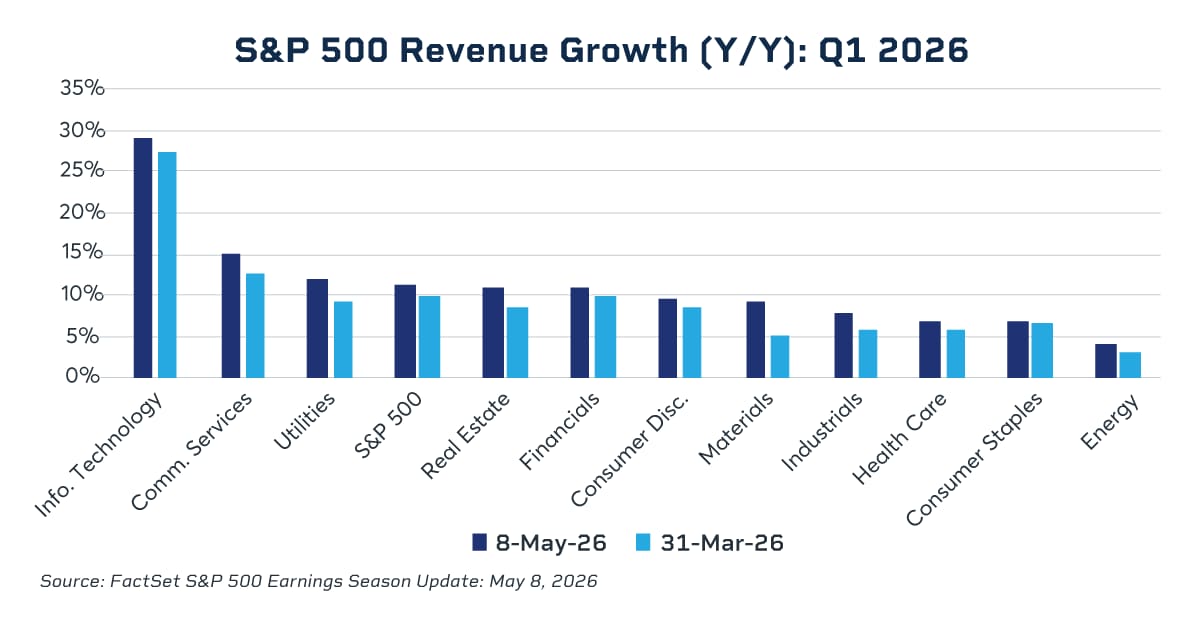
However, Dawson urges investors to read those numbers carefully. Remove one-time gains that hyperscalers recognized on investments in other companies, and the underlying growth rate looks closer to 16%.
“That’s fantastic versus estimates,” she says, “but it’s not as gangbusters as it looks on the surface.”
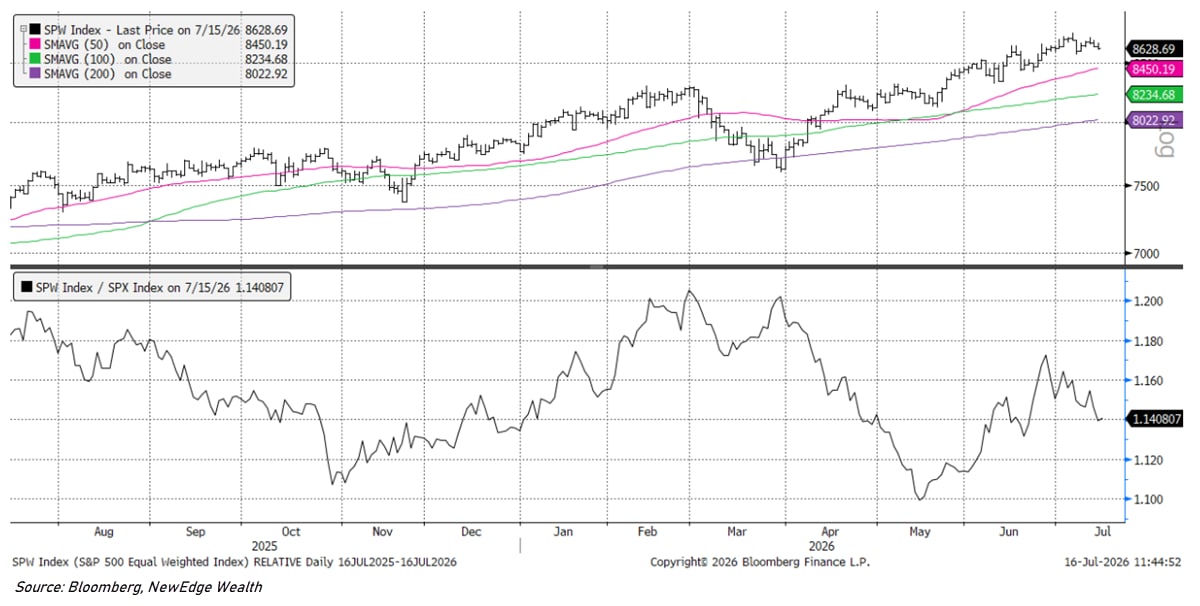
These gains are also narrowly concentrated, with semiconductor companies driving nearly all the index-level upside. The S&P 500 Equal Weight tells a very different story than its market-cap-weighted counterpart, and that divergence matters for how long this growth story can hold.
“In the initial stages of the rollout of AI, it’s actually adding to inflation. All of those dynamics of super-hot demand and AI CapEx could feed into some consumer prices.”
While many hope that AI will eventually be a deflationary force, in its current phase, AI seems to be pushing prices higher, not lower.
Memory chip costs have surged due to relentless infrastructure demand. Local communities hosting data center construction projects are seeing their utility costs spike. The ripple effects extend to consumer electronics, medical devices and automakers – all dependent on the same chip ecosystem now stretched thin by AI-related demand.
“In the initial stages of the rollout of AI, it’s actually adding to inflation,” Dawson says. “All of those dynamics of super-hot demand and AI CapEx could feed into some consumer prices.”
Norland adds a supply-side risk that could slow this boom: helium, a critical input in microchip manufacturing. Prices reportedly rose in response to recent conflict in the Middle East, with one industrial gas supplier noting that a return to normal conditions could take “a considerable period of time.”
“For decades the cost of computer software and accessories fell by about 8% per year on average. In the past twelve months it’s jumped by about 14%,” Norland says. “This doesn’t matter too much for the CPI where this component amounts to just 0.034% of the index weight. However, in the Fed’s preferred measure of inflation, the core PCE, the weight is 35 times higher. As such, instead of subtracting 0.1% from core inflation, the rising cost of computer chips and software is now adding 0.1%-0.2% to the levels of prices each year.”
Look past the mega-caps, and a stark economic disconnect emerges. The top 10% of households are fueling high-end consumption, largely wealth-effect spending driven by their AI-boosted stock portfolios. Meanwhile, the rest of the country is experiencing flat real wage growth and multi-decade low savings rates.
“In the first quarter, U.S. GDP expanded at a fairly robust pace of 2%, but much of that growth came from capital investment and much of the capital investment involved creating data centers, which adds to economic activity but does not add to most people’s sense of personal well-being,” Norland says.
This creates a scenario where aggregate consumer spending numbers look healthy on paper, but only because they are being carried by a small fraction of the population.
“The top 10% of consumers who spend about 50% of the money are driving that consumer spending higher,” Norland notes. “But for the great majority of people, the median consumer’s spending is essentially moving sideways.”
For that median consumer, reality is defined by flat real wage growth. “We heard from corporates in the first quarter of 2026 talking about how consumers were starting to hit the end of the line on being able to dig deep into their pockets,” Dawson warns.
A decoupling at the pump is making matters tougher, with gasoline and diesel prices rising independently of headline crude.
“The largest corporations are benefiting from a massive supercycle, and that strength is masking the weakness under the surface,” Dawson adds. “At what point do pressures in certain portions of the economy become more systemic?”
History does offer a reason for long-term optimism.
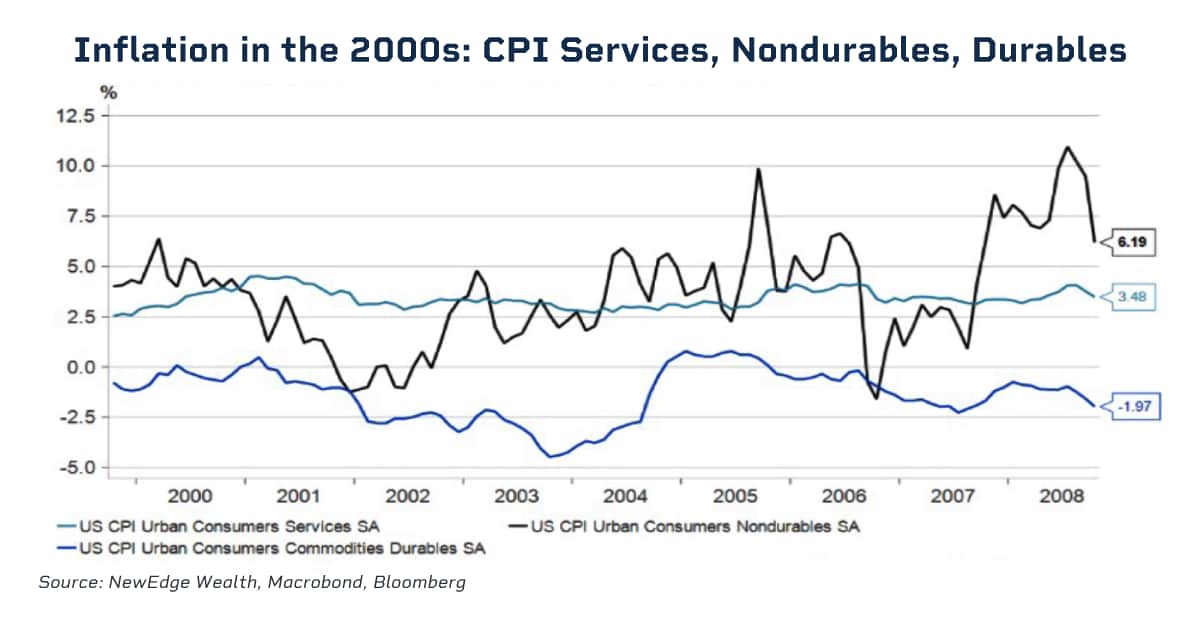
Between 2000 and 2011, commodity prices on major global futures exchanges underwent a supercycle – crude oil climbed from $20 per barrel to well over $100 – yet consumer price inflation across most major economies remained flat at around 2%. The reason, Norland argues, was a digital productivity revolution driven by the widespread adoption of the internet, which effectively doubled annual productivity growth from roughly 1.5% to 3%.
However, two structural safety valves from that era no longer exist, according to Dawson.
The first was China’s historic entry into the World Trade Organization (WTO) in 2001, which drove durable goods prices sharply negative and offset high non-durable goods costs. Today, amid deglobalization and tariffs, that relief is gone. The second was institutional: the Fed didn’t formally adopt a 2% inflation target until 2012. Today, a core CPI reading persistently stuck above 2% gives the central bank far less flexibility to tolerate commodity spikes than it had the last time around.
Current equity market performance may have more to do with semiconductor demand than an AI productivity boom comparable to the internet era. S&P 500 corporate margins have expanded by more than 100 basis points in each of the past two years, but strip out semiconductors and Equal Weight S&P 500 margins remain below their 2022 peak.
“What we’ve been arguing is that we’re not in a productivity boom, we’re in an operating leverage boom,” Dawson says. Semiconductor companies carry high fixed costs; when demand surges, margins expand mechanically – a cyclical feature of the business model, not proof of a new economic era.
“We know that semiconductor margins in past cycles have been mean-reverting,” Dawson cautions. “Gravity eventually applies.”
This intersection of AI spending, supply chain pressures and monetary policy is being actively priced across interconnected asset classes.
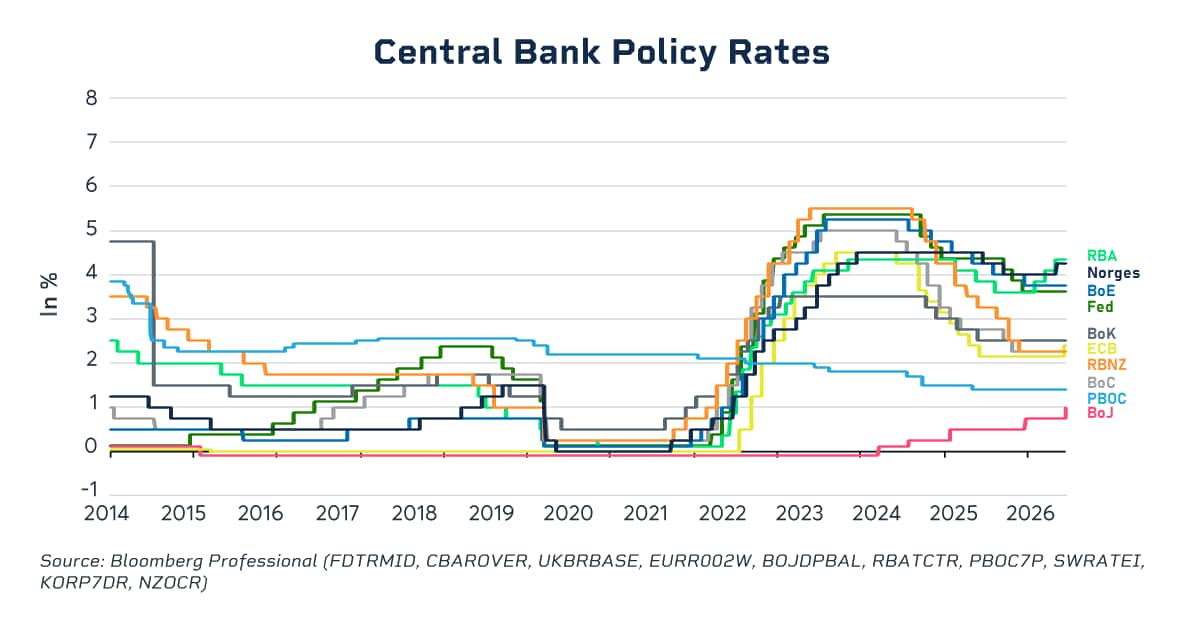
In interest rate markets, for instance, the era of “good news” rate cuts appears to be over. The two-year Treasury yield has broken its multi-year downtrend and is trading above the fed funds rate, signaling that markets are pricing in a prolonged pause or even central bank rate hikes in the face of higher inflation. Futures markets in Europe, the UK, Australia and Canada are actively beginning to price in tightening.
“It all comes back to one question,” Dawson says. “Where is AI CapEx going to go?”
If corporate investment successfully translates into economy-wide efficiency, AI could emerge as a disinflationary force, validating the internet analogy. Dawson notes that the first place to look for evidence is “supercore” inflation data, which captures services inflation excluding housing. As of mid-2026, that number has not meaningfully moved in the right direction.
If it does, the bull case gets stronger. Until then, the AI CapEx boom deserves its optimism but not unconditionally. The technology is still in its resource-heavy construction phase, burning physical inputs while promising future efficiency.
The AI thesis remains, as Norland frames it, “an interesting question to explore” rather than a settled outcome.
—
Originally Posted July 22, 2026 – Is AI Making Inflation Better or Worse?
© [2023] CME Group Inc. All rights reserved. This information is reproduced by permission of CME Group Inc. and its affiliates under license. CME Group Inc. and its affiliates accept no liability or responsibility for the information contained herein, including but not limited to the currency, accuracy and/or completeness of this information, and delays, interruptions, errors or omissions. This information is an unofficial copy and may not reflect the official and accurate version. For the definitive and up-to-date version of any of this information, please see cmegroup.com.
Information posted on IBKR Campus that is provided by third-parties does NOT constitute a recommendation that you should contract for the services of that third party. Third-party participants who contribute to IBKR Campus are independent of Interactive Brokers and Interactive Brokers does not make any representations or warranties concerning the services offered, their past or future performance, or the accuracy of the information provided by the third party. Past performance is no guarantee of future results.
This material is from CME Group and is being posted with its permission. The views expressed in this material are solely those of the author and/or CME Group and Interactive Brokers is not endorsing or recommending any investment or trading discussed in the material. This material is not and should not be construed as an offer to buy or sell any security. It should not be construed as research or investment advice or a recommendation to buy, sell or hold any security or commodity. This material does not and is not intended to take into account the particular financial conditions, investment objectives or requirements of individual customers. Before acting on this material, you should consider whether it is suitable for your particular circumstances and, as necessary, seek professional advice.
Futures are not suitable for all investors. The amount you may lose may be greater than your initial investment. Before trading futures, please read the CFTC Risk Disclosure. A copy and additional information are available at ibkr.com.
Security futures involve a high degree of risk and are not suitable for all investors. The amount you may lose may be greater than your initial investment. Before trading security futures, please read the Security Futures Risk Disclosure Statement. For a copy visit ibkr.com
Related Articles


















Join The Conversation
For specific platform feedback and suggestions, please submit it directly to our team using these instructions.
If you have an account-specific question or concern, please reach out to Client Services.
We encourage you to look through our FAQs before posting. Your question may already be covered!