
- Solve real problems with our hands-on interface
- Progress from basic puts and calls to advanced strategies
Interactive Options Course

Posted July 23, 2026 at 12:36 pm
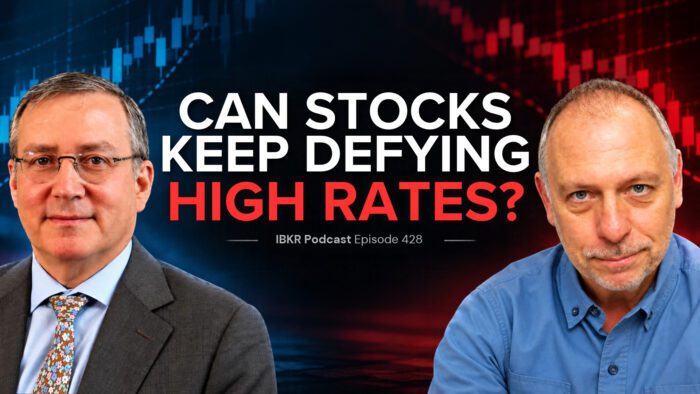
Our IBKR summer interns sat down with veteran trader Jim Iuorio to discuss surviving market crashes, navigating the transition from open-outcry trading pits to the age of AI, managing risk and developing lasting trading instincts. As the next generation of finance professionals prepares to enter the workforce, this conversation offers practical lessons and valuable insights for aspiring traders and seasoned investors alike.
The following is a summary of a live audio recording and may contain errors in spelling or grammar. Although IBKR has edited for clarity no material changes have been made.
Fred Pierce: Hello, and welcome to IBKR Podcast. My name is Fred Pierce, and I’m excited to kick off the first of two special podcast episodes featuring IBKR’s summer interns. Today, we’re very excited to welcome Jim Iuorio to the podcast. Jim is the managing director of TJM Institutional Services and has spent more than 30 years trading futures and options from the days of the open outcry pits to today’s electronic markets. Along the way, he’s navigated some of the biggest market events in modern history, giving him a wealth of experience and a practical perspective on trading, risk management, and what drives markets. How are you, Jim?
Jim Iuorio: Good. Thank you for having me. I really appreciate it.
Fred Pierce: Of course. Well, I’m gonna hand the baton over to Andrew to kick off our first question.
Andrew Jiang: Really great to meet you, Jim. I’m Andrew. I’m a software dev intern in the compliance department, and my question is that you started on the trading floor at the CME Exchange, which sounds like a completely different world from what most of us know trading to be because today’s markets are all electronic and algorithm-driven.
And having lived through that transition, what do you think that experience taught you that you couldn’t have learned any other way?
Jim Iuorio: This is an excellent question, and I really like fielding it a lot too, ’cause if you think about what you said, you said, “vastly different,” I think the word you said, of how it is today. So in 1987, I started in July. Actually this day in 1987, July 6th, when we are taping this, 39 years ago today. And several months later was the stock market crash of ’87 in October. And the vibe on a trading floor, just picture thousands of people crammed into a pit, crawling all over each other trying to get trades, and that was, at the time, the most efficient way to do it.
Now, that sort of environment rewards a couple things. It rewards aggressiveness. It rewards impatience, as weird as that sounds, because you have to be someone who almost… Not scares other people is not the right word, but you have to almost really be aggressive to get a trade. And now all of a sudden, years pass by and everything starts gravitating toward the screen. It almost has the exact opposite characteristics. The screen rewards people who can calm their emotions, calculate, watch things, and then make the trade when it fits all their parameters.
So it’s literally 180 degrees, and many people didn’t make the transition ’cause it wasn’t an easy transition, and there were plenty of times along the way where I thought it was gonna be too difficult to transition for me.
But here we are 39 years later, and I’m still in this business, and I think it’s just amazing. But thank you for that question, ’cause it’s an excellent question.
Andrew Jiang: Yeah, that sounds really great. I’m gonna hand the baton off to Hala for the next question.
Hala Obeid: Hi, Jim. Thanks for being here today. My name is Hala, and I’m a marketing and advertising intern, and my question is, you’ve worked through a wide range of market environments throughout your career. What is one investing or trading principle that has remained constant despite changes in technology and market structure?
Jim Iuorio: So the one thing, almost every podcast I’m on, I give this old expression that traders use. It’s, “Bulls can make money, bears can make money, pigs get slaughtered.” Now, it sounds funny when you hear it, but if you break it down, it’s really something that’s interesting. What it means is that you can have a view, you can trade your view, but as soon as you get greedy, as soon as you become the pig, and as soon as you think that you can do nothing wrong, the market will show you that you’re not, and that’s where the real risk arrives.
So if I had to give anyone a piece of advice, it would be to trade small. If you’re staying up overnight because you’re worried about the size of the position you have on, I can guarantee you it’s too large of a position. So you have to remember that greed kills, emotion kills. These are things you have to control.
And by the way, I know traders who’ve traded every day for longer than I have who still have a difficult time controlling their emotions, and particularly the emotion of greed, which can come out. So as long as you stay within your parameters, have your system, trade your system, things usually work out.
The people I know who it doesn’t work out for are the ones who can’t control that emotion.
Hala Obeid: Thank you. And I’m now going to pass the baton over to Krish.
Krish Arora: Hi, I’m Krish, and I’m interning as a software developer. And you mentioned previously on your interview with CME Group that technical strategies have a shelf life. So I was wondering if you could walk us through how you distinguish between a strategy that’s temporarily underperforming versus one that’s no longer profitable.
Jim Iuorio: So the answer to that question, ’cause that’s a really interesting question, and thanks for it, is that what I said, just to put some color on what he said as well, is that you can have a technical strategy. Our technical strategy currently at unfilteredinvestor.com has about five different parameters to it, and I’ll just give you loosely what it is.
It’s the 8 and the 21 exponential moving averages are important, the 50-day or period exponential moving averages. And then we don’t use Fibonacci sequences. We use every 12 and a half. It’s just a different derivation of Fibonacci, and we use double tops and double bottoms, and we trade off those.
Not that that’s important to the question at all. That’s it. That’s our current technical strategy that we use. Now, along the way, I’ve used several different strategies, and they work up until they don’t. So it’s incumbent upon you to always be testing new things and always be testing the old things you’re using too to make sure it’s not losing it.
So what can happen is that if the trading world starts talking about a specific moving average or a specific trend line, and more and more people start trading a certain thing, then it can lose its efficacy because if everyone’s trading it, then it tends to violate the rules that you had set forth in that technical pattern.
So technical trading, and I will say this, is that I know some hedge fund managers who trade on fundamentals, and you guys, I know you know the difference between that. Fundamental is like someone who breaks down a stock or breaks down an economic policy and sees where it’s going to move markets in months and years to come, where technical traders look at chart patterns and measure sentiment and momentum by what’s traded up until this point.
But the thing is that the more people start to use it and the more positioning gets based on that particular strategy, the less efficacy it often has. So you have to be testing many, many as you go.
Krish Arora: Okay, thank you. That was very interesting. I’m going to pass it on to Jacob for the next question.
Jacob Labkovski: Thank you, Krish. My name is Jacob. I’m an intern this summer with the Equity Derivatives and Trading team here at Interactive Brokers. I know in the past you’ve said that AI in the markets is a bubble, but there’s no doubt it’s become a daily occurrence in almost any career. So I was curious how you’ve implemented generative AI and other more analytical or deterministic AI tools into your strategies in trading and how you see AI in various forms continuing to be used throughout trading.
Jim Iuorio: So the only thing I’ve used AI for in my trading strategies is to help me evaluate different option strategies, different max loss. Again, these are skills I have to evaluate myself. I just use AI to do it quicker so I don’t have to go through my same old process. But the AI thing in the other part of my job, which I know is not exactly what you asked about, but you may find it interesting, is that I consult to different brokerage houses and provide media. AI helps me when I write out my different market strategies and put them out, and it’s almost cut my time in half for that, which I think is extremely helpful.
And research-wise, because I always say that I’m 70% of a technical trader and 30% fundamental. But the 30% fundamental is important, and I like to know exactly what’s going on. And now in the morning, instead of combing through different sources for research, I can just pop into one or two different AI sites and ask, “Tell me the biggest market stories on Nvidia. Tell me what’s going on in Micron. Break down the earnings for me.” And boom, it’s at my fingertips. It really is an unbelievably powerful tool, and again, I use it every day. I can’t imagine a day will ever come where I don’t.
Jacob Labkovski: Okay. Thank you.
Jim Iuorio: Thank you.
Jacob Labkovski: Now I’m gonna pass it on to Fred.
Fred Pierce: I’m Fred Pierce. I’m in Trade Surveillance out in Chicago. Earlier in your career, was there a tough loss or piece of advice that changed your view of trading? And for interns coming from technical backgrounds, what helps bridge the gap between analyzing markets and developing real trading instincts?
Jim Iuorio: So I would say that, because I traded through the crash of 1987, the tech bubble of 2001, and the Great Financial Crisis of 2008. Now I think I heard your question. You cut out a little bit. Is there something I learned in these massive market events that has stuck with me forever?
That was pretty much the question, right, Fred?
Fred Pierce: What helps bridge the gap between analyzing markets and developing real trading instincts?
Jim Iuorio: Oh, I love it. Okay, good. That’s a great question. So you can analyze markets all you want, but I believe that instincts are a real thing. I believe that instincts come from listening to people you’re trading with on your team, watching your technicals, and hearing the news.
Like, if all of a sudden people are starting to talk about, whether it be Twitter or however you’re monitoring some sort of market pulse, you begin to feel things. But now, the analyzing markets part of it, one thing that I always tell people they should keep an eye out for is market positioning, and that manifests itself in different ways.
Like going into 2007 and 2008, people believed fully that there was no risk in real estate and in the bubble that we’d been creating, and then they didn’t understand how that risk would transmit into financial markets. Not just equities with home builders, but equities of everything get dragged down when things like that happen.
So what I tell people to remember is that any time everybody thinks a certain eventuality is impossible and they start pricing that in, that eventuality becomes more and more possible. Now, one thing I look at all the time is the VIX index, or different volatilities in options. This year, 2026, as we’ve averaged about 19% volatility in the VIX, that’s higher than average.
So to me, that’s a good thing. That means there aren’t as many people who are underpricing and underappreciating risk. Because if you are in a situation where nobody thinks there’s any risk around, there is. And if you’re in a position where everybody is pricing for the ultimate risks, like if the VIX shoots up to 80, that means the risk is already gone, and it’s probably smooth sailing from there.
Fred Pierce: Great. Thank you so much.
Luke Culbertson: Looking ahead, what trends or developments in financial markets are you paying the closest attention to, and why do you think they’ll matter over the next years?
Jim Iuorio: I’m gonna… You tell me. Make your guess. What trend am I looking at the most?
Luke Culbertson: What trend are you looking at the most?
Jim Iuorio: The AI investment build-out. It is staggering. I think independent of the AI trade and the build-out that’s going hand-in-hand with that, I believe that we would’ve been in a recession about five months ago when oil prices spiked higher and the labor market was weakening, probably for the same reason that everyone’s building out AI. People aren’t hiring as much.
So that’s the main trend I’m looking at now. I believe someone before said that I believe AI is in a bubble. That and $2.50 gets you a cup of coffee. It is worthless to notice when something is becoming a bubble because you don’t know when that bubble’s going to end.
So you are forced with a decision. Are you going to try to participate in it while you know that it’s inflating beyond reasonable valuations? And the answer to that is you can do that, as long as you know how to use options, hedge your risk, take profits, and don’t ever be the pig—the one who’s too greedy and leaves too many chips on the table or is positioned too heavily to one side.
But I think that right now AI is the… I hate to call it the only game in town, because there’s still… the oil story has… Two weeks ago, the oil story was secondary, and now it seems to be gone. But that’s still the main trend I’m watching.
Luke Culbertson: Awesome. Thank you. I’m gonna pass it back to Fred.
Fred Pierce: Thanks, Luke. Jim, thank you so much for joining us and sharing your insights and experience. We’ve been excited to chat with you about your career, and we’re really looking forward to continuing our professional journey with your insights in mind.
Jim Iuorio: Love it. Thank you guys so much for having me. I like to see the next crew of people who are taking over the business, and when you guys run Interactive Brokers, you can hire me someday.
Fred Pierce: Absolutely, we will. And to the audience, if you enjoyed today’s episode, please subscribe wherever you download your podcasts. Bye for now.
The analysis in this material is provided for information only and is not and should not be construed as an offer to sell or the solicitation of an offer to buy any security. To the extent that this material discusses general market activity, industry or sector trends or other broad-based economic or political conditions, it should not be construed as research or investment advice. To the extent that it includes references to specific securities, commodities, currencies, or other instruments, those references do not constitute a recommendation by IBKR to buy, sell or hold such investments. This material does not and is not intended to take into account the particular financial conditions, investment objectives or requirements of individual customers. Before acting on this material, you should consider whether it is suitable for your particular circumstances and, as necessary, seek professional advice.
The views and opinions expressed herein are those of the author and do not necessarily reflect the views of Interactive Brokers, its affiliates, or its employees.
Futures are not suitable for all investors. The amount you may lose may be greater than your initial investment. Before trading futures, please read the CFTC Risk Disclosure. A copy and additional information are available at ibkr.com.
Options involve risk and are not suitable for all investors. For information on the uses and risks of options, you can obtain a copy of the Options Clearing Corporation risk disclosure document titled Characteristics and Risks of Standardized Options by going to the following link ibkr.com/occ. Multiple leg strategies, including spreads, will incur multiple transaction costs.
The projections or other information regarding the likelihood of various investment outcomes generated by the Tool mentioned are hypothetical in nature, do not reflect actual investment results, and are not guarantees of future results. It is important to understand that these projections are based on certain assumptions and models, and actual outcomes may differ significantly. Please note that results may vary over time.









Join The Conversation
For specific platform feedback and suggestions, please submit it directly to our team using these instructions.
If you have an account-specific question or concern, please reach out to Client Services.
We encourage you to look through our FAQs before posting. Your question may already be covered!