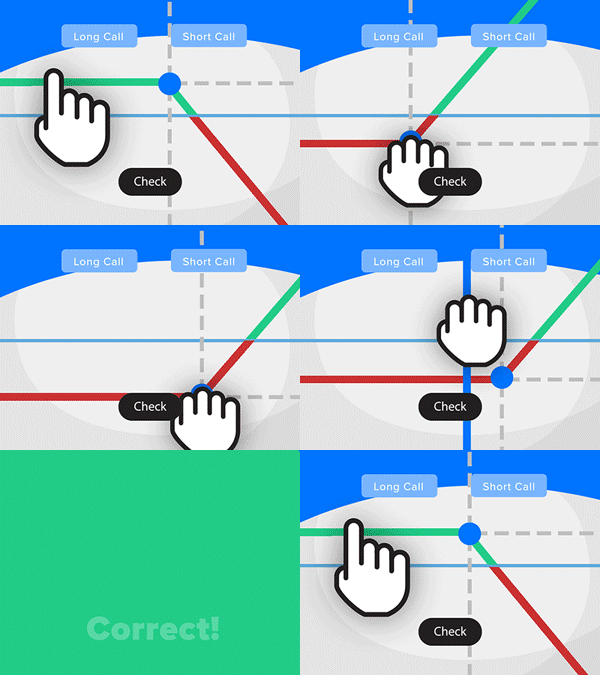
- Solve real problems with our hands-on interface
- Progress from basic puts and calls to advanced strategies
Interactive Options Course

Posted October 14, 2026 at 2:53 pm

The article “Neural Networks in Finance: Risk and Fraud Management” was originally published on PyQuant News.
In the fast-paced world of financial institutions, maintaining trust and stability through effective risk management and fraud detection is more important than ever. As financial transactions increasingly shift to digital platforms, the complexity and volume of data have skyrocketed. Traditional methods are falling short, making way for neural networks—an advanced subset of artificial intelligence (AI)—to transform the financial industry. This article explores how neural networks enhance risk management and fraud detection, delving into their mechanisms, benefits, challenges, and future prospects.
Neural networks, inspired by the architecture of the human brain, consist of interconnected nodes (neurons) that excel in processing and analyzing data. These networks are exceptional at identifying patterns, making predictions, and learning from vast datasets. In financial institutions, neural networks are increasingly used to enhance risk management in finance and bolster fraud detection systems.
Neural networks consist of multiple layers: an input layer, one or more hidden layers, and an output layer. Each neuron in these layers receives inputs, processes them, and passes the output to the next layer, thereby facilitating complex computations.
For risk management in finance and fraud detection, neural networks are trained on vast datasets of historical transactions. By learning from past patterns of legitimate and fraudulent activities, these networks can identify anomalies and predict future risks with remarkable accuracy.
Neural networks present several advantages over traditional risk management methods, including:
One of the most impactful applications of neural networks in financial institutions is credit scoring. Traditional models like the FICO score rely on a limited set of variables. In contrast, neural networks can analyze a broader range of data, including transaction history, social media activity, and even behavioral patterns. This holistic approach results in more accurate credit scores, reducing the risk of defaults and enabling financial institutions to extend credit to a broader customer base.
Stress testing and scenario analysis also benefit greatly from neural networks. By simulating various economic scenarios, these networks can predict the impact on an institution’s portfolio, helping to identify vulnerabilities and develop contingency plans. This capability is particularly valuable in times of economic uncertainty, such as the COVID-19 pandemic, where traditional models may fall short.
Another critical area benefiting substantially from neural networks is fraud detection. Financial fraud is a pervasive issue, costing institutions billions of dollars annually. Neural networks enhance fraud detection systems in several ways:
Neural networks are particularly effective in transaction monitoring for fraud. They can analyze a multitude of factors, such as transaction amount, location, frequency, and user behavior, to identify anomalies. For example, if a customer’s spending pattern suddenly deviates from their usual behavior, the neural network can flag the transaction for further review. This proactive approach minimizes the window of opportunity for fraudsters and reduces financial losses.
In addition to transaction monitoring, neural networks are used for identity verification. By analyzing biometric data, such as facial recognition and fingerprint scans, neural networks can authenticate users with high accuracy. This technology is especially valuable in preventing identity theft, a growing concern in the digital age.
Despite the numerous benefits, implementing neural networks in financial institutions comes with its own set of challenges:
The future of neural networks in financial institutions appears highly promising. As technology advances, we can expect to see even more sophisticated applications of neural networks in risk management and fraud detection. Some emerging trends include:
For those keen to delve deeper into the intersection of neural networks and finance, the following resources are invaluable:
Neural networks are revolutionizing risk management and fraud detection in financial institutions by offering unprecedented accuracy, adaptability, and efficiency. While challenges remain, the potential benefits far outweigh the hurdles. As technology continues to evolve, neural networks will play an increasingly critical role in safeguarding the financial industry, ensuring its resilience in the face of emerging threats and uncertainties. Financial institutions that embrace this technology will be better equipped to maintain trust and stability in an ever-changing landscape.
By understanding and leveraging the power of neural networks, financial institutions can enhance their risk management and fraud detection capabilities and pave the way for a more secure and efficient financial ecosystem.
Information posted on IBKR Campus that is provided by third-parties does NOT constitute a recommendation that you should contract for the services of that third party. Third-party participants who contribute to IBKR Campus are independent of Interactive Brokers and Interactive Brokers does not make any representations or warranties concerning the services offered, their past or future performance, or the accuracy of the information provided by the third party. Past performance is no guarantee of future results.
This material is from PyQuant News and is being posted with its permission. The views expressed in this material are solely those of the author and/or PyQuant News and Interactive Brokers is not endorsing or recommending any investment or trading discussed in the material. This material is not and should not be construed as an offer to buy or sell any security. It should not be construed as research or investment advice or a recommendation to buy, sell or hold any security or commodity. This material does not and is not intended to take into account the particular financial conditions, investment objectives or requirements of individual customers. Before acting on this material, you should consider whether it is suitable for your particular circumstances and, as necessary, seek professional advice.
Interactive Brokers does not guarantee the accuracy or completeness of the data and information provided through the AI service that you choose independently. Information provided using AI integration is not investment advice or a recommendation from Interactive Brokers. Interactive Brokers is not responsible for any investment decision you take in reliance on information generated through the AI integration. You should independently verify information before more making any trading or investment decisions. The Instructions are created based on information provided by your AI service and may not be accurate or reflect what you wish to do. You are responsible for carefully reviewing the Instructions, editing them as appropriate, and deciding if you wish to convert your Instruction to an order on the IBKR platform. All trademarks, logos, and brand names are the property of their respective owners and are used for identification purposes only and does not imply endorsement.








Join The Conversation
For specific platform feedback and suggestions, please submit it directly to our team using these instructions.
If you have an account-specific question or concern, please reach out to Client Services.
We encourage you to look through our FAQs before posting. Your question may already be covered!