
- Solve real problems with our hands-on interface
- Progress from basic puts and calls to advanced strategies
Interactive Options Course

Posted July 24, 2026 at 10:51 am
Investopedia is partnering with All Star Charts on this newsletter. The contents of this newsletter are for informational and educational purposes only.
Here’s something almost nobody knows about the number everyone quotes.
The US Dollar Index is supposed to measure the dollar against the world. It holds six currencies.
The euro is 57.6% of it.
The yen is another 13.6%.
That’s 71% of the entire index sitting in two currencies. The pound, the Canadian dollar, the krona and the franc split whatever’s left.
So when you see a headline that says the dollar is breaking out, what you’re actually being told is that the euro and the yen got weaker. Those are not the same statement, and the difference is about to matter a lot.
Where those weights came from
The Fed set them in 1973. They’ve been changed exactly once, in 1999, when the euro swallowed five separate European currencies.
That’s it. Fifty-plus years, one adjustment.
China isn’t in the basket. Neither is Mexico. Two of the largest trading partners this country has, completely absent from the index that’s supposed to represent American trade.
You’re looking at a snapshot of the world from the Nixon administration and calling it a dollar reading.
Why this matters right now
DXY is at 101.49, pressing on a ceiling it has failed to break four separate times since April of last year. A clean break would be a big deal.
And there’s a real case for it. The Fed held at 3.50-3.75% in June, and nine of eighteen officials put at least one hike in their 2026 projections. Three months earlier the bias was toward cuts. September hike odds have swung between 58% and 70% inside a single week. FOMC decides July 29.
Add the Strait of Hormuz flaring again, oil staying elevated, and you get inflation expectations and safe-haven demand pushing the same direction.
Which is why nobody on Wall Street agrees on what happens next.
Natixis says DXY falls to 98 by year-end. FXStreet says buy the dips. AhaSignals ran the US-Germany yield spread and got an implied dollar near 99.20 against an actual reading of 101.17, meaning by their math it’s already trading richer than rates justify.
Three serious shops. Three different answers. One index everybody’s staring at.
So we ran the same measurement a different way
Take the dollar against the euro, pound, Canadian dollar, Australian dollar, New Zealand dollar, yen, Swiss franc, Swedish krona and Norwegian krone. Nine pairs, equal weight, nothing dominant.
If the dollar is genuinely strengthening, both versions should agree.
For more than a year, they did. Same rounded bottom starting last April. Same ceiling overhead. Same failed attempts in the same places. Two charts, one story.
Then look at what just happened.
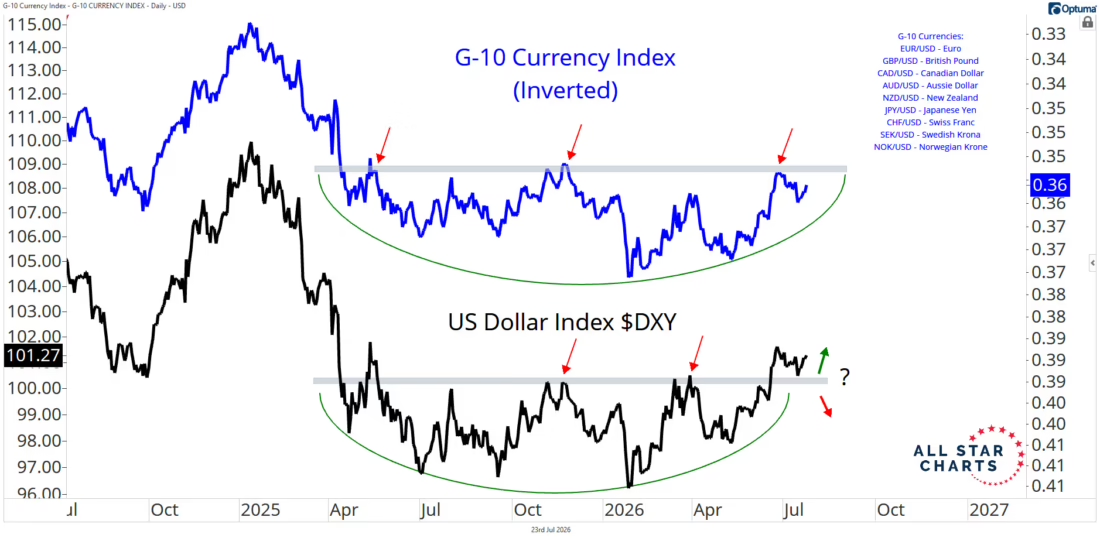
DXY is pushing through. The equal-weight version is still stuck under its own ceiling.
That’s the first time these two have disagreed in over a year, and it’s happening right when everyone’s calling a breakout.
What the split is telling you
Dollar strength right now is concentrated, not broad. It’s the euro and the yen being weak, and the index is built in a way that turns that into a headline about the dollar.
Here’s the part that should bother a bull. If the strength really is just those two currencies, a hawkish Fed on July 29 doesn’t fix it. It just makes those same two currencies weaker and prints another green candle on a chart that isn’t measuring what people think it’s measuring.
The honest counter, because there is one
The DXY is the benchmark. Futures trade against it. Hedges reference it. Institutional positioning is measured by it. Dated weights or not, capital moves through that index, and a breakout has mechanical consequences regardless of what an equal-weight version says.
And the euro and yen aren’t random. They’re the second and third most-traded currencies on earth. Both being weak at once is real information, not noise to filter out.
Fair enough. But a breakout confirmed by two currencies is a different animal than one confirmed across nine, and historically those two resolve differently. That’s the whole argument.
This isn’t really about the dollar
Every weighted index has this problem.
A cap-weighted stock index can print record highs while most of its members go down. A sector fund can look unstoppable because two holdings are carrying it. The weighting decides what the chart is actually telling you, and almost nobody checks.
The equal-weight version is the control group. Agreement means the move is real. Divergence means the headline number is describing its biggest components and nothing else.
For the dollar today, that test is unresolved. Which is why we’re watching both instead of one.
This is the whole job during earnings season
You watch a stock beat estimates and drop 8%.
Another one misses and rips 12%.
The print isn’t what matters. The setup underneath it is, and that setup is visible before the report if you know what to look at.
That’s what the Beat Report does. It finds the companies with the strongest setups going into their number, and pairs each one with a short-term options strategy built to capture the move.
And right now you get it twice.
For Christmas in July, every dollar you spend comes back to you as credit toward anything else we offer that you don’t already own. Spend $500, get $500 to put toward another service. It’s buy one, get one, on your terms.
Ends Monday, July 27 at midnight ET.
Get the Beat Report and your matching credit.
— The AllStarCharts Team
—
Originally posted 24th July 2026
Investopedia.com: The comments, opinions and analyses expressed herein are for informational purposes only and should not be considered individual investment advice or recommendations to invest in any security or to adopt any investment strategy. While we believe the information provided herein is reliable, we do not warrant its accuracy or completeness. The views and strategies described on our content may not be suitable for all investors. Because market and economic conditions are subject to rapid change, all comments, opinions and analyses contained within our content are rendered as of the date of the posting and may change without notice. The material is not intended as a complete analysis of every material fact regarding any country, region, market, industry, investment or strategy. This information is intended for US residents only.
Information posted on IBKR Campus that is provided by third-parties does NOT constitute a recommendation that you should contract for the services of that third party. Third-party participants who contribute to IBKR Campus are independent of Interactive Brokers and Interactive Brokers does not make any representations or warranties concerning the services offered, their past or future performance, or the accuracy of the information provided by the third party. Past performance is no guarantee of future results.
This material is from Investopedia and is being posted with its permission. The views expressed in this material are solely those of the author and/or Investopedia and Interactive Brokers is not endorsing or recommending any investment or trading discussed in the material. This material is not and should not be construed as an offer to buy or sell any security. It should not be construed as research or investment advice or a recommendation to buy, sell or hold any security or commodity. This material does not and is not intended to take into account the particular financial conditions, investment objectives or requirements of individual customers. Before acting on this material, you should consider whether it is suitable for your particular circumstances and, as necessary, seek professional advice.
There is a substantial risk of loss in foreign exchange trading. The settlement date of foreign exchange trades can vary due to time zone differences and bank holidays. When trading across foreign exchange markets, this may necessitate borrowing funds to settle foreign exchange trades. The interest rate on borrowed funds must be considered when computing the cost of trades across multiple markets.
Spot currencies are not available at IBKR Singapore.
Related Articles

















Join The Conversation
For specific platform feedback and suggestions, please submit it directly to our team using these instructions.
If you have an account-specific question or concern, please reach out to Client Services.
We encourage you to look through our FAQs before posting. Your question may already be covered!