
- Solve real problems with our hands-on interface
- Progress from basic puts and calls to advanced strategies
Interactive Options Course

Posted January 2, 2026 at 10:00 am
The energy markets in 2025 were marked by frequent trade tensions and geopolitical uncertainties, at times masking the structural transitions occurring within both natural gas and oil markets. Will 2026 be more of the same? Here are five defining factors for 2026 energy markets.
2026 kicks off what some are calling a tsunami of global liquefied natural gas (LNG) expansions. The commissioning of new LNG liquefaction capacity from 2026 to 2028 is expected to be the largest LNG supply expansion in human history.
Natural gas traders will carefully eye the progression of the U.S. LNG projects already in the start-up phase, as well as those expected to commission in 2026 and 2027. LNG expansion means large increases in U.S. feedgas demand and any delays in expected growth in feedgas demand could weigh on Henry Hub futures prices, which have rallied to over $4.70/mmbtu as of December 2025.
2026 expansions in LNG also include the 4.3 bcf/d North Field East (NFE) project in Qatar. Between NFE, U.S. projects and a handful of brownfield expansions, the global supply pool will swell. The trajectory for Henry Hub, as well as its spread against European and Asian natural gas prices, will be defined in part by the fluctuation in timelines for these giant projects.
Many oil market dynamics that marked 2025 – from resilient non-OPEC growth, geopolitical tensions and sanctions with major producers and the defining hand of the OPEC+ team – look set to continue in 2026.
Despite WTI crude oil prices dipping below $60 per barrel in 2025, non-OPEC oil supply growth is expected to continue, with experts citing over 1 million barrels per day (b/d) in 2026. Growth is coming from resilient Canadian oil sands, Brazil and Guyana, while U.S. output is seen as flat or declining.
At the same time, the late-2025 sanctions crackdown on Russia and Iran has led to a large build up of oil at sea and impaired ability to export. Data from ship tracking firm Vortexa shows that approximately 70 million barrels from sanctioned nations were in floating storage as of November 2025. Traders will be closely tracking developments in sanction pressures, which could further limit supplies. On the other hand, any easing of sanctions that would instantaneously unleash the built-up oil on the water would also be disruptive and likely bearish for oil prices.
The level to which volatility, pricing pressure, new supply or sanction impacts could impact oil prices will depend in part on OPEC+ policy. OPEC+’s decision in November to pause further output increases through the first quarter of 2026 acknowledges a looming surplus as well as the cohesiveness to pivot when market conditions dictate.
The 2026 balancing act for oil doesn’t stop with suppliers. Although China is no longer the engine of oil demand growth it once was, the nation can still have significant influence on markets through its unparalleled ability to swing the quantity of oil it buys and the gasoline and diesel it sells into the global pool.
China’s desire to fill massive and growing strategic petroleum reserves at a lower price point has helped absorb a portion of excess oil supplies in 2025, effectively removing these barrels from commercial trade. On the other hand, limited export quotas have throttled China’s refining capacity, helping to support global gasoline and diesel margins.
Whether these policies will continue in 2026 remains to be seen. The first and largest batch of refined product export quotas issued by China’s Ministry of Commerce (MOFCOM) typically come in January. If MOFCOM releases a high volume of exports, it would likely flood the Asian market with cheap gasoline and diesel, a move that would reverberate all the way to New York Harbor. A high export quota could be bullish for crude oil, since it could be interpreted as a sign that China will continue buying additional volume, although in this case for refining rather than storage. China’s decisions to buy oil to refine and export are poised to become defining factors for WTI, RBOB gasoline and ULSD futures prices in 2026.
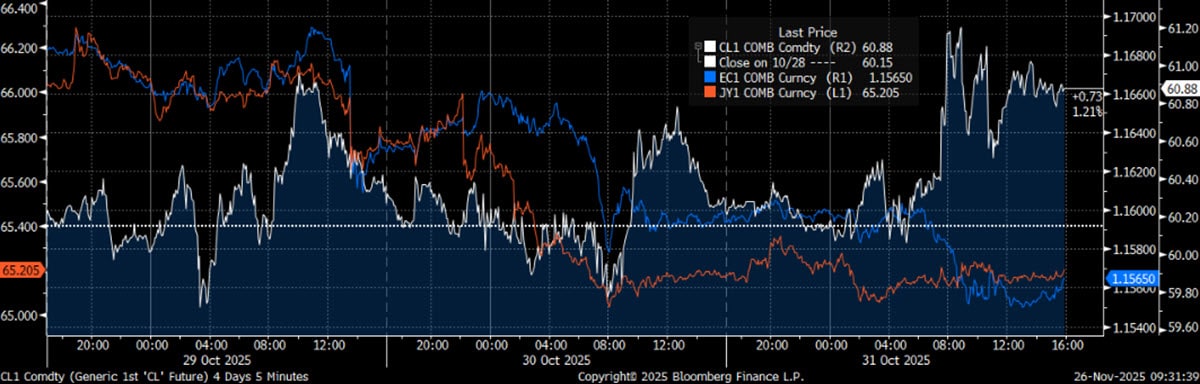
While the oil market looks oversupplied or at best balanced in 2026, the foreign exchange market may be setting up for volatility. Across most investment houses, the U.S. dollar is forecast to weaken further in 2026, driven by loosening U.S. monetary policy and tariff and trade uncertainty. But the path is unlikely to be straight: the pace and depth of Federal Reserve Bank cuts versus those of the European Central Bank or the Bank of Japan, U.S. debt ceiling politics and tariff policy surprises are expected to drive volatility in the U.S. dollar.
A structurally weaker dollar has historically provided a bullish background for crude oil. This stems from cost: when the dollar is weaker, the U.S.-dollar denominated commodity is cheaper for non-U.S. buyers, hence boosting demand. However, this relationship has ebbed in recent years, with oil and the U.S. dollar showing a more positive correlation.
Central bank announcements and economic releases that drive volatility in the dollar create the potential for secondary effects in oil. Oil traders will likely be watching these FX events as closely as EIA Weekly reports, as some of the biggest oil moves in 2026 may not come directly from barrels but from FX repricing.
The explosive growth in data center infrastructure supporting artificial intelligence (AI) is synonymous with an explosive growth in energy consumption. Data centers are power-hungry, with energy costs making up 30% to 60% of data center operating expenses. Power consumption, rather than GPU or square footage, is a typical indicator of project scale. As a result, 2026 electricity demand is estimated to rise by over 2%, the highest rate in over 15 years.
The result is a frantic race for power. Utilities and developers are scrambling to meet the load, challenged by a backlog of gas turbines, regulatory hurdles and long interconnection queues. This race is a defining factor for the electricity market in 2026, but the impact of data center demand goes well beyond power.
In 2024 and 2025, AI and data-center-related stocks were responsible for approximately 75% of the S&P 500’s total returns, effectively carrying the broader market. This financial dependence is rooted in tangible economic activity; economists estimate that data center investment alone accounts for 1% of U.S. GDP growth in 2025. With a strong correlation between oil demand, oil price and the stock market, AI is also a defining factor for WTI in 2026.
With OPEC+, China and geopolitics still top of mind, 2025 playbooks don’t need to be entirely rewritten. With 2026 looking set to bring structural change to some parts of the energy market, traders should have plenty of new and familiar opportunities in the coming year.
—
Originally Posted December 11, 2025 – Five Things To Watch In Energy Markets in 2026
© [2023] CME Group Inc. All rights reserved. This information is reproduced by permission of CME Group Inc. and its affiliates under license. CME Group Inc. and its affiliates accept no liability or responsibility for the information contained herein, including but not limited to the currency, accuracy and/or completeness of this information, and delays, interruptions, errors or omissions. This information is an unofficial copy and may not reflect the official and accurate version. For the definitive and up-to-date version of any of this information, please see cmegroup.com.
Information posted on IBKR Campus that is provided by third-parties does NOT constitute a recommendation that you should contract for the services of that third party. Third-party participants who contribute to IBKR Campus are independent of Interactive Brokers and Interactive Brokers does not make any representations or warranties concerning the services offered, their past or future performance, or the accuracy of the information provided by the third party. Past performance is no guarantee of future results.
This material is from CME Group and is being posted with its permission. The views expressed in this material are solely those of the author and/or CME Group and Interactive Brokers is not endorsing or recommending any investment or trading discussed in the material. This material is not and should not be construed as an offer to buy or sell any security. It should not be construed as research or investment advice or a recommendation to buy, sell or hold any security or commodity. This material does not and is not intended to take into account the particular financial conditions, investment objectives or requirements of individual customers. Before acting on this material, you should consider whether it is suitable for your particular circumstances and, as necessary, seek professional advice.
Futures are not suitable for all investors. The amount you may lose may be greater than your initial investment. Before trading futures, please read the CFTC Risk Disclosure. A copy and additional information are available at ibkr.com.
There is a substantial risk of loss in foreign exchange trading. The settlement date of foreign exchange trades can vary due to time zone differences and bank holidays. When trading across foreign exchange markets, this may necessitate borrowing funds to settle foreign exchange trades. The interest rate on borrowed funds must be considered when computing the cost of trades across multiple markets.
Spot currencies are not available at IBKR Singapore.
Related Articles


















Join The Conversation
For specific platform feedback and suggestions, please submit it directly to our team using these instructions.
If you have an account-specific question or concern, please reach out to Client Services.
We encourage you to look through our FAQs before posting. Your question may already be covered!