
- Solve real problems with our hands-on interface
- Progress from basic puts and calls to advanced strategies
Interactive Options Course

Posted May 5, 2026 at 12:51 pm
Wall Street is rebounding after Washington officials stated that the US-Iran ceasefire remains in place, suppressing worries about a reescalation in tensions that could drive oil even higher. The development occurs on the heels of attacks across the region occurring just yesterday, as the grapple over control of the Strait of Hormuz continues. Stocks are rallying against this backdrop although Treasurys are barely advancing as technology equities lead and contribute to fresh records for the Nasdaq 100 and Russell 2000 benchmarks. Almost every sector is participating in the upside minus energy, communication services and real estate as hedging demand eases in light of the robust outlook for corporate earnings and quelled Middle East concerns. The economic calendar, furthermore, didn’t stand in the way of the bulls, as ISM-services, JOLTS and new home sales all arrived near expectations while signaling healthy cyclical activity amidst heavy inflationary pressures. Stronger cost forces are indeed weighing on the fixed-income recovery, however, following a session when yields soared in response to anxiety related to an accelerating CPI and an associated Fed hike being priced into 2026’s curve. Additionally, buoyant growth numbers and projections of wider fiscal deficits are also hampering bond gains. Elsewhere, non-energy commodities are all climbing, the greenback is steady and cryptocurrencies and prediction markets are catching bids.
Services activity expanded at the slowest pace of the year as consumer demand decelerated amidst heavy cost pressures. The Institute for Supply Management’s (ISM) Purchasing Managers’ Index delivered an April headline result of 53.6, weaker than the 53.7 projected and the 54 from the prior month. New orders sank from 60.6 to 53.5, as the unchanged 70.7 inflation figure weighed on transaction momentum. Still, business production, backlogs and exports were well above the expansion-contraction threshold of 50, printing 55.9, 53 and 52.1. Hiring remained weak, however, with the 48 number signaling that payroll reductions continued after March’s statistic posted an even deeper 45.2. The report underscores risks to the economic outlook, as tired shoppers contend with adverse price forces that are outpacing wage increases.

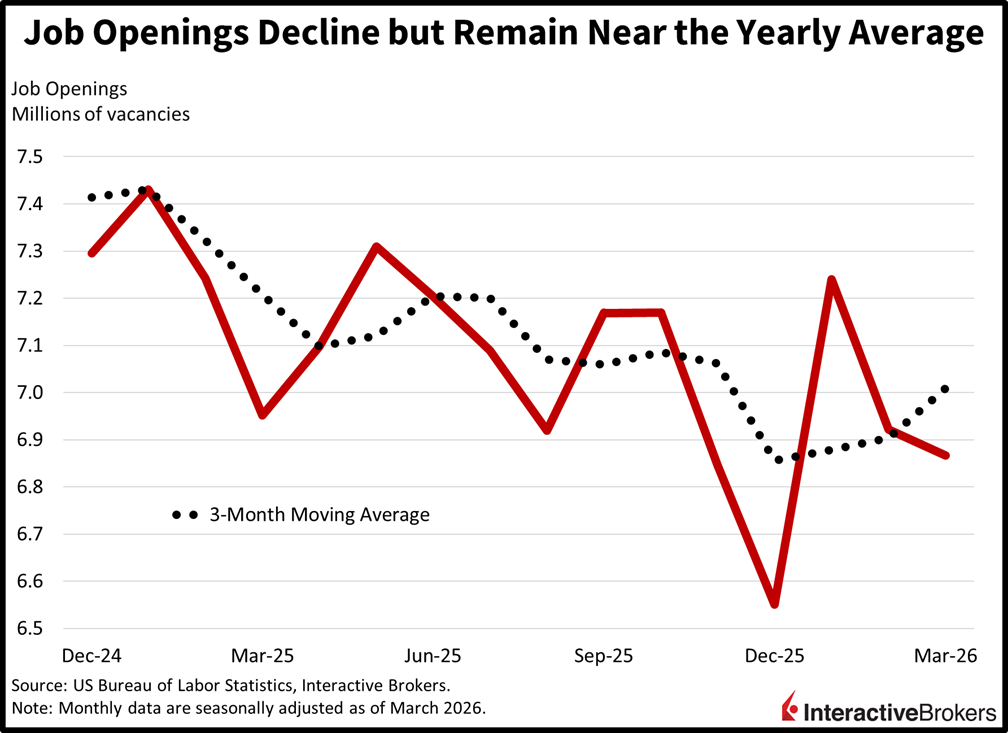
March employment vacancies were virtually unchanged, dropping negligibly from 6.922 million in February to 6.866 million, according to the Job Openings and Labor Turnover Survey (JOLTS). Economists anticipated a slightly steeper decline to 6.860 million. The numbers signal that the hiring and layoff situations remains stable, as firms across the economy sustain their for-hire signs.
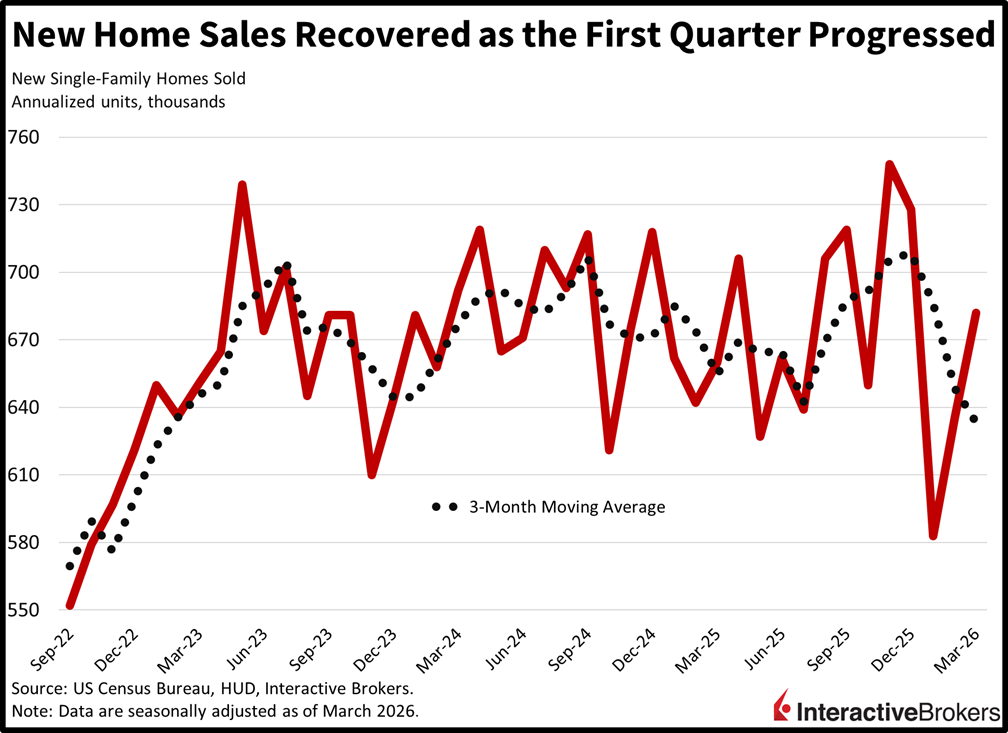
New home sales expanded as the first quarter progressed with all geographies improving from a weak January for real estate. The 682k seasonally adjusted annualized units (SAAU) in March surpassed the 650k expectation as well as the previous two months, which came in at 635k and 583k. February and March were included in this morning’s report because the government shutdown affected the release schedule for the indicator. Inventories grew and pricing slipped to the lowest levels of 2026, as 8.5 months’ supply coincided with median and average closing values of $387.4k and $503.1k. Listings were the softest since December while valuations were the cheapest going back to at least July.
Today’s equity market exuberance stands at odds with fixed-income and oil, which are only reflecting a modest alleviation from the Middle East situation. On the one hand, stocks are optimistic that the geopolitical conflict and its associated disruptions won’t negatively affect the outlook for corporate earnings or for economic growth much, however, crude and yields are still extremely elevated relative to the beginning of the year and increasingly signaling caution going forward. Indeed, WTI remains at $103 a barrel and the Treasury curve is implying a 28% chance of a hike by year-end, while the probability of a cut is at just 8% as the government debt complex pushes back against quickly accelerating price pressures. Investors are certainly bullish on stronger profit projections from the tech sector and appear unwilling to believe that a Trump chosen Kevin Warsh will lift rates in response to a CPI that is rising ahead of 4% this month. A monetary policy institution that tolerates above-target inflation is constructive to appreciating stock prices, and that’s been a major contributor to the ongoing bull market.
The Reserve Bank of Australia (RBA) hiked its key interest rate from 4.10% to 4.35% this morning, a widely expected move, but it also warned that the action may have little impact on limiting future price pressures. It was the third consecutive meeting in which the bank lifted the benchmark and was followed by Reserve Bank Michele Bullock opining that the soaring cost of oil triggered by the US-Iran war will cause price hikes throughout the country’s economy and that this morning’s RBA actions “are not going to do anything for inflation in the next six months.” The Consumer Price Index is now forecast to hit 4.8% during the quarter. Prior to the US-Iran war, the RBA anticipated it would peak at 4.2%.
After falling 4.3% month over month (m/m) in February, retail sales in Singapore bounced back in March with a 3.7% jump. Relative to March of 2025, sales were 4.8% higher after climbing 8.3% year over year (y/y) in February. With higher gasoline costs, the petrol service stations category led the m/m ascent with a 16.2% increase. Other categories experiencing significantly stronger cashier transactions and the extent of the increases were as follows:
The recreational goods category, however, had the worst showing, recording a 9% decline. Other categories with contracting results and the extent of the drops were as follows:
The value of Canada’s goods exports in March exceeded imports by $1.78 billion, a strong reversal from the $5.11 billion trade deficit in February and substantially better than the economist consensus estimate for a $2.4 billion shortfall. It was the first surplus since January 2025 when exports exceeded imports by $3.95 billion. Goods shipped beyond the country’s borders jumped 8.5% while imports slipped 1.6%, according to Statistics Canada. The recent surplus was driven, in large part, by metal and non-metallic mineral product exports climbing 24.0% to a record $15.3 billion. The growth was driven by an ascent of gold purchased by the United Kingdom. Higher oil prices, furthermore, pushed up the value of energy exports by 15.6% to $17.1 billion, the highest level since September 2022. Among 11 product groups, demand from foreign countries increased in seven, although when excluding energy and the category of metal and non-metallic mineral products, the rise in goods shipped beyond the country’s borders was only 1.1%.
Hong Kong’s first-quarter gross domestic product (GDP) grew 5.9% y/y, according to a preliminary release. The result is notable acceleration from the 3.8% expansion in the preceding period and stronger than the economist consensus estimate for positive 3.5% rate. When compared to the final quarter of 2025, GDP was 2.9% higher following the 1% fourth-quarter growth. Exports were a key driver of the economic expansion, according to Financial Secretary Paul Chan Mo-po.
New to Interactive Brokers?
Open AccountInformation posted on IBKR Campus that is provided by third-parties does NOT constitute a recommendation that you should contract for the services of that third party. Third-party participants who contribute to IBKR Campus are independent of Interactive Brokers and Interactive Brokers does not make any representations or warranties concerning the services offered, their past or future performance, or the accuracy of the information provided by the third party. Past performance is no guarantee of future results.
This material is from IBKR Macroeconomics, an affiliate of Interactive Brokers LLC, and is being posted with its permission. The views expressed in this material are solely those of the author and/or IBKR Macroeconomics and Interactive Brokers is not endorsing or recommending any investment or trading discussed in the material. This material is not and should not be construed as an offer to buy or sell any security. It should not be construed as research or investment advice or a recommendation to buy, sell or hold any security or commodity. This material does not and is not intended to take into account the particular financial conditions, investment objectives or requirements of individual customers. Before acting on this material, you should consider whether it is suitable for your particular circumstances and, as necessary, seek professional advice.
Trading in digital assets, including cryptocurrencies, is especially risky and is only for individuals with a high risk tolerance and the financial ability to sustain losses. Eligibility to trade in digital asset products may vary based on jurisdiction.
Related Articles

















Join The Conversation
For specific platform feedback and suggestions, please submit it directly to our team using these instructions.
If you have an account-specific question or concern, please reach out to Client Services.
We encourage you to look through our FAQs before posting. Your question may already be covered!