
- Solve real problems with our hands-on interface
- Progress from basic puts and calls to advanced strategies
Interactive Options Course

Posted September 11, 2026 at 1:13 pm
Stocks are staging a relief rally and are advancing for the first session in five in response to the annualized core CPI plunging to a 64-month low. Even though a hotter-than-anticipated monthly number lifted the odds of a rate hike this Wednesday to a staggering 87%, fixed income as a whole is benefiting from WTI crude finding resistance at $100 on news that Tehran and nearby Gulf leaders will meet soon to seek a deal that could facilitate traffic through the critical Strait of Hormuz. The bifurcation has the Treasury curve shifting in split fashion amidst an unchanged greenback, with the monetary policy sensitive short end rising, while duration falls subsequent to the 10-year encountering a plethora of buyers right under 5%, reaching a peak of 4.992% today prior to retreating to 4.91%. Sinking oil prices have participants overlooking substantially heavier inflation expectations stemming from the UMich Consumer Sentiment Index, while the headline reading arrived significantly below projections, plummeting to its second lowest print ever. Additionally, a blockbuster earnings report from Oracle also energized AI enthusiasm and drove investors to buy dips across tech. But it’s a broad climb on Wall Street, with every sector and major benchmark gaining. Cryptocurrencies, precious metals and cyclical commodities aren’t being left behind either as they jump materially. Risk-on attitudes have traders dropping volatility protection instruments; however, they are gravitating to prediction markets, especially contracts related to next week’s central bank decision.
Inflation hit its fastest pace since May last month, as escalating hostilities between the US and Iran pushed up fuel charges amidst broad lifts in most other categories. The August Consumer Price Index (CPI) climbed 0.4% month over month (m/m) and 3.4% year over year (y/y) following July’s 0.1% and 3.4% print. And while the headline numbers met expectations, the core version was slightly hotter than projections, posting a 0.3% m/m lift versus the 0.2% anticipated. The 2.4% y/y clip was the weakest in 64 months, however, illustrating that without the Middle East conflict, cost pressures would be in the vicinity of the Fed’s 2% target. Among segments, fuel oil, gasoline, transportation services, used cars/trucks, food at dining establishments, new automobiles, and shelter became 10.1%, 3.9%, 0.5%, 0.4%, 0.3%, 0.3% and 0.3% more expensive m/m. Conversely, heating services, medical care and electricity provided relief as they became 1.1%, 0.2% and 0.2% cheaper m/m, while food at markets was unchanged.

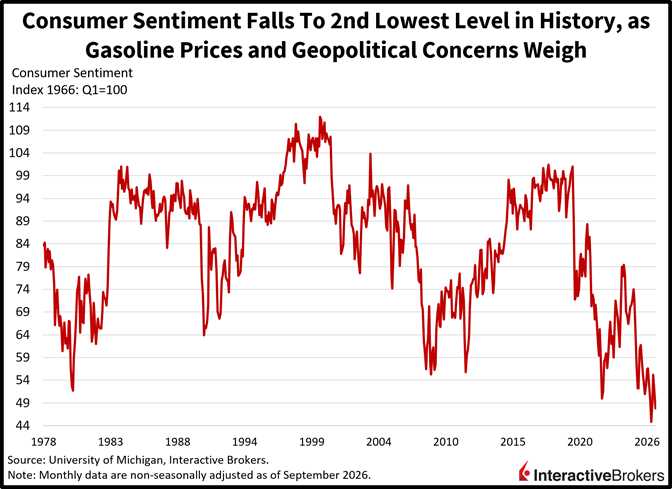
Household moods soured this month to the second weakest level ever recorded as the lift in fuel costs accompanied by heavier interest rates and stock market bumpiness weighed on both optimism and outlooks. Indeed, the University of Michigan’s (UMich) Consumer Sentiment Index plunged to 47.8, well beneath the median expectation of 51 and August’s 51.7. The indices reflecting current conditions and the road ahead also weakened, dropping from 51.9 and 51.5 to 50.9 and 45.8. Inflation expectations over 1- and 5-year time horizons rose from 4% and 3.3% to 4.6% and 3.4%, as families anticipate cost pressures to continue weighing on their financial situations.
Wall Street is now setting itself up to not be disappointed by a rate hike next week, as the Treasury complex is effectively demanding that Chair Warsh follow through on his hawkish posture that he expressed during his earlier days at the helm. Moreover, a 25-basis point (bp) increase would likely flatten the yield curve, as duration is poised to respond positively from inflation fighting discipline at the central bank. Meanwhile, this morning’s 2.4% CPI is emblematic of overall price pressures being closer to target than we all think, as the significant 1% spread between core and headline signals that cost forces are geared to plunge towards the 2% monetary policy objective once, and if, this geopolitical conflict is reconciled. The only way to get lower yields while battling Iran; however, would be a reinstitution of the quantitative easing program, as Secretary Bessent’s $6 billion put is simply too weak when compared to a budget deficit north of $2 trillion amidst nosebleed issuance levels from both Washington and AI firms. Nonetheless, the market is cheering the fact that oil appears to want to stay beneath $100 per barrel on West Texas Intermediate (WTI), because if it does, then we may avoid the terrifying 5-handle on the 10-year, which we narrowly missed today by less than 1 bp.
The UK’s economy grew 0.4% m/m and 1.6% year over year y/y in July and exceeded expectations for a flat monthly print and a 1.2% ascent from the year-ago period. The metrics also accelerated from the m/m and y/y results of 0.3% and 1.1% in June, according to the Office for National Statistics. The three-month period to July, furthermore, the economy, or real gross domestic product, was up 0.4% when compared to the three-month period to April. The m/m growth during July benefited from services, production and construction expanding by 0.4%, 0.2% and 0.1%, respectively.
The UK’s total goods and services trade deficit for the three months to July fell from £10.1 billion in the three months to April to £9 billion, according to the Office for National Statistics. The value of goods shipped beyond the UK’s borders climbed 2.8% while imports were up only 2.4%, which caused the goods trade deficit to sink by £400 million to £61.6 billion. Services exports, meanwhile, climbed 1.4% while imports grew only 0.7%, which caused the sector’s trading surplus to climb by £700 million to £52.6 billion.
In releasing the data, the Office for National Statistics also reported that the value of goods exports climbed 2.8% in July m/m and imports ascended by only 2.4%. During the month, goods exports to the European Union (EU) and non-EU countries climbed 5.2% and 0.6%, respectively. Goods imports from non-EU markets were up by 6.7% but EU countries experienced a 1.4% decline in the value of shipments sent to the UK. Services exports in July, however, expanded by 0.5% m/m, which trailed the 0.7% jump in imports.
UK consumer views of current price pressures and future inflation have eased slightly from May, according to the latest figures from the Bank of England. The organization’s Inflation Attitudes Survey for August 2026 featured a media answer of 4.9% when individuals were asked to identify the current rate of price increases. That’s down from 5% in May. The median expectation for inflation over the coming year, furthermore, fell from 4% in May to 3.2%. Regarding future interest rates, 51% of respondents said they expect financing costs to climb during the coming 12 months. In May, 53% of respondents said they expected rates to rise.
Japan’s Producer Price Index depicted wholesale prices falling 0.2% m/m in August, a weaker showing than the economist consensus expectation for no change and a reversal from July’s 0.4% ascent. Prices eased, however, on y/y basis with August’s 7.6% pace down from 7.7% in July. Despite the marginal decline, the print was still hotter than the economist consensus estimate of 7.4%. Within the headline m/m print, the scrap and waste classification and the agricultural, forestry and fishery products categories sank by 4.7% and 2.3%. Other items that became less costly and the extent of their changes were as follows:
The m/m decline was driven by weakness in both import and export wholesale prices, which sank 3% and 0.7%, respectively, on a constant yen basis. The cost of petroleum, coal and natural gas imports slipped by 6.1% while lumber and the category of chemicals and related products that came from foreign markets sank 2.2% and 2.3%.
New to Interactive Brokers?
Open AccountInformation posted on IBKR Campus that is provided by third-parties does NOT constitute a recommendation that you should contract for the services of that third party. Third-party participants who contribute to IBKR Campus are independent of Interactive Brokers and Interactive Brokers does not make any representations or warranties concerning the services offered, their past or future performance, or the accuracy of the information provided by the third party. Past performance is no guarantee of future results.
This material is from IBKR Macroeconomics, an affiliate of Interactive Brokers LLC, and is being posted with its permission. The views expressed in this material are solely those of the author and/or IBKR Macroeconomics and Interactive Brokers is not endorsing or recommending any investment or trading discussed in the material. This material is not and should not be construed as an offer to buy or sell any security. It should not be construed as research or investment advice or a recommendation to buy, sell or hold any security or commodity. This material does not and is not intended to take into account the particular financial conditions, investment objectives or requirements of individual customers. Before acting on this material, you should consider whether it is suitable for your particular circumstances and, as necessary, seek professional advice.
Futures, event contracts, and forecast contracts are not suitable for all investors. Before trading these products, please read the CFTC Risk Disclosure. For a copy, visit our Warnings and Disclosures Page.
Investments in certain commodities (precious metals) may be subject to significant price volatility and often involve risks related to market fluctuations, liquidity constraints, geopolitical events, and changes in global economic conditions that could adversely affect their value.
Trading in digital assets, including cryptocurrencies, is especially risky and is only for individuals with a high risk tolerance and the financial ability to sustain losses. Eligibility to trade in digital asset products may vary based on jurisdiction.
Related Articles
















Join The Conversation
For specific platform feedback and suggestions, please submit it directly to our team using these instructions.
If you have an account-specific question or concern, please reach out to Client Services.
We encourage you to look through our FAQs before posting. Your question may already be covered!