
- Solve real problems with our hands-on interface
- Progress from basic puts and calls to advanced strategies
Interactive Options Course
Posted May 14, 2026 at 7:27 am
Investopedia is partnering with All Star Charts on this newsletter. The contents of this newsletter are for informational and educational purposes only.
The stock market is calm. Bank stocks are not.
The S&P 500 is near a record high, and the VIX (the measure of how nervous traders are about a crash) is calmer than it has been in months.
By any headline measure, everything looks fine.
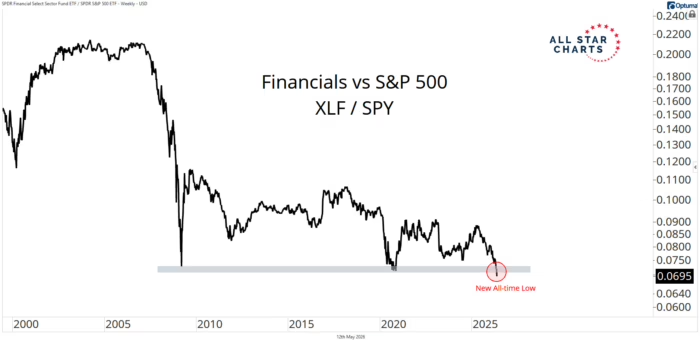
But underneath the headlines, the chart of financials compared to the rest of the market just broke to its lowest reading ever.
That is worse than the 2008 financial crisis, worse than the March 2020 COVID low, and worse than any point in the 28-year history of the data.

Two ETFs matter here. SPY tracks the S&P 500, which most people own in some form through their 401(k). XLF holds the biggest financial sector stocks: JPMorgan Chase, Bank of America, Berkshire Hathaway, Visa, and Mastercard.
Divide one by the other. The XLF to SPY ratio tells you whether banks are doing better or worse than the rest of the market. That ratio peaked in early 2007 and has been falling almost continuously since, but it just broke to its lowest reading in the 28 years XLF has been trading.
Why does this matter?
Because banks are the engine room of the economy, lending money to businesses that want to expand, families buying homes, and credit cards funding everyday spending.
When banks pull back, downstream activity slows with them. That is why investors who study market history watch bank stocks as a leading indicator, since they tend to be a gauge for the broader market.
What Makes This Signal Different
In 2008 and 2020, the broader market was already in trouble when banks broke down. The VIX was elevated. Headlines were scary. The bank chart’s warning was redundant with everything else investors were seeing.
This time, the broader market is at record highs, and the VIX is calm. Nobody is panicking. So if it is not panic pushing bank stocks down, what is it?
The current weakness is sector-specific.
Net interest margins (how much profit banks make on each loan) have been squeezed. Mortgage activity is roughly 68 percent below the pandemic-era peak.
And the Financial Stability Board, an international watchdog, just published a report on May 6 warning about risks in private credit, a $1.5 to $2 trillion corner of finance where banks have quietly built up exposure and where a handful of high-profile blowups have already cost regional banks real money.
In other words, the rest of the market does not see a problem yet.
The part of the market closest to where the actual money flows is acting like there is one.
What to Watch From Here
You do not need to be a Wall Street analyst to use this. Pull up the XLF to SPY ratio on any free charting website, type in XLF/SPY, and check it once a week.
Until XLF starts reclaiming ground relative to SPY, this chart remains one of the more credible early warning signals that the rally may be narrower and more fragile than the headline index suggests.
If you want to learn how I take information just like this and turn it into actionable trades, click here to discover more.
—
Originally posted 13th May 2026
Investopedia.com: The comments, opinions and analyses expressed herein are for informational purposes only and should not be considered individual investment advice or recommendations to invest in any security or to adopt any investment strategy. While we believe the information provided herein is reliable, we do not warrant its accuracy or completeness. The views and strategies described on our content may not be suitable for all investors. Because market and economic conditions are subject to rapid change, all comments, opinions and analyses contained within our content are rendered as of the date of the posting and may change without notice. The material is not intended as a complete analysis of every material fact regarding any country, region, market, industry, investment or strategy. This information is intended for US residents only.
Information posted on IBKR Campus that is provided by third-parties does NOT constitute a recommendation that you should contract for the services of that third party. Third-party participants who contribute to IBKR Campus are independent of Interactive Brokers and Interactive Brokers does not make any representations or warranties concerning the services offered, their past or future performance, or the accuracy of the information provided by the third party. Past performance is no guarantee of future results.
This material is from Investopedia and is being posted with its permission. The views expressed in this material are solely those of the author and/or Investopedia and Interactive Brokers is not endorsing or recommending any investment or trading discussed in the material. This material is not and should not be construed as an offer to buy or sell any security. It should not be construed as research or investment advice or a recommendation to buy, sell or hold any security or commodity. This material does not and is not intended to take into account the particular financial conditions, investment objectives or requirements of individual customers. Before acting on this material, you should consider whether it is suitable for your particular circumstances and, as necessary, seek professional advice.
Any discussion or mention of an ETF is not to be construed as recommendation, promotion or solicitation. All investors should review and consider associated investment risks, charges and expenses of the investment company or fund prior to investing. Before acting on this material, you should consider whether it is suitable for your particular circumstances and, as necessary, seek professional advice.
Related Articles















Join The Conversation
For specific platform feedback and suggestions, please submit it directly to our team using these instructions.
If you have an account-specific question or concern, please reach out to Client Services.
We encourage you to look through our FAQs before posting. Your question may already be covered!