
- Solve real problems with our hands-on interface
- Progress from basic puts and calls to advanced strategies
Interactive Options Course

Posted April 8, 2026 at 10:45 am
As we start a brand new quarter in 2026, it also resets the earnings cycle for companies to report their quarterly results — and I believe that Q1 Earnings Season could have a lot in store.
Q4 earnings season at the start of the year gave traders a lot to process. It also set the tone for what to expect for Q1 results. Big Tech continued to dominate headlines. Earnings reports from big names — like the Mag 7 — were driven by massive A.I. spending and strong (but moderating) growth.
Other sectors (financials, healthcare, utilities) showed early signs of catching up, and could give traders a pivotal update on their progress in Q1. At the same time, tariffs, persistent inflation, and geopolitical tensions in the Middle East introduced new layers of uncertainty that companies are still working to navigate.
The overall takeaway?
Earnings held up better than feared, but the market wants to see if (and how) that growth can broaden and sustain.
Expectations are shifting as we head into Q1 Earnings Season. Traders want proof on whether A.I. investments are translating into real returns, how companies are managing rising costs, and what the road ahead could look like amid ongoing global instability.
I’ll break down three of the biggest storylines to watch in Q1 Earnings Season, and which sectors to consider keeping on your radar.
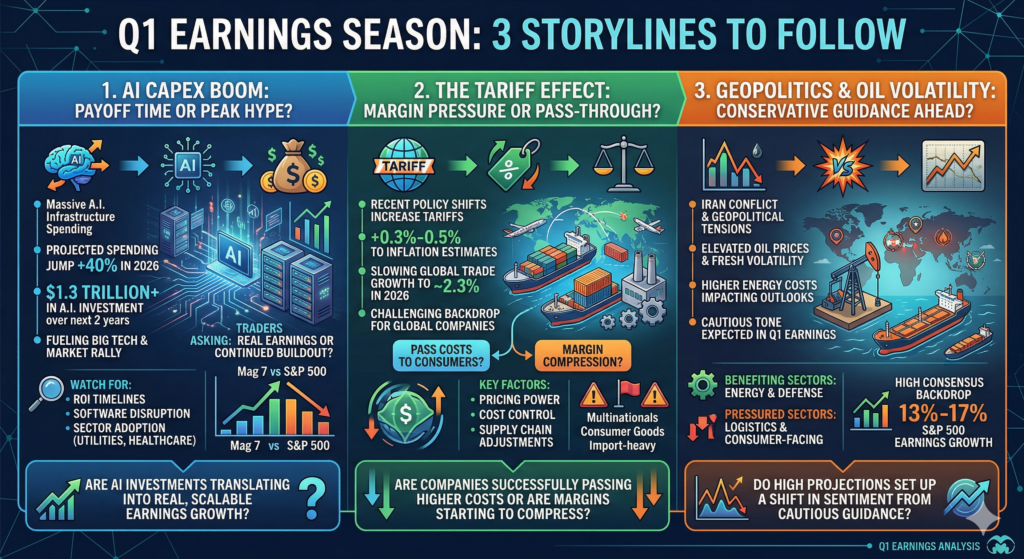
As of late, massive A.I. spending has been one of the market’s biggest forces. Q1 Earnings Season is expected to provide a crucial update on if it’s showing actual results. With spending projected to jump more than 40% in 2026, the largest cloud players are expected to invest over $1.3 trillion into A.I. infrastructure over the next two years. That level of investment has fueled much of the recent market rally, particularly in Big Tech.
Q1 Earnings Season could be a turning point, with traders starting to ask a more important question: Are these investments translating into real, scalable earnings growth…or is this still a capex-heavy buildout phase with returns yet to come?
Growth among the “Magnificent 7” is expected to slow to around 23%. However, the rest of the S&P 500 is projected to post double-digit growth for the first time in years. That shift could signal a broader earnings expansion, or highlight that A.I.-driven gains are still concentrated.
In Q1 Earnings Season, I believe traders should consider paying close attention to the following details:
With tariffs back in focus, I believe Q1 Earnings Season could reveal how companies are handling their impacts. Recent policy shifts have pushed effective tariff rates to levels we haven’t seen in nearly a century. According to estimates, they’re adding roughly 0.3%-0.5% to inflation, while also slowing global trade growth to around 2.3% in 2026.
That combination creates a challenging backdrop for companies operating on a global scale. As Q1 Earnings Season gets under way, I believe traders will be watching closely for how management teams are navigating these pressures.
Here’s the key question: Are companies successfully passing higher costs onto consumers, or are margins starting to compress?
Commentary around pricing power, cost control, and supply chain adjustments will be very telling.
Certain sectors will be under a bigger microscope. Multinational corporations, consumer goods companies, and import-heavy businesses are particularly susceptible to rising input costs and shifting trade dynamics. Any signs that these companies are struggling to protect margins could be reflected in sentiment.
On the flip side, firms that demonstrate resilience could stand out from the rest of the pack. These are companies whose upcoming earnings results are highlighted by strategic sourcing, pricing flexibility, or operational efficiency.
To bring everything full circle, I believe this earnings season could clearly separate those adapting effectively from those beginning to feel the squeeze.
Geopolitical tensions are back in the spotlight — and their effects are showing up directly in energy markets. The Iran Conflict has kept oil prices elevated, injecting a fresh layer of volatility into an already uncertain environment. As a result, many affected companies will likely enter Q1 Earnings Season with a more cautious tone, as higher energy costs begin to affect outlooks.
Just like with tariffs, I believe this earnings cycle could offer a clearer look at how companies are adapting to these conditions. Sectors like energy and defense could continue to benefit from higher demand and pricing strength. Logistics and consumer-facing businesses could feel increasing pressure from rising input costs and potential supply chain disruptions. I’ll be looking to see how companies are planning around these risks, and if they’re adjusting expectations accordingly.
What I believe makes this dynamic especially important is the broader backdrop. Despite these challenges (and like I mentioned earlier), consensus still calls for 13%-17% earnings growth across the S&P 500. These projections set a high bar, and any signs of cautious guidance or margin pressure could drastically shift sentiment.
In this environment, I believe forward-looking commentary could matter just as much — if not more — than the reported numbers.
Volatile markets can be tricky to navigate.
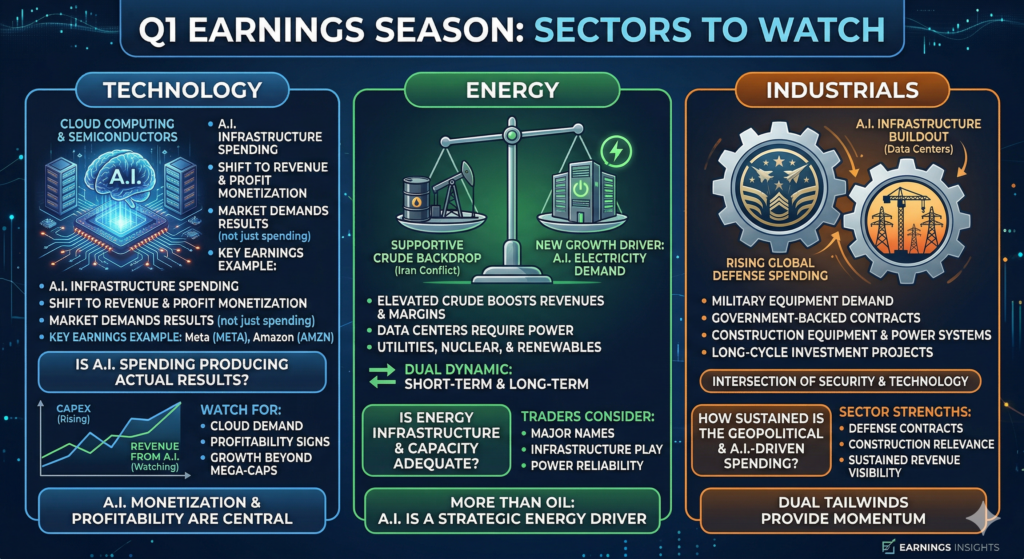
Fueled by massive spending on A.I. infrastructure, cloud computing, and semiconductors, the technology sector continues to sit at the center of the market narrative. Investors are shifting focus from how much companies are spending, to how effectively they’re turning those investments into revenue and profits.
Like I mentioned earlier: While this spending has fueled recent gains, I believe Q1 Earnings Season could signal if it’s beginning to produce actual results.
We saw the importance of this with the Meta Platforms (META) and Amazon (AMZN) reports last earnings season. Although both companies beat expectations, these stocks pulled back sharply amid concerns about the increasing capex on A.I. investments without significant revenue results from that spending. Companies are no longer being rewarded just for spending on A.I.; the market is looking for results.
In this earnings cycle, I believe attention will be on A.I. monetization, cloud demand, and early signs of profitability from these initiatives. Just as important, traders will be watching to see if growth starts to expand beyond a small group of mega-cap leaders — potentially signaling a broader, more sustainable phase for the technology sector.
To reiterate, energy is back in focus. The Iran conflict continues to push oil prices higher, which is creating a supportive backdrop for traditional oil and gas companies. If you missed the oil trade last month, then I think it’s possible that Q1 Earnings Season could potentially offer a short-term window to anticipate playing off quarterly reports from some of the sector’s major energy names.
Having said that, while all eyes have been on the oil play, a new growth driver is also emerging: The surge in electricity demand tied to A.I. infrastructure and data centers. Let’s also not forget alternative clean energy sources, which I covered in a recent article.
This dual dynamic is giving the sector a unique blend of short-term strength and long-term opportunity. On one side, elevated crude prices can boost revenues and margins for major energy producers. On the other, the rapid expansion of A.I. is increasing demand for reliable, large-scale power that brings utilities, nuclear, and renewable energy providers into the spotlight.
As a result, the energy sector is about much more than oil prices. Right now, it’s also about energy infrastructure and capacity. This makes energy one of the more diverse and strategically important areas for traders to consider watching this earnings cycle.
Stocks in the industrials sector are gaining momentum thanks to two powerful tailwinds: Rising global defense spending, and continued investment in A.I. infrastructure.
Current geopolitical tensions are driving higher demand for military equipment, aerospace systems, and defense technologies, creating a steady pipeline of government-backed contracts. At the same time, the rapid buildout of A.I. capabilities are fueling demand for data centers, construction equipment, and energy-related infrastructure.
This puts industrial companies at the intersection of two major macro trends: Security and technology.
Businesses involved in construction, engineering, manufacturing, and power systems are all seeing increased relevance as capital continues flowing into these areas. These trends also go well beyond short-term demand. Many of these projects are long-cycle investments, which can provide sustained revenue visibility.
For traders, I believe this could make industrials a sector worth watching this earnings season, as geopolitical and A.I.-driven spending continue to take shape.
During earnings season, volatility can affect stocks differently in certain stock market sectors.
Q1 Earnings Season kicks off amid a mix of opportunity and caution.
Q4 2025 set the stage, showing strong — but moderating — growth in Big Tech fueled by massive A.I. investments. At the same time, it showed that sectors like financials, healthcare, and utilities showed early signs of catching up. For Q1 results, I believe traders should consider watching for signs of broadening growth beyond a handful of mega-cap leaders…or if it remains concentrated.
Tariffs, inflation, and geopolitical tensions in the Middle East continue to cloud the outlook, impacting energy, logistics, and consumer-facing businesses. Company guidance on margin management, pricing power, and capital allocation will likely drive market sentiment as much as reported numbers.
For traders, I think the main takeaway is clear: Adaptability and selectivity could matter more than ever in Q1 Earnings Season. I would consider focusing on sectors and companies that can deliver returns amid ongoing uncertainty. Stay ready to act as the upcoming earnings cycle reveals the big winners and losers.
Remember — earnings season is only part of the equation. Understanding market conditions, and how to consider trading them is just as important.
Originally Posted on April 6, 2026 – Q1 Earnings Season Preview: What To Expect
IMPORTANT NOTICE: Trading Stock, Stock Options, Cryptocurrencies, and their derivatives involves a substantial degree of risk and may not be suitable for all investors. Currently, cryptocurrencies are not specifically regulated by any agency of the U.S. government. Past performance is not necessarily indicative of future results. Prosper Trading Academy LLC provides only training and educational information. By visiting the website and accessing our content, you are agreeing to the terms and conditions.
Information posted on IBKR Campus that is provided by third-parties does NOT constitute a recommendation that you should contract for the services of that third party. Third-party participants who contribute to IBKR Campus are independent of Interactive Brokers and Interactive Brokers does not make any representations or warranties concerning the services offered, their past or future performance, or the accuracy of the information provided by the third party. Past performance is no guarantee of future results.
This material is from Prosper Trading Academy and is being posted with its permission. The views expressed in this material are solely those of the author and/or Prosper Trading Academy and Interactive Brokers is not endorsing or recommending any investment or trading discussed in the material. This material is not and should not be construed as an offer to buy or sell any security. It should not be construed as research or investment advice or a recommendation to buy, sell or hold any security or commodity. This material does not and is not intended to take into account the particular financial conditions, investment objectives or requirements of individual customers. Before acting on this material, you should consider whether it is suitable for your particular circumstances and, as necessary, seek professional advice.
Related Articles
















Join The Conversation
For specific platform feedback and suggestions, please submit it directly to our team using these instructions.
If you have an account-specific question or concern, please reach out to Client Services.
We encourage you to look through our FAQs before posting. Your question may already be covered!