
- Solve real problems with our hands-on interface
- Progress from basic puts and calls to advanced strategies
Interactive Options Course

Posted July 10, 2026 at 11:30 am
Bending Spoons has become one of the most closely watched European technology stories of 2026. The Milan-based company went public on the Nasdaq Global Select Market under the ticker BSP, with its IPO priced at $29 per share and trading beginning on July 1, 2026. The offering involved nearly 58 million ordinary shares, split between newly issued shares and shares sold by existing shareholders.
The first day of trading immediately attracted attention. According to Reuters, Bending Spoons shares opened above the IPO price and closed at $40.50, giving the company a market value of roughly $25.7 billion. But a strong debut is only the beginning of the story. The more interesting question for investors is not whether the IPO was successful, but what kind of business Bending Spoons is becoming — and what risks come with its unusual model.
Bending Spoons is often described as a technology company, but that definition is incomplete. Its model is closer to a hybrid between a software operator, an acquirer of digital assets, and a turnaround platform.
The company buys digital businesses, integrates them into its internal platform, restructures them, and tries to improve their monetization, efficiency, and product development. Its portfolio includes well-known names such as AOL, Vimeo, Eventbrite, Evernote, WeTransfer, StreamYard, Remini, Meetup, Brightcove, komoot, Issuu, and others. Reuters describes the company’s playbook as focused on buying and revamping struggling or underperforming technology businesses.
This makes Bending Spoons different from many software companies that are built around one core product. Salesforce, for example, historically scaled around CRM software. Adobe scaled around creative software. Spotify around music streaming. Bending Spoons, by contrast, is not tied to a single product category. Its real product may be its operating system: talent, data, technology, pricing experiments, subscription infrastructure, and acquisition discipline.
That distinction matters. If one product matures, declines, or becomes less relevant, the company can theoretically shift its focus to other assets in the portfolio or acquire new ones. At the same time, this model depends heavily on execution. The company must continue to identify attractive targets, finance acquisitions, integrate them, improve them, and retain enough talent to repeat the process.
One way to understand Bending Spoons is to think of it as a “Kitchen Nightmares” model for digital businesses. A restaurant may have a good location, a recognizable brand, and loyal customers, but poor operations. A turnaround specialist can come in, simplify the menu, improve costs, redesign the customer experience, and restore profitability.
Bending Spoons appears to apply a similar logic to technology assets. It acquires businesses that may still have brand value, users, data, or distribution, but that may be under-optimized operationally. The company then tries to improve pricing, product quality, user conversion, cost structure, and engineering velocity.
The scale of the current portfolio is already significant. In its prospectus, Bending Spoons reported that, in March 2026, its businesses served more than 500 million monthly active users and more than 9 million monthly paying customers. Revenue grew from $387 million in 2023 to $1.31 billion in 2025, implying a compound annual growth rate of 84% over the period.
However, there is an important nuance: much of that growth has come from acquisitions. The company itself states that 2025 revenue growth was primarily driven by acquisitions, while organic revenue growth was 13% in 2025. For some investors, acquisition-led growth is less attractive than organic growth. For others, it is simply the core of the strategy. The right interpretation depends on whether Bending Spoons can continue to acquire at attractive prices and improve the assets after purchase.
A natural comparison is Constellation Software, the Canadian company known for acquiring and operating vertical market software businesses. Constellation describes itself as a long-term acquirer of mission-critical software companies serving specialized industries. Its approach emphasizes a buy-and-hold model, decentralized operations, and long-term capital allocation.
The comparison is useful, but it should not be stretched too far. Constellation mainly focuses on vertical market software, often business-to-business, and typically allows acquired companies to keep a high degree of autonomy. Bending Spoons appears more centralized and more interventionist. Its model is built around a proprietary internal platform and significant transformation of acquired businesses.
Constellation’s track record shows that acquisition-led compounding can create a durable business model when capital allocation, integration, and operating discipline are strong. In 2025, Constellation reported $11.6 billion in revenue, up 15% year over year, and free cash flow available to shareholders of $1.68 billion, up 14%.
Constellation Software’s revenue chart offers an interesting historical parallel.
The highlighted period in the image below, 2013–2014, shows when Constellation Software was generating a level of revenue broadly comparable to where Bending Spoons stands today. From there, Constellation continued to scale mainly through acquisitions, proving that an acquisition-led growth model can work when execution, capital allocation, and integration are strong.
Another key point: over time, the stock price moved higher alongside revenue growth, showing how the market rewarded the company’s ability to compound through acquisitions.
Of course, this does not mean Bending Spoons will follow the same path — but it shows that this type of growth model is not theoretical. It has already happened before.

One of the most interesting elements of the Bending Spoons story is its culture. The company places unusual emphasis on talent density, meritocracy, and internal mobility. In its prospectus, Bending Spoons describes practices such as prioritizing talent over experience, favoring returns over organic revenue growth, and bringing established businesses “back to startup mode.”
This is not a minor detail. If the company’s competitive advantage is its ability to transform acquired assets, then people are central to the thesis. The bottleneck may not be the number of companies available to buy, but the number of highly capable employees who can execute the transformation.
Another interesting element is Luca Ferrari’s background. Like several successful founders and CEOs, Ferrari also spent part of his career at McKinsey before co-founding Bending Spoons. This does not guarantee future success, of course, but it helps explain the company’s analytical, process-driven and talent-centric culture. McKinsey itself has often highlighted the entrepreneurial track record of its alumni: in a 2023 article, the firm noted that McKinsey alumni had founded 80 active and exited unicorn companies, with a combined valuation of more than $335 billion. In this sense, Ferrari’s McKinsey background adds another layer to the Bending Spoons story: this is not only a company built on acquisitions, but also on management discipline, operational execution and capital allocation.
Bending Spoons’ has also a very good reputation as an employer. According to Glassdoor, the company has an employee rating of 4.7 out of 5, well above the average for the information technology sector, with employees giving particularly high scores to culture, values and career opportunities. Bending Spoons’ own careers page also highlights its recognition among Europe’s Best Workplaces, including a third-place ranking in Europe in 2025. This matters because the company’s growth model depends heavily on attracting exceptional people: if talent is the real bottleneck, then being perceived as one of Europe’s most attractive workplaces can become a strategic advantage.

The public listing could reinforce this advantage. As a Nasdaq-listed company, Bending Spoons now has greater international visibility and potentially more attractive equity-based compensation. In theory, this could help the company attract engineers, product managers and operators from global technology hubs such as Silicon Valley, Seattle, New York, Boston or London — especially if Milan is perceived as offering a better quality-of-life tradeoff than some of the world’s most expensive tech centers.
Bending Spoons’ business is heavily exposed to subscriptions. The company’s prospectus states that subscription fees are important to its business model and profitability, while also warning that pricing changes, renewal behavior, churn, regulatory changes, cancellation rules, and customer conversion may materially affect results.
From a business-quality perspective, subscriptions can be attractive because they may create recurring revenue and better visibility. But subscriptions are not automatically safe. Consumer subscriptions can be cancelled quickly, and many Bending Spoons products operate in competitive categories where users may switch if perceived value declines.
The consumer focus is an interesting differentiator. In an age where artificial intelligence may allow companies to build internal tools more easily, some B2B software models may face pressure. Consumer software could be less exposed to that specific risk, because the average consumer is unlikely to build a substitute app from scratch. Still, consumers are price-sensitive, app stores are competitive, and subscription fatigue is real.
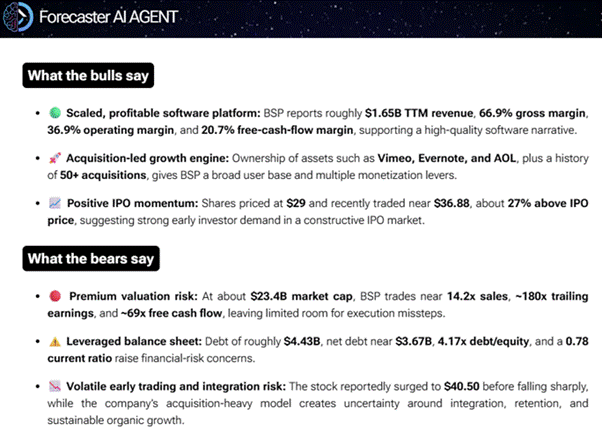
A useful way to frame Bending Spoons is to look at both sides of the investment narrative. On the bullish side, the company combines scale, profitability and strong operating metrics, with roughly $1.65 billion in trailing-twelve-month revenue, high gross margins, and a portfolio of well-known digital assets such as Vimeo, Evernote and AOL. Its acquisition-led model gives it access to a broad user base and multiple monetization levers. On the bearish side, however, investors must consider valuation risk, leverage, and integration complexity. A premium multiple leaves limited room for execution mistakes, while a debt-heavy balance sheet and an acquisition-driven strategy make future results potentially less predictable. This is exactly the kind of balanced bull-and-bear framework that can be built using Forecaster’s AI for finance tools, which help investors organize market narratives, sentiment and financial data into a clearer analytical structure.
The main financial risk is leverage. Bending Spoons has used debt to support its acquisition strategy. In its prospectus capitalization table, as of March 31, 2026, the company showed $4.36 billion of total debt on an actual basis, and $4.94 billion on a pro forma as adjusted basis.
Debt can accelerate growth when acquisitions perform well and cash flow is strong. But it also reduces flexibility if interest rates rise, acquisition returns disappoint, or operating performance weakens. For a newly listed company pursuing a rapid acquisition strategy, the balance sheet deserves close monitoring.
Investors should also be aware of governance structure. Bending Spoons disclosed that its four founders — Matteo Danieli, Luca Ferrari, Francesco Patarnello, and Luca Querella — would hold 82.71% of total voting power immediately after the offering, or 82.48% if the underwriters’ option were fully exercised. Founder control can support long-term decision-making, but it also means minority shareholders have limited influence over major corporate matters.
Bending Spoons argues that its addressable acquisition universe remains large. The company says it has identified more than 1,000 digital businesses, both private and public, that could be attractive acquisition targets, representing nearly $400 billion in aggregate estimated 2025 revenue.
This is important because one common concern with serial acquirers is market saturation. As a company grows, it often needs larger deals to move the needle. Larger deals can be more competitive, more expensive, and harder to integrate. Bending Spoons’ response is that the opportunity set remains broad.
Potential future acquisition categories could include legacy internet brands, productivity tools, creator platforms, cloud services, data platforms, marketplaces, or consumer software businesses. Any discussion of specific targets, however, should remain strictly speculative unless the company announces a transaction.
As an illustration — and these are my own ideas, not companies that Bending Spoons has cited as acquisition targets — names such as Yahoo, Dropbox, or Quora help show how broad the opportunity set could be. A brand like Yahoo could give Bending Spoons exposure to legacy internet assets, digital advertising, media, email, search, and financial data through Yahoo Finance. Dropbox would open the door to cloud storage, productivity software, file collaboration, and potentially enterprise workflow tools. Quora, meanwhile, could give the company access to user-generated knowledge, community-driven content, search-like discovery, and data assets that may become increasingly relevant in the age of artificial intelligence.
The point is not that these transactions will happen. There is no indication from Bending Spoons that these specific acquisitions are being considered. The more relevant analytical point is that Bending Spoons has designed itself to be sector-flexible. It is not limited to one software niche. If the company can continue to apply its operating platform across different types of digital assets, the potential acquisition universe may remain wider than that of a traditional software company.
For investors following Bending Spoons, several indicators may be more useful than short-term share-price movements.
First, organic growth. Acquisition-led growth can be powerful, but organic growth shows whether existing assets are improving after acquisition.
Second, margins and cash conversion. The model depends on improving acquired businesses, not merely buying revenue.
Third, leverage. Debt levels, refinancing conditions, interest expense, and covenant headroom matter.
Fourth, retention and culture. A company that relies on exceptional talent must continue to attract and retain it.
Fifth, acquisition discipline. The biggest risk for serial acquirers is overpaying when the market becomes excited about the model.
Finally, investors should expect volatility. Newly listed growth companies with acquisition-heavy models can experience sharp price swings around earnings, deal announcements, integration updates, and changes in investor sentiment toward software and AI.
Bending Spoons is one of the most unusual technology listings in Europe’s recent history. It is not simply an app company, nor a traditional software vendor, nor a private equity firm. It is trying to build a public-market compounding platform around the acquisition and transformation of digital businesses.
The bull case rests on culture, talent, operating discipline, subscription monetization, AI-enabled efficiency, and a large acquisition pipeline. The bear case rests on debt, execution risk, reliance on acquisitions, integration complexity, subscription churn, valuation sensitivity, and concentrated founder control.
That makes Bending Spoons a fascinating company to study, but not a simple one to value. Its future will depend less on the success of any single product and more on whether the company can repeatedly turn acquired digital assets into stronger, more profitable businesses.
This article is for educational and informational purposes only and should not be interpreted as investment advice, a recommendation, or a solicitation to buy or sell any security. Investors should conduct their own due diligence and consider their own risk tolerance before making investment decisions.
Information posted on IBKR Campus that is provided by third-parties does NOT constitute a recommendation that you should contract for the services of that third party. Third-party participants who contribute to IBKR Campus are independent of Interactive Brokers and Interactive Brokers does not make any representations or warranties concerning the services offered, their past or future performance, or the accuracy of the information provided by the third party. Past performance is no guarantee of future results.
This material is from Forecaster.biz and is being posted with its permission. The views expressed in this material are solely those of the author and/or Forecaster.biz and Interactive Brokers is not endorsing or recommending any investment or trading discussed in the material. This material is not and should not be construed as an offer to buy or sell any security. It should not be construed as research or investment advice or a recommendation to buy, sell or hold any security or commodity. This material does not and is not intended to take into account the particular financial conditions, investment objectives or requirements of individual customers. Before acting on this material, you should consider whether it is suitable for your particular circumstances and, as necessary, seek professional advice.
Related Articles


















Join The Conversation
For specific platform feedback and suggestions, please submit it directly to our team using these instructions.
If you have an account-specific question or concern, please reach out to Client Services.
We encourage you to look through our FAQs before posting. Your question may already be covered!