
- Solve real problems with our hands-on interface
- Progress from basic puts and calls to advanced strategies
Interactive Options Course
Posted August 4, 2026 at 12:45 pm
The following is a summary of a live audio recording and may contain errors in spelling or grammar. Although IBKR has edited for clarity no material changes have been made.
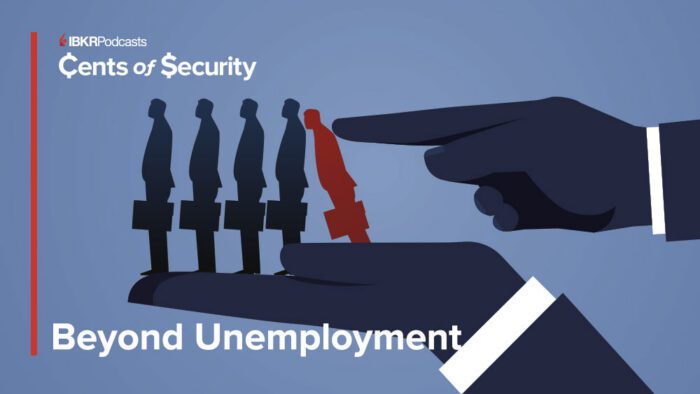
Hello, everyone. Welcome back to the Cents of Security podcast. I’m Drew Tunstall. The labor market is often at the center of the American news cycle, with the unemployment rate being viewed as one of the key indicators of the American economy. But one less discussed metric may be just as important to understanding the American economy, that being the labor force participation rate.
To help explain what this metric is, how it relates to unemployment, and how it, how important it is to the American economy, I’m joined by James Yendrey of InvestMentorSM. Hi, James. How are you?
I’m doing well, Drew. How are you?
I’m doing well. Could you explain to our audience what exactly the labor force participation rate measures how it differs from unemployment, and how important it is for understanding the health of the American economy?
Sure. So, the labor force participation rate measures the share of the civilian population their workforce as a whole from, say, age 16 and up that are actively looking for work. So, if you’re employed, you’re counted. If you’re unemployed but actively looking for a job, you’re also counted. If you’re retired, say a, a full-time student or like a stay-at-home parent, you’re not actively searching for a job at the moment. These would be somebody who have effectively stopped looking for it, and so you’re not of the labor force. And that differs from the unemployment rate, which measures the percentage of people in the labor force who do not have a who don’t have a job but are actively looking for one. So, the participation rate measures how many people are participating in in the labor market at all
So, over the past 25 years, we’ve seen the United States labor force participation rate decline by about 6%, which is fairly notable. What does this say about the American economy, and do we know what’s causing this change?
Yeah, relatively speaking. So, the biggest factor is going to be demographics, right? Say, take January of 2000, for example, labor force participation was high 60s, or right around 60%, 70%. But by June 2026, last month’s print, it’s fallen to 61.5%. A large share of that decline reflects the retirement of the baby boomer generation as more Americans move into their late 60s and 70s, and a larger portion of that population naturally exits the workforce.
Even if older Americans work longer than let’s say previous generations, participation still tends to decline with age.
What are some of the economic consequences of having a lower labor force participation rate? On the surface, it kind of seems like it would mean there’s more open jobs.
Yeah. Lower participation means fewer workers are available to produce goods and services. So over time, it can lead to slower economic growth greater labor shortages key industries, upward pressures on wages, higher fiscal pressures on programs such as Social Security and Medicaid, which are reliant on the current workforce paying for it.
I would say long-term economic growth generally comes from two sources: more workers and higher productivity. So, if the workforce growth slows, productivity has to do more of the heavy lifting. And yes, to your point, we do see a little bit more jobs, but you have a worker who is significantly more well-versed in different facets of the business environment than you did in the early 2000s.
Interesting. So, when we look more closely at the data, we see that the participation rates among prime age workers, so those between 25 and 54, have remained pretty strong, while participation among teenagers and older Americans has declined. We touched on what caused older American participation rate to decline, but what’s going on with the teenagers?
This is actually probably one of the more encouraging labor market stories where you have prime age workers that are generally considered the core labor force that are past the school age and not necessarily near retirement. Their participation rate stood around 83.3% last month so near the highest levels seen in more than two decades.
So that tells us that the typical worker age American remains highly connected into the labor market. The overall decline in participation isn’t primarily about the working age per se rather than the demographic changes. You have these individuals that are deciding to stay in, in school a little bit longer to get more advanced degrees because the degrees will now set them apart from what they had been in the past.
So typically, you would be okay with getting a bachelor’s, an associate’s or a master’s degree. People are now putting preference over master’s degree or, master’s and PhDs in some of these more advanced fields, and that also helps us get a little bit more insight on the gap between the pay from the lower earners that are coming out from, let’s say, an an associate’s degree in liberal arts as opposed to somebody who has a STEM-based degree.
And so, their starting salary is significantly higher, so their outputs for that generation are or for those individuals are going to be bifurcated as well.
Wow, okay. That’s fascinating. So, for the people coming out of college now, Gen Z, are we seeing that their participation rates are roughly in line with millennials and Gen X before them?
Yeah. I would say like millennials, Gen Z is entering a, a labor force later because, as I said, more are pursuing higher education and professional training and that tends to suppress labor force participation among like teenagers, young adults in the shorter term. And at the same time, Gen Z entered the labor market during a very tight labor market following the pandemic, right?
We had a strong demand for workers across all the industries. So, while young people today may spend a little bit longer in school, they generally encounter a stronger hiring environment than a millennial would after the great the Great Recession or subprime of ’08, ’09.
So, then it poses a question. I’m trying to figure out how I would want to articulate this. I guess the long-term question is less whether Gen Z works and more when they enter the workforce and how quickly they are able to transfer into what would be a stable career. So, because you have that delay and they’re seeking higher education for a little bit longer, to mid-career tends to be 27 to 34 for an individual like a millennial or a Gen X that had been in an industry and didn’t like it, hopped, and was able to have an established base thereafter, and then really get entrenched to their career.
So, think of jobs versus careers. Whereas Gen Z the difference would be they would be starting a little bit later, entering a little bit later into the workforce, and perhaps we will see a shift in in industries later on if they follow the same pattern as Gen X and millennials
Okay, interesting. So, some European economies like Germany and France, who are about as developed as us, have seen their participation rates rise in the past 25 years. What explains this difference with America?
Policy usually. Countries like Germany and France have implemented reforms that encourage greater labor market participation, particularly among women and older workers. A lot of that kind of expands the childcare support. They have more flexible work arrangements. They’ve changed the pension structure to encourage a little bit later retirement.
We’re starting to see some of that here, but they’ve been doing it for a little while. And then policies around immigration as well. But, at the same time, many European countries started from a lower participation rate, which gave them more room to improve, so the graph looks slightly better.
Where the US already had a relatively high participation rate by, we’ll call it, international standards, taking that example I gave from early 2000s making gains a little bit harder to achieve. Meanwhile, the aging population in the US is particularly Baby Boomers are starting to move into retirement in droves
Okay. With the added benefits of Europe, they surely come at a cost. Like I know, for example, that France has a higher unemployment rate than we do, even though they have a higher labor force participation rate. Are those two things– how closely are those related to each other? How much of a direct trade-off is it to emphasize higher participation rate at the cost of unemployment?
I will say underemployment kind of captures where workers who are technically employed, but those employment situations don’t really reflect the available labor market, right? Classic example is somebody working 15 to 20 hours a week who wants a full-time job but can’t necessarily find one. Here in the US, we track a broader measure called like Market Slack via U6.
It includes unemployed workers, discouraged workers, and people who are trying to work, working part-time, right? Last month the official employment rate here was at 4.2, while the broader U6 measure was at like 7.9, which would be on par with the example that you gave in France.
So, understanding the differences within those particular metrics and how it’s viewed would be key to understanding that.
That’s amazing. Thank you.
Yeah
Before we wrap up, what would you say is the biggest misconception the public has around the labor market?
Probably one of the biggest misconceptions is that the unemployment rate alone tells the whole story. People are emphatic about these headlines. They chase these trends on social media or, wherever they get their news from.
But a labor market can have lower unemployment and still face important challenges, right? People may have dropped out of the labor force for viable reasons. Workers may be unemployed, but certain industries may be struggling to grow while others are booming. Think tech sector AI right now, it is on fire.
Wage growth may also be slowing in certain sectors, right? So, when you look at it as a whole, I would say unemployment, labor force participation, prime age, wage gap, all of these things they matter just as much as the headline. And so, it’s not necessarily a single number scoreboard.
It’s more what is happening on the broad scale, and what are the nuances in the numbers? How do they shift over time and from print to print? That’s what I would say is worth looking into more so than just the headline figure itself.
Great. Thank you so much for joining us today, and for the viewers, make sure to follow us on wherever you get your podcasts, and we’ll see you next time.
Bye. Thank you.
IBKR InvestMentor (dba “InvestMentor”) is a service of Interactive Academy LLC, an affiliate of IB LLC and majority-owned by IBG LLC. All content provided by InvestMentor is for informational and educational purposes only and should not be interpreted as implying any sponsorship, partnership, endorsement, recommendation, or approval by IB LLC or its affiliates.
Information posted on IBKR Campus that is provided by third-parties does NOT constitute a recommendation that you should contract for the services of that third party. Third-party participants who contribute to IBKR Campus are independent of Interactive Brokers and Interactive Brokers does not make any representations or warranties concerning the services offered, their past or future performance, or the accuracy of the information provided by the third party. Past performance is no guarantee of future results.
This material is from InvestMentor, an affiliate of Interactive Brokers LLC, and is being posted with its permission. The views expressed in this material are solely those of the author and/or InvestMentor and Interactive Brokers is not endorsing or recommending any investment or trading discussed in the material. This material is not and should not be construed as an offer to buy or sell any security. It should not be construed as research or investment advice or a recommendation to buy, sell or hold any security or commodity. This material does not and is not intended to take into account the particular financial conditions, investment objectives or requirements of individual customers. Before acting on this material, you should consider whether it is suitable for your particular circumstances and, as necessary, seek professional advice.
IBKR InvestMentorSM is a service of Interactive Academy LLC, an affiliate of IB LLC and majority-owned by IBG LLC. All content provided by IBKR InvestMentorSM is for informational and educational purposes only and should not be interpreted as implying any sponsorship, partnership, endorsement, recommendation, or approval by IB LLC or its affiliates.












Join The Conversation
For specific platform feedback and suggestions, please submit it directly to our team using these instructions.
If you have an account-specific question or concern, please reach out to Client Services.
We encourage you to look through our FAQs before posting. Your question may already be covered!