
- Solve real problems with our hands-on interface
- Progress from basic puts and calls to advanced strategies
Interactive Options Course
Posted September 15, 2026 at 12:20 pm
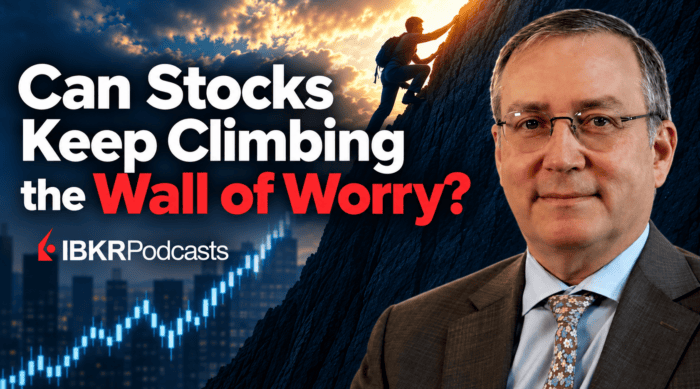
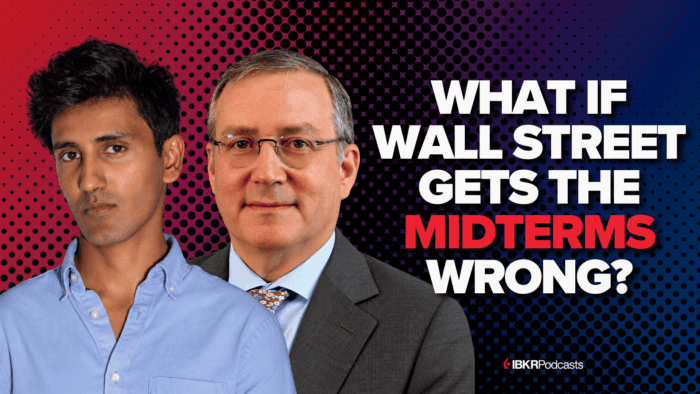
Steve Sosnick joins Andrew Wilkinson on this IBKR Podcast to break down why stocks continue climbing a growing wall of worry, even as AI concerns, rising Treasury yields and economic risks test investor confidence. They also discuss the market’s persistent buy-the-dip mentality, the Fed’s next move and whether the upcoming midterm elections could disrupt the rally.
New to Interactive Brokers?
The following is a summary of a live audio recording and may contain errors in spelling or grammar. Although IBKR has edited for clarity no material changes have been made.
Welcome to this week’s podcast. I’m Andrew Wilkinson, your host, coming to you directly from Greenwich, Connecticut, Interactive Brokers headquarters, where I am joined by Chief Strategist, Steve Sosnick. Welcome, Steve. How’s it going to kick off Monday morning?
As Mondays go, Andrew, it’s been a pretty good one. Good to see you again, even though we really should be taping this from the same room despite sitting in two different rooms in the same complex.
You have your building, I have mine, Steve. What can I say?
There we go.
Something funny hit the market this morning. I mean, the AI stocks have been through the through the mill this morning, starting in Asia and then Europe, and now the United States, but leveling off in terms of magnitude. And it’s all driven by speculation about that existential question: does AI need guardrails?Could it wipe out society? What’s your take on Monday morning’s price action?
So, for the listeners we’re taping this Monday afternoon about 2:00 PM Eastern Time. And certainly, the talk of the day was the weekend post by Anthropic founder Dario Amodei where he basically made a call for tempering the crazy pace of AI development and putting guardrails on the process, and that maybe it’s time that we look at the societal risks surrounding AI and not just look at the potential benefits and potential financial returns. Now, it’s important to remember this follows a piece from last week where a former OpenAI and Anthropic researcher named Jacob Coxon — I don’t have his name in front of me, so I hope I got that right — posted a piece basically saying why he resigned and essentially going into the premise that AI could kill us all in 10 years.That is maybe true, maybe hyperbole. I don’t know what odds to put on that. You know, I guess we could do a prediction market on it, but how would you collect if it was true if it came out “Yes”.
But anyway, it got people thinking about this. Now, there, there have been AI — I’m not gonna say doomsayers — but there have been those who are cautionary about AI for some time. And I think they were, you know, either put aside or viewed as cranks or, you know, “how dare they get in the way?” And so, it’s obviously a huge change when the head of Anthropic if not necessarily joins that chorus but certainly starts a rhyming one of his own.But there’s an interesting take to this, and I think to a certain extent it’s somewhat self-serving. You know, as I put in the piece that I wrote today, it’s particularly convenient when societal concerns that might be affecting the industry neatly coincide with creating shareholder value. And to a certain extent, you can look at this as saying there is a self-serving nature to tapping the brakes on AI spending, because if Anthropic doesn’t spend as much and all the others don’t spend as much, we don’t have this AI arms race, and it benefits those companies who are spending the zillions of dollars to roll this out. And I think the “tell” on that one was that Sam Altman from OpenAI and Elon Musk from SpaceX AI and [the head of] Google’s AI product all chimed in with more or less the same thing within a few minutes almost. And so, commercially they’re aligned on this, and while I would like to think that this is truly altruistic, when you see deep competitors agreeing you have to think there’s more to it. Also, I think they’re also reading the political winds. There’s a lot of talk among midterm candidates about throttling back AI. It is viewed in many corners as a boogeyman. And tomorrow, Tuesday there’s an artificial intelligence forum that features what I call the stupefying pair of Bernie Sanders and Steve Bannon together discussing the risks of AI.
That’s gonna be fun.
So, I think these guys see that there’s certainly political backlash potential, and while at the same time, a little commercial potential maybe to — I’m not gonna say to jam on [the brakes] or to stop the car — but maybe let’s tap on the brakes a little bit.
We saw stocks, tech stocks sell off a little bit this morning because so much of the market is driven by AI spending, so much of the economy is driven by AI spending, but that recovered as the day went on. The bond market had something to do with it, but we can get into that with the next couple of questions
Well, let me ask you, are you fearful or more of a risk taker at this stage as we head towards the end of the third quarter?
I get the sense that, that there’s much more talk about risk, there’s much more sense of risk, there’s much more — I’m not gonna say glass half empty — but the glass isn’t as relentlessly full as it’s been all year. Yet at the same time, we don’t really see anybody eager to sell. And when there’s still an opportunity to jump on a rally, people do it.
Think about the rally we had on Friday. The CPI number was not good. Oil prices rose; bond yields rose. But stocks said, “Eh, you know what? We’ve been down four days in a row, let’s rally and let’s rally hard.” This morning, we never even gave back Friday’s rally, dubious as it was, because the buy the dip impulse remains there, and I just don’t get the sense that people are ready or willing to part with their stock positions right now, despite the fact the risks are mounting, (and despite the fact the lights just went off in this room,) and despite the fact that I get the sense that there’s a lot of negatives pulling at the market here. Yes, the positive remains the earnings picture but, you know, I do have to… It’s tough to put together back-to-back years like the ones that are, the… You know, yes, we had a great year, but I think it’s interesting to see expectations continuing to improve even after some of the one-time effects of taxes and things like that are not gonna be replicated next year. And despite higher interest rates and higher oil prices and all the other things.
I’ve used the term Spider-Man market before, but I get that sense, is the, the wall of worry is huge and steep, but this market just continues to climb right up it.
Or maybe it’s Wile E. Coyote, right? We don’t realize we’ve run off the edge of the cliff until we actually look down. We can keep running for a while. But, as of now, this market is more than willing to shrug off risk despite it being discerned by an increasing number of market participants
Let’s talk about bonds. Let’s come back to that. You mentioned that earlier on. I’m getting a little bit concerned that Treasury Secretary Bessent’s comments seem to be inviting a collective “bring it on” to the bond market. What are your thoughts that you’d share with the audience about rising yields?
Well, I mean, this morning we actually, at least in the short term, completed what I considered an inevitable run to 5% on the 10-year. Fortunately, I have the tape to prove that I said it on the first of the month and said that it would look like 5% was inevitable.
We got there, we got a little above 5%, and then quickly recouped those losses.
Just had to be done, didn’t it?
It did have to be done and hey, bond traders buy dips too. And that was sort of a big psychological number. One day completes what seemed to be the trend move. Now we have to see if that holds, if that becomes if that becomes you know, support, talking in terms of price terms — because again, yield up, price down. Whether that proves to be support/resistance or whether that turns out to be just a pause in a broader secular trend. We’re not gonna get that answer in a couple of days or a week or two. But I do think we sort of completed that move, and that’s when stocks were at their worst today, and that’s when they recovered pretty well.
Again, it kind of gave a little fig leaf for stocks. You know, I think there was a little concern if we broke through. But as soon as we rallied, you know, we bounced up a bit and, you know, those who are watching crude oil rally that came off its highs a little bit.
But stocks don’t care at this point. Stocks really, you know, they really don’t. It’s, you know, I hate to… I don’t know, maybe we’re all nihilists in the stock market, I’m not sure. But a rally is in place, until proven otherwise despite all the mounting evidence and despite all the mounting concerns that could, in theory, put a halt to it
Well, in the medium term, in a couple of months or weeks we’ve got the midterms. Do you see that they pose much risk to the market?
In theory, yes, because it upends the status quo. In reality, it’s hard to say because markets tend to do well when there’s gridlock. I think you have at this point, you know, the polls are pretty unquestioning about the unpopularity of the current administration, the likelihood of a change in control of the House, and potentially even a change in control in the Senate.That still remains murky. And of course, you can watch those odds change in real time and participate in them on IBKR Prediction Markets. But I don’t know that it changes much. The current setup now with the president and having control of both houses of Congress hasn’t led to a lot of legislation anyway.
It’s mostly been by executive order and the like. There hasn’t been a lot of regulation. What it means also is you probably almost have a total gridlock because the veto pen will get a lot of use. What it means is you’ll probably get a pretty steady drumbeat of negative news flow, investigations, things of that nature. But you know, ultimately the markets don’t really pay that close attention to it.
So, you know, I think it’s a risk, and I do think it’s notable that the last two down years occurred during midterm election years. I also think if the Fed raises rates it is now priced into the market this week, I think you’ll get a bit of a tantrum from the administration
That’ll be interesting.
And that could unsettle it.
Someone gave me an amazing theoretical construct. They said, “what if the committee votes to raise rates and Warsh is the dissenter?” I have no idea if that’s true. Obviously, I don’t know. But the market, basically the– we’ll see. The FOMC typically is not like to surprise markets.I was fairly adamant until the last set of inflation numbers came out that the Fed would avoid trying to raise rates before the December meeting. I still think there’s a lot of the committee that just does not want to draw that kind of fire. But you’re in interesting situation now. If they do raise rates, it’s what the market expects, and you’re gonna have political blowback.
If they don’t raise rates you’re gonna have real questions about Fed credibility that could really affect the long bond. And again, markets don’t like surprises. So, I think the best to hope for is a relatively benign hike because I think that’ll shock the market less, In the long, in the longer term…
If you can come out of Wednesday with relief for Treasury yields, then I think stocks might actually appreciate that decision
Or you could just sort of put it as: stocks would like it if yields don’t go up, if long-term yields don’t go up; stocks will like it if short-term rates don’t go up, so ergo buy any dip.
Yeah.
That is not investment advice, mind you. That is more snark than pure investment advice, but it seems to be the trader mindset right now, so…
Oh, okay. Steve Sosnick, thank you for joining me. And Steve mentioned that he’s just written his latest article, which, if you want to read more snark, go to Traders’ Insight on the Interactive Brokers website under Education and the Campus there, you’ll find all of Steve’s prior articles and lots more from all of our contributors.
So, thanks for joining us today, and don’t forget to like and subscribe wherever you download your podcasts from. So, Steve, thank you so much for taking the time.
My pleasure, Andrew. Talk again soon. Take care
Speak soon. Bye for now
Useful links:
Steve’s most recent article: OK, Doomer | Traders’ Insight
Steve’s page on IBKR Campus: Steve Sosnick | IBKR Campus
IBKR Campus home: IBKR Campus | Financial Education and Market Commentary
IBKR Prediction Markets: IBKR Prediction Markets
The analysis in this material is provided for information only and is not and should not be construed as an offer to sell or the solicitation of an offer to buy any security. To the extent that this material discusses general market activity, industry or sector trends or other broad-based economic or political conditions, it should not be construed as research or investment advice. To the extent that it includes references to specific securities, commodities, currencies, or other instruments, those references do not constitute a recommendation by IBKR to buy, sell or hold such investments. This material does not and is not intended to take into account the particular financial conditions, investment objectives or requirements of individual customers. Before acting on this material, you should consider whether it is suitable for your particular circumstances and, as necessary, seek professional advice.
The views and opinions expressed herein are those of the author and do not necessarily reflect the views of Interactive Brokers, its affiliates, or its employees.









Join The Conversation
For specific platform feedback and suggestions, please submit it directly to our team using these instructions.
If you have an account-specific question or concern, please reach out to Client Services.
We encourage you to look through our FAQs before posting. Your question may already be covered!