
- Solve real problems with our hands-on interface
- Progress from basic puts and calls to advanced strategies
Interactive Options Course
Posted March 12, 2026 at 1:14 pm
Wars often redraw borders on the ground, but the Iran conflict has redrawn them in the sky. Overnight, vast stretches of Middle Eastern airspace turned into no‑fly zones. Dubai, Abu Dhabi, and Doha — normally busy tourist and business travel hubs — have been reduced to cautious, half‑lit versions of themselves. Local carriers are inching back into the air, but many international airlines want no part of a sky where missiles and drones are still falling.
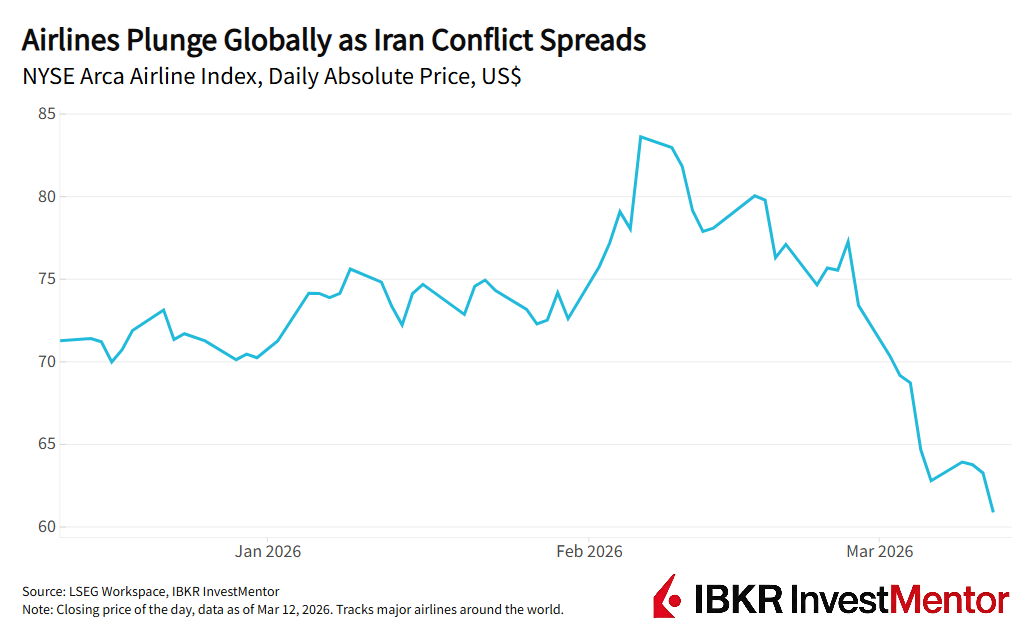
Airline stocks have taken a hit worldwide as tens of thousands of flights have been cancelled, and more forced into long, fuel‑hungry detours.
Jet fuel prices, around $2.40 per gallon pre-war, briefly surged past four dollars. Oil benchmark Brent crude jumped from the low $70s per barrel to nearly $120 on Monday and has since swung wildly, depending on the daily war rhetoric.
Iran has even threatened to push prices above $200, targeting oil tankers and attempting to lay mines on the Strait of Hormuz. This key shipping route accounts for about a fifth of the world’s oil and liquefied natural gas deliveries in normal times.
The International Energy Agency warns of the largest oil supply disruption in history: roughly 8 million barrels a day, 8% of global demand, cut off as the Strait of Hormuz remains effectively closed. Even if a peace deal were signed tomorrow, restarting damaged or idled production in the Gulf could take months.
When a conflict closes airspace, the impact is felt across the world. Airlines are now threading their way through narrow “safe corridors,” stacking detours on top of detours. With Ukraine, Russia, and now much of the Middle East off‑limits, it’s difficult to just beeline across the sky from A to B anymore.
Longer flights mean more fuel, more crew hours, and fewer aircraft available. That pressure shows up quickly in airline profits and ticket prices. And while airlines can raise prices only as far as demand allows, the underlying math is unforgiving: when the flight gets longer, tickets tend to get more expensive.
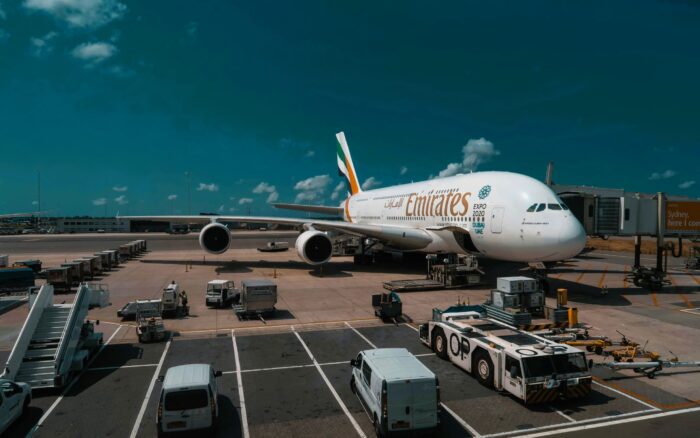
The Gulf, usually the beating heart of global aviation, is feeling the slowdown acutely. Emirates, Etihad and Qatar Airways — the big Middle Eastern carriers that move millions between Europe, Asia, and Australia — are resuming flights but operating reduced schedules. Dubai’s airport, the world’s busiest international hub, is still running at a fraction of its usual volume. British Airways, for example, has stopped all but repatriation flights in the Middle East.
The city’s tourism machine has sputtered: malls are quiet, beach resorts half‑empty, and influencers acting more like war reporters.
Aviation has never been an easy business, with high fixed costs: planes, crews, and maintenance keep running even when demand doesn’t. But the past two decades have turned it into one of the most shock‑prone industries.
Each time, air travel has bounced back, but often at great cost.
Fuel hedging is one tool carriers have to soften the blow of sudden fuel price spikes. This is usually done through futures contracts to lock in the price of fuel for months or sometimes even years ahead. European and Asian airlines tend to hedge heavily: Air France–KLM, Lufthansa, and Ryanair had all locked in prices for around 80-90% of their fuel needs for this coming year before the war, plus additional hedging further down the line.
US airlines, having been burned by hedging losses in the past, now rely more on the scale of their domestic network, loyalty programs, and dynamic pricing to manage revenue swings. This is a strategy that works well with modest fuel price fluctuation but leaves them exposed to major crises like this one.
Airlines operate on thin margins and high fixed costs. They can’t easily pass on rising expenses, and they can’t instantly shrink when demand falls. If ticket prices surge too much, passengers could balk, leaving fleets of expensive jets grounded.
Yet air travel can rebound sharply when conditions improve. And that keeps investors circling despite the turbulence.
The war in Iran shows how interconnected and vulnerable global aviation is. A regional conflict can now disrupt travel patterns from Sydney to Helsinki, push up fuel prices worldwide, and shake an industry already pummeled by years of crises.
When the sky closes, the world feels smaller, poorer, and more fragile. The longer this conflict drags on, the more it will test not just airlines, but the entire world economy that depends on global connections.
To learn more about how sudden shocks like the Iran war can impact different asset classes, download IBKR InvestMentor. A free app full of interactive lessons and daily explainers on finance and economics.
IBKR InvestMentor (dba “InvestMentor”) is a service of Interactive Academy LLC, an affiliate of IB LLC and majority-owned by IBG LLC. All content provided by InvestMentor is for informational and educational purposes only and should not be interpreted as implying any sponsorship, partnership, endorsement, recommendation, or approval by IB LLC or its affiliates.
Information posted on IBKR Campus that is provided by third-parties does NOT constitute a recommendation that you should contract for the services of that third party. Third-party participants who contribute to IBKR Campus are independent of Interactive Brokers and Interactive Brokers does not make any representations or warranties concerning the services offered, their past or future performance, or the accuracy of the information provided by the third party. Past performance is no guarantee of future results.
This material is from InvestMentor, an affiliate of Interactive Brokers LLC, and is being posted with its permission. The views expressed in this material are solely those of the author and/or InvestMentor and Interactive Brokers is not endorsing or recommending any investment or trading discussed in the material. This material is not and should not be construed as an offer to buy or sell any security. It should not be construed as research or investment advice or a recommendation to buy, sell or hold any security or commodity. This material does not and is not intended to take into account the particular financial conditions, investment objectives or requirements of individual customers. Before acting on this material, you should consider whether it is suitable for your particular circumstances and, as necessary, seek professional advice.
Futures are not suitable for all investors. The amount you may lose may be greater than your initial investment. Before trading futures, please read the CFTC Risk Disclosure. A copy and additional information are available at ibkr.com.
Related Articles
















Join The Conversation
For specific platform feedback and suggestions, please submit it directly to our team using these instructions.
If you have an account-specific question or concern, please reach out to Client Services.
We encourage you to look through our FAQs before posting. Your question may already be covered!