- Solve real problems with our hands-on interface
- Progress from basic puts and calls to advanced strategies
Interactive Options Course

Posted February 5, 2026 at 2:00 pm
Another day, another set of declines in popular financial assets. Unfortunately, there is nothing new about that. What is different this time – and I acknowledge that to be among investors’ most dangerous phrases) – is that today is less about rotation than outright selling. Although this morning’s declines in major indices are roughly commensurate with those of recent days, the underlying metrics are not.
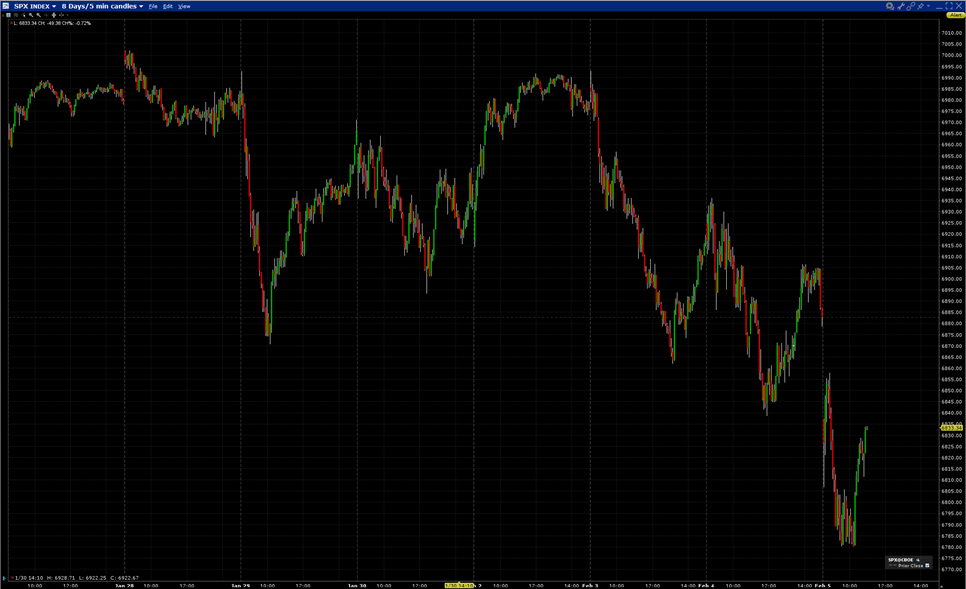
As I type this before noon ET, the S&P 500 (SPX) and Nasdaq 100 (NDX) have recovered from their intraday lows. Both are about -0.9% lower, but SPX has recouped about a third of its worst losses, and NDX has recovered a bit more than half. That is commensurate with the daily trading patterns that have prevailed over the past few days. Stocks sold off, then recovered from their worst levels when dip buyers stepped in. The chart below shows this occurring in five of the prior six sessions, with today following that pattern for a sixth:
SPX, 8-Days, 5-Minute Candles
Source: Interactive Brokers
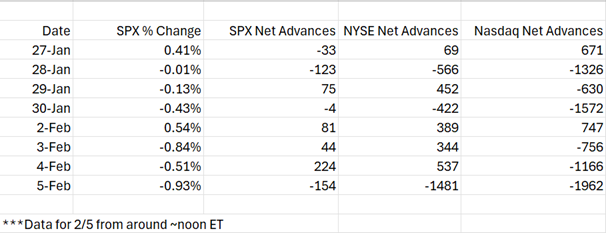
Today, however, we see more selling across the board. In the period covered by the above graph, it was not uncommon to see more SPX stocks advancing than declining even as the index sank. Note yesterday’s figure, which showed nearly half of SPX stocks advancing despite a -0.51% selloff:
Net Advances vs. Daily % Change
Source: Interactive Brokers
The net advances on the NYSE roughly followed those of the SPX, while Nasdaq, unsurprisingly, leaned more negatively. The recent selloff – it’s not even close to a correction, by the way – has been led by technology stocks, particularly in the software sector. Think of how many times you’ve heard the phrase, “tech-heavy Nasdaq.” Our previous assertion that the relatively modest index declines were more the result of turbulent rotation under the market’s surface than broad-based selling was borne out by the data. Today’s advance-decline statistics indicate that situation has changed.
Perceptions about the economy are the main culprit for this morning’s change in psychology. Challenger Job Cuts soared by 117.8% on a year-over-year basis, largely thanks to major layoffs at UPS, Amazon, and Dow Chemical (DOW). Initial Jobless Claims rose to 231,000 from 209,000, well above the 212,000 consensus. Continuing Claims rose from a revised 1,819K to 1,844K, though today’s figure was slightly below the 1,850K consensus. And JOLTS data added to the gloom at 10:00 AM ET. The December figure came in at 6,542K, well below the 7,250K consensus and November’s 6,928K, which itself was revised down from the originally reported 7,146K.
The jobs data gave economic bulls a bit of pause, particularly with the January employment report pushed back from tomorrow to Wednesday. Bond yields fell about 6 basis points across the curve. The move at the short end reflected that Fed Funds futures were now pricing in a full cut for the June FOMC meeting rather than July and a second cut is now solidly priced in for December. The rotation reflected enthusiasm for the economic outlook. Today’s reports dampened that enthusiasm, and hence the rotation turned to outright negativity.
Yet most questions that I continue to receive involve the selloff in software, and more broadly in technology stocks. I believe that to be the result of two key factors:
We discussed some of this yesterday, how highly valued stocks can be much more vulnerable to unpleasant hiccups. Many of the popular software stocks traded with very high P/Es, reflecting high expectations for future growth. AppLovin (APP), a popular stock, has fallen by about 40% yet still sports a P/E over 40. Yet some could understandably see the value of a stock that now sports a PEG ration of 0.54. The question, of course, is to what extent analysts’ expectations will be adjusted to match the public’s sudden lack of confidence.
Unfortunately for other recent speculative darlings, such as silver and cryptocurrencies, there are no earnings expectations. It’s much more about supply and demand, and those dynamics have flipped markedly. Dip buying is very different when there are fewer obvious fundamentals to base one’s buying upon.
New to Interactive Brokers?
Open AccountAlready an Interactive Brokers Client?
Request Trading PermissionThe analysis in this material is provided for information only and is not and should not be construed as an offer to sell or the solicitation of an offer to buy any security. To the extent that this material discusses general market activity, industry or sector trends or other broad-based economic or political conditions, it should not be construed as research or investment advice. To the extent that it includes references to specific securities, commodities, currencies, or other instruments, those references do not constitute a recommendation by IBKR to buy, sell or hold such investments. This material does not and is not intended to take into account the particular financial conditions, investment objectives or requirements of individual customers. Before acting on this material, you should consider whether it is suitable for your particular circumstances and, as necessary, seek professional advice.
The views and opinions expressed herein are those of the author and do not necessarily reflect the views of Interactive Brokers, its affiliates, or its employees.
Futures are not suitable for all investors. The amount you may lose may be greater than your initial investment. Before trading futures, please read the CFTC Risk Disclosure. A copy and additional information are available at ibkr.com.
Investments in certain commodities (precious metals) may be subject to significant price volatility and often involve risks related to market fluctuations, liquidity constraints, geopolitical events, and changes in global economic conditions that could adversely affect their value.
Trading in digital assets, including cryptocurrencies, is especially risky and is only for individuals with a high risk tolerance and the financial ability to sustain losses. Eligibility to trade in digital asset products may vary based on jurisdiction.
For specific platform feedback and suggestions, please submit it directly to our team using these instructions.
If you have an account-specific question or concern, please reach out to Client Services.
We encourage you to look through our FAQs before posting. Your question may already be covered!
Related Articles

















Sometimes (as in days like today), the best thing to do is nothing. Just hold your nose and ride it out. Do not look at your brokerage account (unless you’re a bit of a masochist).
Market is just back to the levels it was a few weeks ago. If the markets gets anywhere being rationally valued then we have to keep away from the financial accounts for years. Maybe it is better to move to better values or out of markets.
ToAnonymous, please share more regarding better values and if out of markets, what to do with all of that cash (far less after tax hit) Thank you
Sounds great if you don’t have a lot invested and are not leveraged. But, if you have a lot at stake the losses can keep you up at night. You never know how far a pullback will go and the more the market falls the more traders get worried and want to sell. Some may get margin calls, and some just get too uncomfortable losing money to hold on. Holding on – easy to say, hard to do. Some people just don’t have the will to put a pillow over their head and pretend like nothing is happening. I have gone through many huge drops, like in 1987, so I know what it feels like when the market implodes. Some traders have never experienced a big drop. They think the market just goes up with little bumps along the way.
I hear what you’re saying, and don’t disagree. Myself, I never trade on margin. Setting appropriate alerts in my brokerage account (Price change percentage, trading volume, Moving average alerts, etc..), and paying more attention to the news and less attention to my overall portfolio performance has worked jut fine for me. I don’t get emotional about investments, and for some reason, I never panic. Panicking never helps and always makes things worse. Steve made a great point, as he often does – we’re nowhere near a correction yet. My time horizon is also longer term than some other investors. 5 to 10 years. Thinking long term, and staying stoic has always worked for me.
Test
It appears (so far) reason and remaining calm trumps panicking and selling. Those who sold yesterday may be a bit disappointed; but market lessons can be expensive. Not counting my chickens yet. The day has just started, and who knows what next week brings given the recent vacillations in economic indicators. CPI print next Friday the 13th. I’m not superstitious.