
- Solve real problems with our hands-on interface
- Progress from basic puts and calls to advanced strategies
Interactive Options Course

Posted February 4, 2026 at 1:12 pm
Yesterday afternoon I was asked to provide a quick comment about the initial market reaction to AMD’s earnings. The questioner was understandably perplexed. The stock beat expectations for EPS and revenues, and offered positive revenue guidance for the coming quarter, yet it was trading about -5% lower. Today we see AMD trading more than -16% lower, and PLTR, yesterday’s darling, is down about -12% after a +7% post-earnings bump. This is what happens when rotation meets stratospheric valuations.
Indeed, as I type this around noon ET, we have the S&P 500 (SPX) trading about -0.3% lower and the Nasdaq 100 (NDX) down a significant -1.7%. Even though I view the Dow Jones Industrials (INDU) as the market’s version of Jurassic Park, that average’s 0.6% rise offers a prima facie “tell” about the rotation that once again is occurring apace. NDX is of course heavily weighted with technology stocks, while INDU’s archaic price-weighted averaging means that it is underweight that key sector.
A look at the sectoral movements within SPX makes the rotation obvious. Only three sectors are substantially lower: Consumer Discretionary (-0.73%), Communications Services (-1.36%), and Information Technology (-2.23%). Energy, Real Estate, Consumer Staples, Materials, Health Care, and Financials are all up more than +1%, while Utilities and Industrials are essentially flat. The surface of the market is not exactly placid, but a deeper view of the key benchmark (SPX) reveals significant undercurrents.
In the specific cases of AMD and PLTR, this is the danger of high valuation. AMD came into yesterday’s report with a P/E exceeding 100. Thanks to a good quarter and a big price drop, that is down to a “mere” 79. Although its forward P/E, now in the 30s, was more reasonable, the huge spread between the backward- and forward-looking measures shows just how much enthusiasm was priced into shares. Very good was not good enough. Great was required.
As for PLTR, that stock understandably had a very positive initial reaction to Monday afternoon’s report. They too reported a great quarter and solid guidance. Investors were justifiably exuberant, and the stock ran up over +10% at its best level yesterday. Fading to just under +7% by the close didn’t seem too problematic, but it did indicate that some of the enthusiasm was curbed. A few sentences that I wrote last week to someone who asked about PLTR’s valuation summed up the risks:
… the “tell” is in PLTR’s PEG ratio as much as it is in its P/E. The 397 trailing P/E is staggering, but so is its [forward P/E] of 230 and its PEG of 4.72. (I typically consider somewhere in the 1 range to be a value.) The PEG means that the market is pricing in about 85% growth. Could that be achievable by PLTR? Maybe, especially if the administration continues to favor it with contracts, but that is an incredibly high hurdle for guidance!
Thus, for PLTR investors, merely great was not good enough.
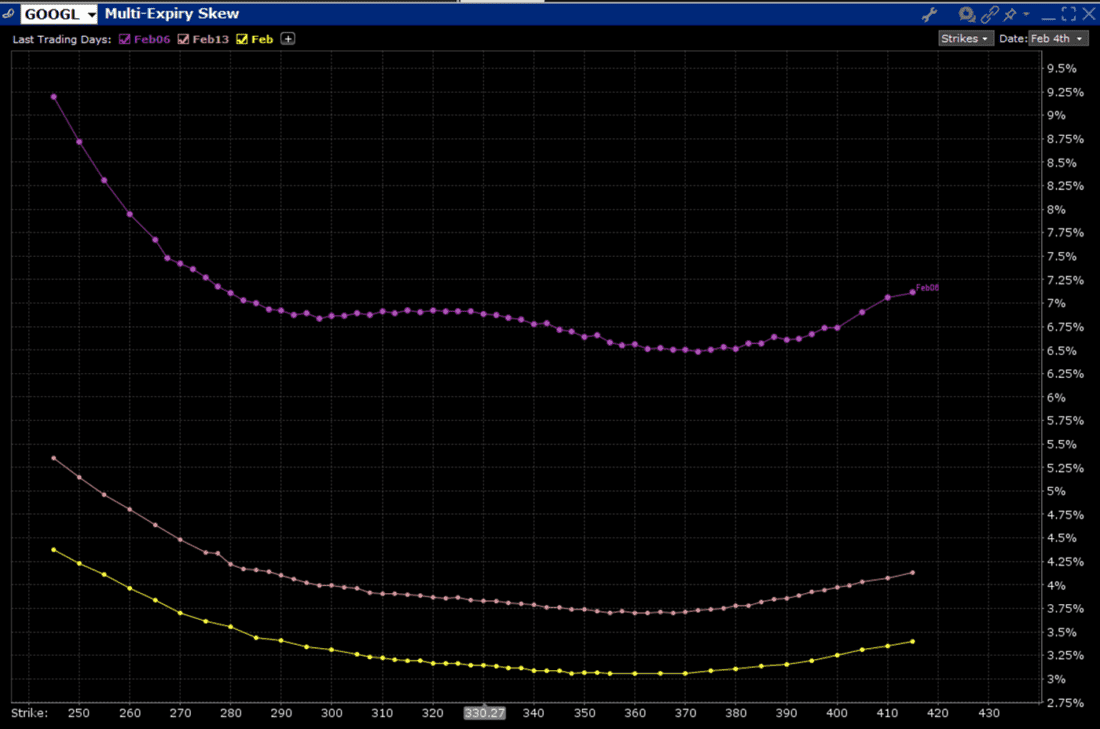
Tonight, we get to pore over another key company’s earnings when Alphabet (GOOGL, GOOG) reports after the close. Alphabet is famously sparse with forward guidance, so there is a bit more uncertainty than with other similarly hefty companies. Despite that, GOOGL is not always a big mover after results, with a 6-quarter average move of 3.4% (+2.52%, +1.02%, +1.68%, -7.29%, +2.82%, -5.04%). The 6.88% daily implied volatility that is priced into at-money options seems like adequate compensation for the risk. Skews are flattish, perhaps unsurprisingly after the stock’s recent big run, though with a slight asymmetry to the downside:
Skews for GOOGL Options Expiring February 6th (top), February 13th (middle), February 20th, 2026 (bottom)
Source: Interactive Brokers
The flattish skew is reflected in the symmetrical probability curve that peaks with at-money options:
IBKR Probability Lab for GOOGL Options Expiring February 6th, 2026

Source: Interactive Brokers
GOOGL shareholders have an advantage over those of AMD and PLTR. Its valuations are much more reasonable. The stock is not necessarily a bargain with a 38 P/E, a 31 forward P/E, and a PEG ratio of 1.9, but those remain well below the stratosphere even after its stellar run in recent months. Hopefully for investors, GOOGL’s hurdle is not as high.
New to Interactive Brokers?
Open AccountAlready an Interactive Brokers Client?
Request Trading PermissionThe analysis in this material is provided for information only and is not and should not be construed as an offer to sell or the solicitation of an offer to buy any security. To the extent that this material discusses general market activity, industry or sector trends or other broad-based economic or political conditions, it should not be construed as research or investment advice. To the extent that it includes references to specific securities, commodities, currencies, or other instruments, those references do not constitute a recommendation by IBKR to buy, sell or hold such investments. This material does not and is not intended to take into account the particular financial conditions, investment objectives or requirements of individual customers. Before acting on this material, you should consider whether it is suitable for your particular circumstances and, as necessary, seek professional advice.
The views and opinions expressed herein are those of the author and do not necessarily reflect the views of Interactive Brokers, its affiliates, or its employees.
Options involve risk and are not suitable for all investors. For information on the uses and risks of options, you can obtain a copy of the Options Clearing Corporation risk disclosure document titled Characteristics and Risks of Standardized Options by going to the following link ibkr.com/occ. Multiple leg strategies, including spreads, will incur multiple transaction costs.
The projections or other information generated by the Probability Lab tool regarding the likelihood of various investment outcomes are hypothetical in nature, do not reflect actual investment results and are not guarantees of future results. Please note that results may vary with use of the tool over time.
For specific platform feedback and suggestions, please submit it directly to our team using these instructions.
If you have an account-specific question or concern, please reach out to Client Services.
We encourage you to look through our FAQs before posting. Your question may already be covered!
Related Articles
















OK, “yet it was trading about -5% lower” means that it was trading 5% higher. That’s how negative numbers work. Aren’t you guys supposed to be good at math?
Thank you for obviating my reply. I’m sure the author would retort something like, ‘Whatever, you know what I meant!,’ which is no justification for writing the opposite of what was meant.
“Fading to just under +7% by the close didn’t seem too problematic, but it did indicate that some of the enthusiasm was curbed.” I’m popping. Just wait. Trust me, I wrote the code and it has more bugs than can possibly imagine or hallucinate. When will it get even better?
Works for PLTR and other tech price drops but why has UNH and other similar ones sank so dramatically even though their sector was a big gainer? It seems the recent news was overly dramatic as I’ve only seen a reported 2% drop to future earnings?