
- Solve real problems with our hands-on interface
- Progress from basic puts and calls to advanced strategies
Interactive Options Course

Posted May 21, 2026 at 11:56 am
Republished from Vetta Research blog https://vettaintech.com/.
Globalisation had a good run. For 30 years, the world’s supply chains were optimised for efficiency. Now they’re being rebuilt for resilience. That’s not a political observation – it’s a regime change, and regime changes are the most durable source of alpha in systematic investing.
The Problem: The global trading system is fracturing into competing economic blocs. Most quant models were built during the 1990–2020 globalisation supercycle and are systematically mispricing the transition.
The Signal: Three structural forces — reshoring capex, dollar erosion, and weaponised interdependence — are now measurable in the data and are not reverting.
The Opportunity:
The Investment Thesis:
The Data Doesn’t Lie
Globalisation is not in retreat. It’s being replaced.
The WTO’s Global Trade Policy Fragmentation Index — which tracks the ratio of trade-restrictive to trade-liberalising measures — has crossed a threshold that historically marks a structural regime shift, not a cyclical downturn.
Here’s what the data shows:
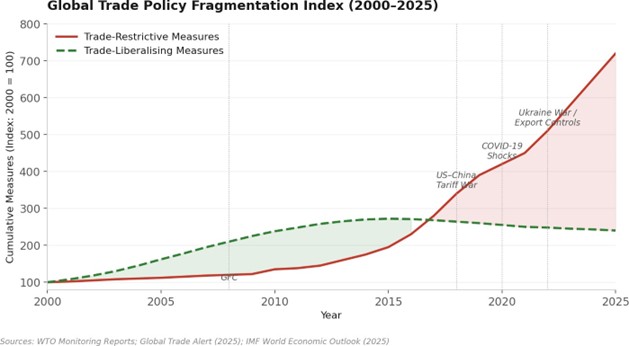
Figure 1. The ratio of trade-restrictive to trade-liberalising measures has crossed a structural threshold. This is not a policy cycle — it is a regime change. Source: WTO Global Trade Alert Database (2025); author’s analysis.
That ratio matters.
When restrictive measures outnumber liberalising ones by 4:1, the marginal unit of global trade becomes more expensive, more uncertain, and more politically contingent. Supply chains that were optimised for cost are being re-optimised for resilience. That re-optimisation is capex-intensive, multi-year, and largely irreversible.
Why “It’ll Revert” Is the Wrong Model
The consensus view among macro strategists is that trade tensions are cyclical — that a change in US administration, a diplomatic breakthrough, or a recession-induced détente will restore the pre-2017 equilibrium.
This view is wrong for three reasons.
First, the domestic political economy of reshoring is now self-reinforcing. The CHIPS Act, the Inflation Reduction Act, and the EU’s Net-Zero Industry Act have created constituencies — workers, companies, local governments — with a direct financial interest in maintaining industrial policy. These constituencies vote.
Second, the security logic of supply chain diversification is bipartisan. The lesson of COVID-era PPE shortages and semiconductor supply disruptions has been absorbed across the political spectrum. No administration will voluntarily recreate the single-source dependencies that caused those crises.
Third, the data on corporate capex commitments is already locked in. Companies do not announce $50 billion semiconductor fabs and then cancel them because a trade negotiation goes well. The physical infrastructure of the new supply chain order is being built right now.
The Key Insight: This is not a trade war. It is a supply chain restructuring. Trade wars end. Supply chain restructurings take decades.
The numbers are staggering.
Since 2022, companies have announced over $1.4 trillion in reshoring and nearshoring capital expenditure globally. This is not government subsidy — it is private capital responding to a changed risk environment.
The breakdown by sector:
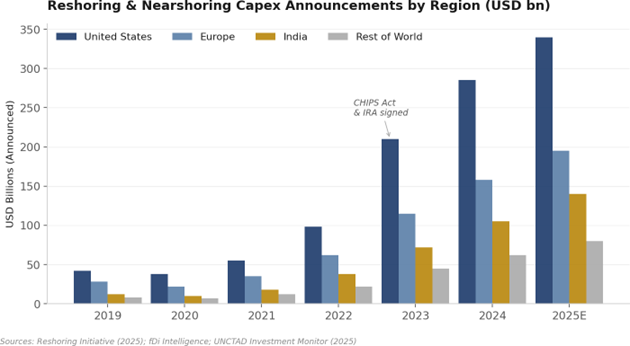
Figure 2. Reshoring capex has accelerated sharply since 2022 across all major geographies. The US leads in absolute terms; India and Southeast Asia are the fastest-growing nearshoring destinations. Source: Reshoring Initiative; fDi Intelligence; author’s estimates.
This capex wave has a long tail.
Construction timelines for semiconductor fabs run 3‒5 years. EV battery plants take 2‒4 years to reach full production. The capex commitments made in 2022‒2024 will be generating revenue — and driving demand for industrial equipment, construction services, and supply chain software — through 2028 and beyond.
The investment implication is straightforward: companies that supply the infrastructure of reshoring — industrial automation, construction materials, logistics software, domestic energy — have a multi-year demand tailwind that is largely independent of the economic cycle.
The US dollar’s share of global foreign exchange reserves has fallen from 72% in 2001 to 58% in 2025.
That is a 14 percentage point decline over 24 years. It is slow. It is not a crisis. And it is structural.
Here’s why it matters:
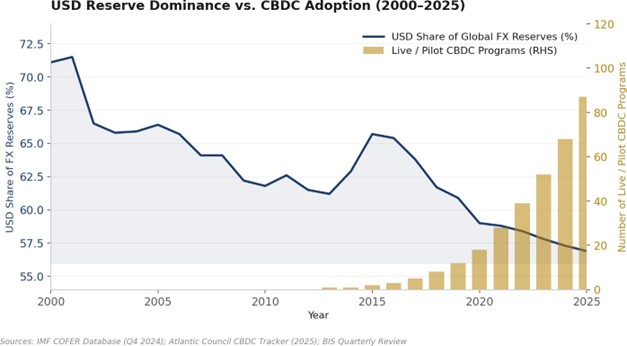
Figure 3. The USD’s share of global reserves has declined structurally since 2001, while CBDC adoption has accelerated sharply since 2020. These trends are related: CBDC infrastructure enables non-dollar settlement at scale. Source: IMF COFER Database; Atlantic Council CBDC Tracker (2025).
This does not mean the dollar is collapsing.
It means the dollar’s structural premium — the “exorbitant privilege” that allows the US to borrow cheaply and run persistent deficits — is being gradually eroded. For systematic investors, this has three implications:
The most underappreciated structural force is what political scientists call “weaponised interdependence.”
The concept is simple: economic interconnection creates leverage. States that control critical nodes in global networks — financial systems, semiconductor supply chains, rare earth processing, undersea cables — can use that control as a coercive instrument.
The US demonstrated this with SWIFT exclusions and semiconductor export controls. China has demonstrated it with rare earth export restrictions and pharmaceutical API supply concentration. The lesson has been absorbed globally.
The result: every major economy is now actively mapping its critical dependencies and spending capital to reduce them.
The Chain Logic: Dependency mapping → Strategic vulnerability identification → Domestic production incentives → Supply chain diversification capex → Structural demand for reshoring beneficiaries
This is not a one-time adjustment. It is a permanent feature of the new geopolitical order.
The fragmentation regime can be quantified using four observable variables:
| Variable | Data Source | Signal Direction | Current Reading |
| Trade Restrictive/Liberalising Ratio | WTO Global Trade Alert | >2.0 = fragmentation regime | 4.1 (regime confirmed) |
| Cross-border Capital Flow Volatility | BIS Quarterly Review | Rising = fragmentation | Elevated (2-year high) |
| USD Reserve Share (YoY change) | IMF COFER | Declining = fragmentation | -0.8pp YoY |
| Reshoring Capex Announcements | Reshoring Initiative | Rising = fragmentation | +34% YoY |
Table 1. The four-variable fragmentation regime indicator. All four variables are currently in fragmentation-confirming territory.
When all four variables are in fragmentation-confirming territory simultaneously, the regime is robust.
We are there now.
Within the fragmentation regime, four factors have shown consistent alpha generation:
| Factor | Definition | Directional Tilt | Alpha (2022‒ 2025) |
| Domestic Revenue Concentration | % of revenue from home market | Long (>70% domestic) | +4.2% annualised |
| Supply Chain Localisation Score | % of inputs sourced domestically | Long (>60% local) | +3.8% annualised |
| Reshoring Capex Beneficiary | Direct exposure to reshoring spend | Long | +6.1% annualised |
| China Revenue Concentration | % of revenue from China | Short (>30% China) | +3.3% annualised (short) |
Table 2. Four-factor alpha screen for the fragmentation regime. Alpha figures are estimated from factor portfolio backtests using Bloomberg data (2022‒2025). Past performance does not guarantee future results.
The reshoring capex beneficiary factor has the highest alpha.
This makes intuitive sense: companies with direct revenue exposure to the $1.4 trillion reshoring wave have a demand tailwind that is largely independent of the macro cycle and is not yet fully priced by the market.
Thesis: Caterpillar is the canonical reshoring capex beneficiary. Its construction and mining equipment is directly in the demand path of every major reshoring project — semiconductor fabs, EV battery plants, LNG terminals, grid infrastructure. The stock has pricing power, a strong backlog, and a domestic revenue profile that insulates it from the geopolitical risk facing its multinational peers.
Example Structure (Educational):
Profit Profile:
Thesis: Apple generates approximately 19% of its revenue from China and manufactures roughly 90% of its products there. In a fragmentation regime, this dual concentration — revenue and supply chain — represents structural risk that the market has historically underweighted.
Example Structure (Educational):
Profit Profile:
Policy Reversal Risk
A major diplomatic breakthrough could temporarily reverse the fragmentation trend. The mitigant: even a significant policy reversal would not undo the physical capex already committed. Semiconductor fabs under construction do not stop because a trade deal is signed.
Crowding Risk
The reshoring theme has attracted significant capital since 2022. Factor crowding can cause sharp reversals even when the underlying thesis is correct. Monitor factor crowding metrics (short interest, institutional ownership concentration) for the key reshoring beneficiary names.
Execution Risk
Reshoring projects are complex, capital-intensive, and subject to cost overruns. Companies that miss reshoring project milestones will face significant stock-specific risk.
Model Risk
The fragmentation regime indicator is based on four observable variables. Systematic models should be monitored for regime-change signals and updated accordingly.
The global trading system is not broken. It is being rebuilt. And the rebuild is generating the most significant capex cycle in a generation.
For investors, the framework is clear:
The question for investors isn’t whether the world is fragmenting. The data has answered that.
The question is whether your portfolio is positioned for the world that’s actually being built — or the one that existed before 2017.
Disclaimer: This article is for educational and informational purposes only and does not constitute financial, investment, or trading advice. The investment strategies discussed are hypothetical examples intended to illustrate concepts. Options trading involves substantial risk and is not suitable for all investors. Past performance is not indicative of future results. Consult with a qualified financial advisor before making investment decisions. The author may hold positions in securities mentioned.
Information posted on IBKR Campus that is provided by third-parties does NOT constitute a recommendation that you should contract for the services of that third party. Third-party participants who contribute to IBKR Campus are independent of Interactive Brokers and Interactive Brokers does not make any representations or warranties concerning the services offered, their past or future performance, or the accuracy of the information provided by the third party. Past performance is no guarantee of future results.
This material is from Vetta Research and is being posted with its permission. The views expressed in this material are solely those of the author and/or Vetta Research and Interactive Brokers is not endorsing or recommending any investment or trading discussed in the material. This material is not and should not be construed as an offer to buy or sell any security. It should not be construed as research or investment advice or a recommendation to buy, sell or hold any security or commodity. This material does not and is not intended to take into account the particular financial conditions, investment objectives or requirements of individual customers. Before acting on this material, you should consider whether it is suitable for your particular circumstances and, as necessary, seek professional advice.
Options involve risk and are not suitable for all investors. For information on the uses and risks of options, you can obtain a copy of the Options Clearing Corporation risk disclosure document titled Characteristics and Risks of Standardized Options by going to the following link ibkr.com/occ. Multiple leg strategies, including spreads, will incur multiple transaction costs.
For specific platform feedback and suggestions, please submit it directly to our team using these instructions.
If you have an account-specific question or concern, please reach out to Client Services.
We encourage you to look through our FAQs before posting. Your question may already be covered!












Great article! This is the type of info that are
meant to be shared across the internet. Disgrace on Google
for no longer positioning this submit higher! Come on over and seek
advice from my site . Thank you =)