
- Solve real problems with our hands-on interface
- Progress from basic puts and calls to advanced strategies
Interactive Options Course

Posted August 5, 2025 at 10:15 am
Farmers are facing an uphill battle in the current economic climate with relatively low commodity prices and surging input costs.
Data shows that fuel prices are significantly higher than they were at pre-pandemic levels; land rents have increased by almost $100 per acre in 15 years; labor and hiring costs have doubled in the last two decades; and fertilizer prices, though down from pandemic peaks, remain elevated.*
While many of these costs cannot be hedged, CME Group offers risk management tools that allow farmers to protect fuel and fertilizer input costs. Historically, the U.S. Gulf Urea fertilizer contract listed at CME Group has been better suited for market participants with barge-sized exposure. In June 2025, however, CME Group launched a smaller-sized 10-Ton Urea U.S. Gulf futures contract, allowing those producers with urea input cost risk to hedge against adverse price movements.
The cost of fertilizer can make up between 20% and 30% of the total cost of production for corn and soybeans. This is a significant portion of the total value of a commodity that now has a derivatives tool to help manage price risk.
As Corn and Soybean futures are priced in cents per bushel and 10-Ton Urea U.S. Gulf futures are priced in dollars per ton, one way to think about fertilizer pricing is via the Corn-Urea or Soybean-Urea ratio. This is simply the number of bushels of corn or soybeans it will take to purchase a ton of fertilizer.
“If I’m looking at fertilizer for the 26 crop, I want to look at the ratio of December 26 Corn to fertilizer prices,” explains Matt Bennett, a seventh-generation farmer in Shelby County, Illinois, and co-founder of AgMarket.Net. “From mid-August to November, I typically look at how many bushels it takes to buy all of my fertilizer…Whenever this ratio is lower, it’s a good time to lock that ratio in because I have to market less bushels to be able to cover that fertilizer cost.”
Instead of separately estimating corn, soybean and urea prices, a farmer can also look at this ratio to determine, historically, whether the price per ton of urea costs more bushels or fewer bushels of corn or soybeans than in prior years around the same time.
The charts below show the Corn-Urea and Soybean-Urea ratios using front month Urea futures prices and next crop December or November prices for Corn or Soybean futures respectively.
Most Recent in Agriculture
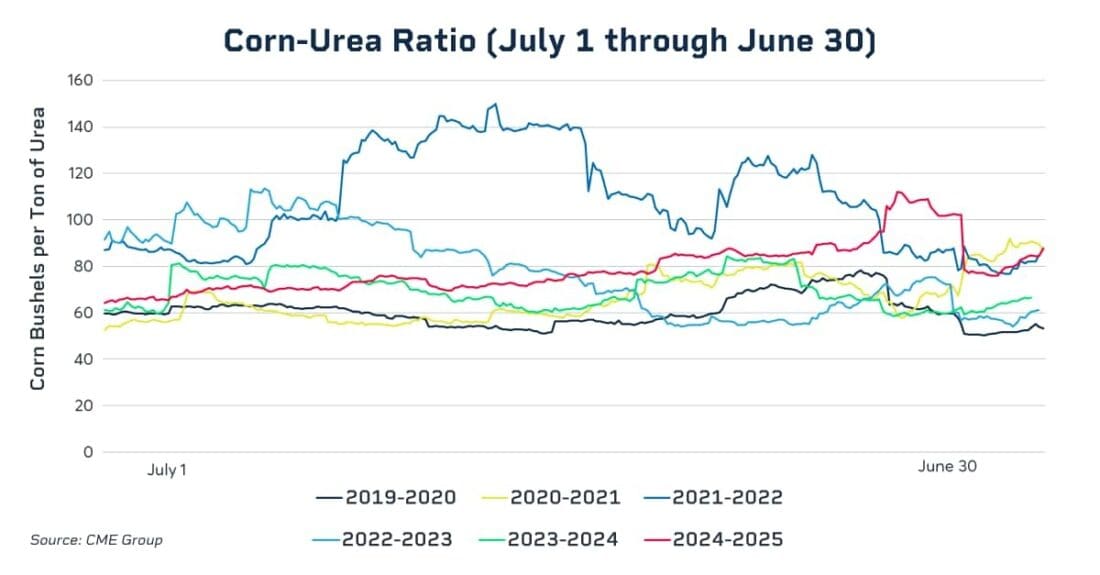
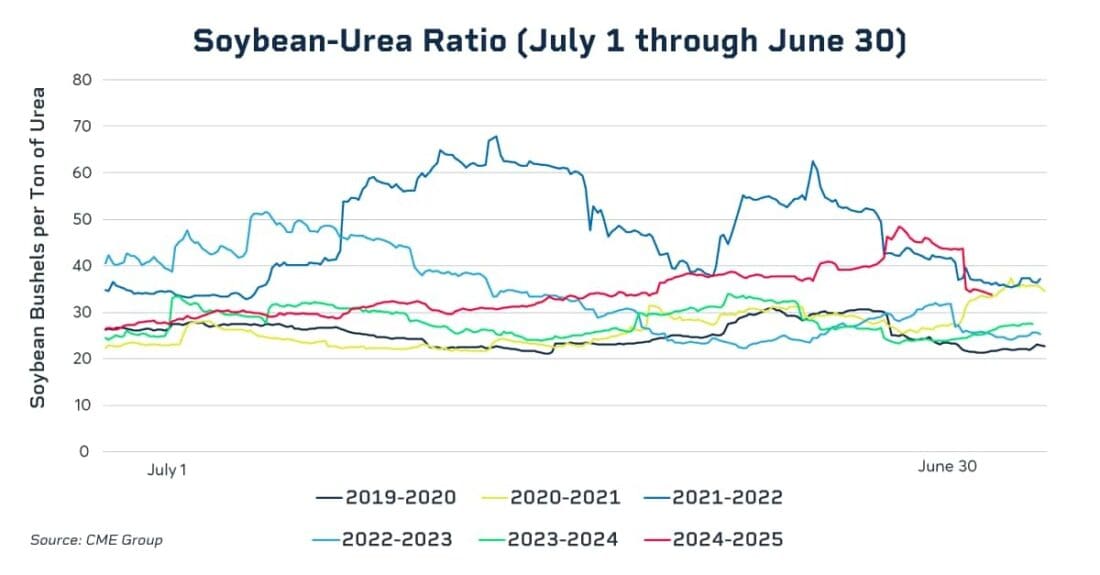
Because the current environment shows relatively low corn and soybean prices and relatively high urea prices, it would take a significant amount of bushels – about 87 bushels of corn or 38 bushels of soybeans – to buy one ton of urea. These values are at or near five-year highs for the beginning of July.
Being aware of potential seasonal patterns and the corn-urea and soybean-urea relationship over time may help farmers make decisions when it comes to hedging input costs. For example, $400 per ton of urea may seem like a reasonable price or a high price depending on the overall context. By putting this cost into the perspective of how many bushels of corn or soybeans it will take to purchase that ton of urea, farmers can make decisions based on historical trends.
For example, urea in the U.S. Gulf was about $400 per ton in June 2021, January 2023 and April 2025. In June 2021, it would have cost 79.5 bushels of corn to purchase one ton of $400 urea, while in January 2023 it would have only cost 67.8 bushels per ton. Meanwhile, in April of 2025, the same $400 ton of urea would cost 89.7 bushels of corn.
Looking at only January data from previous years, 68 bushels per ton appears high. However, assessing the ratio during times when urea was the same price ($400) reveals that 68 bushels is actually a relatively low ratio.
While input costs are considered year-round, spring and fall are more typical times for retailers and farmers to be thinking about fertilizer. The spring buying and application period is more straightforward, but some farmers may be interested in keeping track of price relationships as harvest season approaches.
The June 2025 USDA Acreage report showed that planted acres in corn are expected to be the third-highest since the 1940s. The market is expecting a significant corn crop, but if weather turns unfavorable or the crop starts looking tight, some producers may see a benefit in additional fertilizer application. Additionally, if a quality specification is forecasted to be difficult to come by – protein content in a large Hard Red Winter Wheat crop, for example – some farmers will opt for fall fertilizer application to be able to deliver a premium product and reap a higher price.
Beyond the spring and fall applications, farmers will continue to look at factors impacting both commodity prices and fertilizer prices. Crop progress and crop quality reports may have significant impacts on corn, soybean and wheat prices, which will alter the urea price ratios and may provide an opportunity to lock in a beneficial price relationship.
“For the last two years, it’s really hurt people, buying fertilizer and not selling corn,” Bennett said. “I think [fertilizer futures] could be a really handy tool.”
Through the summer and into the fall, water levels in the Mississippi River will also be closely monitored. For each of the past three years, the river was at or near record low water levels, which inhibited fertilizer from making its way from the port to the upper corn belt and also limited the amount of corn and soybeans that could be shipped back to the Gulf.
Overall, the ability to price urea based on bushels of corn and soybeans coupled with the newly accessible fertilizer risk management tool offers new opportunities for retailers and farmers to hedge an important input cost.
*Data sources: Federal Reserve Bank of St. Louis; Farm Bureau; USDA
—
Originally Posted August 4, 2025 – Why Fertilizer Risks Are a Year-Round Consideration
© [2023] CME Group Inc. All rights reserved. This information is reproduced by permission of CME Group Inc. and its affiliates under license. CME Group Inc. and its affiliates accept no liability or responsibility for the information contained herein, including but not limited to the currency, accuracy and/or completeness of this information, and delays, interruptions, errors or omissions. This information is an unofficial copy and may not reflect the official and accurate version. For the definitive and up-to-date version of any of this information, please see cmegroup.com.
Information posted on IBKR Campus that is provided by third-parties does NOT constitute a recommendation that you should contract for the services of that third party. Third-party participants who contribute to IBKR Campus are independent of Interactive Brokers and Interactive Brokers does not make any representations or warranties concerning the services offered, their past or future performance, or the accuracy of the information provided by the third party. Past performance is no guarantee of future results.
This material is from CME Group and is being posted with its permission. The views expressed in this material are solely those of the author and/or CME Group and Interactive Brokers is not endorsing or recommending any investment or trading discussed in the material. This material is not and should not be construed as an offer to buy or sell any security. It should not be construed as research or investment advice or a recommendation to buy, sell or hold any security or commodity. This material does not and is not intended to take into account the particular financial conditions, investment objectives or requirements of individual customers. Before acting on this material, you should consider whether it is suitable for your particular circumstances and, as necessary, seek professional advice.
Futures are not suitable for all investors. The amount you may lose may be greater than your initial investment. Before trading futures, please read the CFTC Risk Disclosure. A copy and additional information are available at ibkr.com.
Related Articles















Join The Conversation
For specific platform feedback and suggestions, please submit it directly to our team using these instructions.
If you have an account-specific question or concern, please reach out to Client Services.
We encourage you to look through our FAQs before posting. Your question may already be covered!