
- Solve real problems with our hands-on interface
- Progress from basic puts and calls to advanced strategies
Interactive Options Course
Lesson 2 of 6
New to Interactive Brokers?
Momentum, in financial terms, refers to the tendency of stock prices to continue moving in the same direction—up or down—over a given period. This concept is based on the Newtonian notion that an object in motion tends to stay in motion unless acted upon by an external force.
To quantify this momentum, investors often use the Momentum Formula, which is a simple yet powerful tool. The formula is:
Momentum = V_{current} – V_{previous}
Where Vcurrent is the most recent price of the stock, and Vprevious is the price of the stock at a prior point in time. The difference between these two values gives us the momentum of the stock.
A positive result indicates an upward momentum, while a negative result suggests a downward momentum.
Let’s consider a stock that was priced at $100 a month ago and it’s today $120. Using the momentum formula, we calculate the momentum as follows:
20 = 120 – 100
This positive momentum of 20 suggests that the stock has been on an upward trend over the past month. Investors might view this as a signal that the stock could continue to rise in the near term, influenced by investor sentiment, market conditions, or other factors.
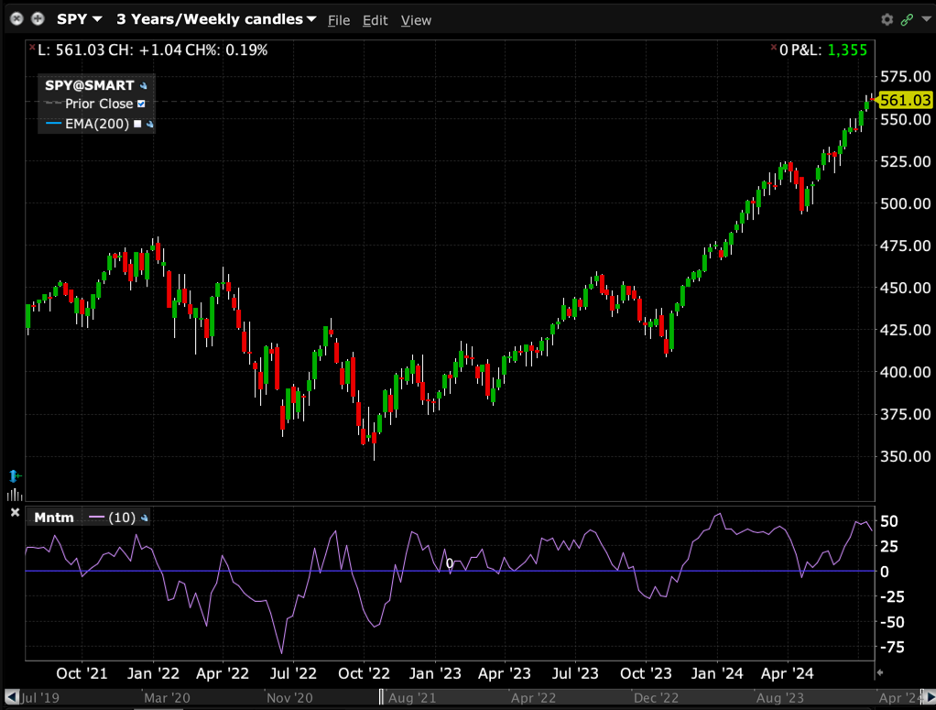
One way to measure momentum is by using the SPDR S&P 500 ETF Trust (ticker symbol SPY) as a benchmark, along with a momentum indicator. This approach can be particularly insightful over different periods, such as a 10-day momentum analysis over three years.
The 10-day momentum of SPY is calculated by subtracting the closing price of SPY 10 days ago from today’s closing price. This calculation gives a simple yet powerful representation of how much SPY has moved over the last 10 days. By examining this over a period of three years, one can observe how short-term price movements contribute to longer-term trends.
You’ll see a line at 0, above the 0 line is positive momentum and below the line negative momentum.
This analysis can reveal several key insights. For instance, periods of consistently positive momentum may suggest a strong bullish trend where prices are expected to continue rising.
Conversely, periods of negative momentum might indicate a bearish trend. Moreover, by comparing these momentum trends with historical events or market changes, investors can gain a deeper understanding of what drives market fluctuations.
While momentum may be a useful indicator, it is not foolproof. External factors such as market volatility, economic news, or changes in industry conditions can quickly alter the momentum of a stock.
Viewing the SPY chart with a momentum indicator to analyze the 10-day momentum over three years provides a lens through which to view market dynamics.
We’ll explore more indicators in the next lessons.
The analysis in this material is provided for information only and is not and should not be construed as an offer to sell or the solicitation of an offer to buy any security. To the extent that this material discusses general market activity, industry or sector trends or other broad-based economic or political conditions, it should not be construed as research or investment advice. To the extent that it includes references to specific securities, commodities, currencies, or other instruments, those references do not constitute a recommendation by IBKR to buy, sell or hold such investments. This material does not and is not intended to take into account the particular financial conditions, investment objectives or requirements of individual customers. Before acting on this material, you should consider whether it is suitable for your particular circumstances and, as necessary, seek professional advice.
The views and opinions expressed herein are those of the author and do not necessarily reflect the views of Interactive Brokers, its affiliates, or its employees.
Any stock, options or futures symbols displayed are for illustrative purposes only and are not intended to portray recommendations.











Join The Conversation
For specific platform feedback and suggestions, please submit it directly to our team using these instructions.
If you have an account-specific question or concern, please reach out to Client Services.
We encourage you to look through our FAQs before posting. Your question may already be covered!