
- Solve real problems with our hands-on interface
- Progress from basic puts and calls to advanced strategies
Interactive Options Course
Posted June 4, 2026 at 4:40 pm
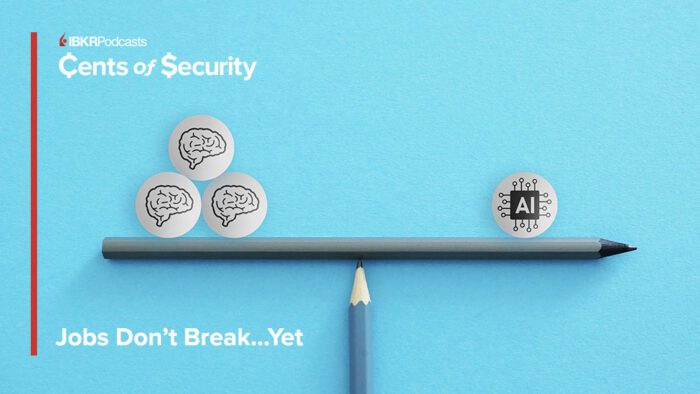
Despite growing fears around AI replacing workers, job growth remains surprisingly strong. Mary MacNamara and Jose Torres break down the latest data on hiring, inflation, and markets—and what it all means for investors navigating an AI-driven economy.
The following is a summary of a live audio recording and may contain errors in spelling or grammar. Although IBKR has edited for clarity no material changes have been made.
Hello everybody, and welcome to the Cents of Security podcast. Today we are back again with Jose Torres, Senior Economist at Interactive Brokers, to talk about the current news. Welcome, Jose. How are you?
Hi, Mary. Doing well. Great to be here. It’s been a while
Good. So, tell me, what is going on economically and otherwise?
Wow, Mary. Economic data has been strong lately. The jobs numbers have been terrific. We got job openings yesterday, Tuesday June 2nd. It was the highest amount of labor vacancies in twenty-three months. Today, ADP jobs report, today is June 3rd, Wednesday. We got the strongest level of hiring in sixteen months, all occurring against the backdrop of folks worrying that AI is going to weaken job opportunities and maybe even displace industries and employment. However, we’re seeing that as the significant rally in AI and tech stocks continues, albeit today is June 3rd, we’re getting the first pullback in a while after nine consecutive days of advances for the S&P 500. We’re seeing that despite the buoyant earnings expectations and the increased projections of AI adoption; employers continue to add workers at a very fast pace.
And that’s very good news. It means that the technology is actually at this juncture we can’t conclude much, it’s still early, but it appears that firms are learning how to use the appropriate amount of technology alongside the corresponding amount of labor. So, it doesn’t really– not really a connection here between rising AI adoption and less jobs.
It could actually end up being positively correlated, which would be, of course, a great development. More wealth, more prosperity, but also more growth. Another thing, AI is incredibly expensive. It’s been driving inflationary pressures. Inflation, we’ve been getting very high price pressure figures in the recent data points in ISM surveys on manufacturing and services, as well as the producer price index, the consumer price index, and the personal consumption expenditures price index, all way above target.
Last number on PPI was six percent, CPI three point eight, PCE around three point eight as well. So very elevated inflation, partially driven by the increase in oil costs now that we’re past the Iran war. We’re past month three on that. We’ve seen that prices are starting to increase across the overall economy.
Physical products, of course, are starting to rise because we are seeing that it costs more to move them around. And then all in all, that’s starting to increase services prices as well. And that’s usually what happens after you have an energy price shock. It takes around three months for it to really broaden across the economy and expectations.
So wages, however, haven’t risen as fast as inflation rate. Wages are rising at around 3.5%, and inflation is rising now, and May’s numbers haven’t come out yet. They’ll be out in a few weeks. But May– inflation is running north of 4%, and wages are in the mid-threes. So, workers are getting cheaper on a real basis when you compare worker compensation packages, the growth rate on that versus the prices in the overall economy, of which AI equipment is an important int- an important aspect of the inflationary surge. And all in all, it shows that, workers are getting cheaper and firms want them. After all, it doesn’t look like anytime soon AI is really going to be displacing large amount of em- a large amount of employees
Yeah, there’s been a lot of noise. I’ve been reading lately about how the annual cost of AI tokens for a company to pay may at some point be more than hiring a human, right? So, there’s big talk about that, where you still need humans to interface, maybe not do 100% of the AI.
But I think there’s going to be a little bit of pullback. But then again, I don’t know. I don’t have a crystal ball, so I have no clue. But it’s interesting to see how it’s working out
Yeah. And Google, one of the most profitable companies in the world, just did a secondary equity offering for $80 billion because it needs more money to fund AI. So, if Google, one of the Magnificent Seven names, needs more money to fund AI, what does that tell you about, how smaller firms in the economy, mid-size firms, where are they in the whole AI capital expenditure process, most haven’t even started for obvious reasons. It’s too expensive, and most are still gravitating towards labor as a way to scale their operations. So that’s that. Yesterday, June 2nd, Tuesday, that was really an important bifurcation where we saw the JOLTS number jump to a 23-month high.
Today, ADP number jumping up to a 16-month high during the same week that Google needs more money for AI. So, a clear signal there in the short term. Of course, it could all be a coincidence, but that we’re getting these stellar job numbers irrespective of an energy cost spike, rates that are still elevated consumer spending that’s doing great some months, weaker others.
ISM services this morning, June 3rd, were particularly strong. We had strong new orders, robust activity. Prices, though, very elevated, same as ISM manufacturing data that we got on Monday, June 1st, and the manufacturing data was really bolstered, of course, by the AI build-out and the momentum that last year’s passage of the Big Beautiful Bill really offered the manufacturing sector via first-year 100% depreciation.
So, firms essentially have an incentive to go out and invest as much money as they can into a lot of different kinds of activities. And, of course, what’s been dominating has been the AI build-out. Even the GDP numbers, gross domestic product, we’re seeing that more of the buoyancy is coming from business investment thanks to AI, rather than even consumer spending.
Consumer spending looks like it’s, it’s a little weaker this year. Consumers are going through a lot. They have; their paychecks aren’t growing as fast as inflation. Prices are high. Interest rates are elevated. Consumers are having a little bit of trouble but not enough to derail the expansion.
Still positive, AI still helping, and of course, the wealth effect from rising stocks is also assisting households in, at least in some cases, sustaining their expenditure patterns, while in others, expanding them.
You know what’s surprising with the war going on, where we are right now, and oil and gas prices and so forth, I’m surprised there’s just– there’s not more, panic. It seems like the market just is saying, “Okay, there’s that issue over there, but this is what we got going on. Earnings are great.
Everything, is moving forward.” So how do you think about that?
Yeah, we all got caught by surprise. We didn’t expect that the AI rally would really recover strongly from the March 30th low on the S&P 500 to drive a 20% rally in two months to yesterday’s all-time high at around 7620. So north of 20% in two months roughly. No one thought that all those economic headwinds could be conquered easily, Mary, easily conquered, easily offset, countered by this massive AI capital expenditure spree that essentially is driving the bottom lines and the projections of the earnings into the future a lot higher.
No one expected that at the same time that you had these severe economic headwinds, that earnings would be this buoyant and that the projections moving forward would also be very positive, because usually when you have an oil price spike and interest rates increase and you have some geopolitical uncertainty, that serves to constrain economic activity.
That’s more of a cooling effect, but no, and that’s why a lot of investors got caught offsides because those economic headwinds weren’t enough to stop the momentous rally in AI, and let’s just remember, December to March was a particularly slow period for the tech trade. The tech trade wasn’t really doing that well.
In fact, from January to March, we were flat. We were very range bound in stocks. So, to think that the war and that the associated lift in interest rates and crude oil ended up being positive for stocks, is really a peculiar development. It’s really shocking. But it’s the AI trends that were able to have us overcome those difficulties
So I saw something that the Bureau put out about they look at the metropolitan centers around the United States, and they comment on the job and employment. Did you see anything interesting there, the South doing better than the Northeast or vice versa?
Yeah. So, we’ve been seeing a lot of regional discrepancies. Recently the Northeast has been doing better than the South. I think part of that is that the South tends to be a little more speculative, and then post-pandemic, really the South was on a tear. Now we’re seeing, economic activity really starting to move more back into the Northeast.
We’re not having that much incoming migration into the South. That’s traditionally, during some periods, that hurts activity in the Northeast, but we’ve been seeing that lighten up. Of course, housing costs in the South have gone through the roof so you know, there’s been less of an incentive to move down to the Sun Belt, like to sunny Florida, for example.
Pre-pandemic, folks remember the differentials between Connecticut and New York and New Jersey living versus Florida, and they were particularly wide. But then after housing valuations in the South really expanded significantly, and then the associated rather the accompanied lift in insurance costs as well as property taxes, then that arbitrage housing exchange more or less really has narrowed.
So, you know, not as much flows heading into the South these days.
So, it seems like there’s also a lot of talk about these data centers, right? From positive okay, they’ll bring on some jobs, but then people are complaining about the noise, the lights stay on all night, there’s some sort of humming. And, although they do bring jobs to a particular town or area to get them built, then afterwards it doesn’t take that many employees to run the data center.
So, what have you been hearing about that economically?
Yeah, that’s been really a weak point of the Trump administration is that manufacturing employment has declined in the past year and a half of the Trump 2.0 era. There’s an expectation, an optimistic one, that once a lot of these data centers and these facilities are built, that somehow, we’ll have a big recovery in manufacturing jobs.
I tend to be a little more pessimistic, how you framed your question about how once these data centers are built, a lot of it is automated robotics and you don’t really need that many people. I tend to be on that side of the argument. We got to wait and see what happens but the social costs of the data centers, the associated lift in electricity, the noise some of the hazards perhaps, that’s really been worrying a lot of the American public.
Some towns, municipalities have denied entry to the data center construction. They don’t want data centers built in their areas for some of those reasons. So really uncertain at this point. But AI is looking like it’s going to bolster profits for the tech sector going forward to be- to the benefit of shareholders.
Not quite sure how that’s going to benefit, the environment or society or middle class and lower income class middle income and lower income workers.
So what do you see for the rest of the week? What’s coming up?
We have a big jobs report on Friday. Of course, we’ll have our live stream here at Interactive Brokers. I’m expecting to see a lot of the same stuff that we’ve been seeing. Buoyant hiring, wage gains, still robust, not as fast as inflation broad sector participation. I think that’ll still– the markets will be okay with strong jobs numbers, but we have to wait to see what happens with tariffs too, because tariffs now, Mary, are back in the conversation.
President Trump wants to reestablish tariffs of at least 10% on 60 countries.nPart of the justification is to level the playing field between the US and foreign counterparts, also looking to bolster the domestic manufacturing sector. And part of the reason why he’s doing this is because he’s saying that a lot of these countries are using forced labor so that they can drive their costs of production lower and then essentially be more competitive on the global manufacturing front.
President Trump doesn’t think that’s fair, so he’s looking for alternative ways to push the tariffs after last year’s tariffs got rejected by the Supreme Court.
We’ll have to see about all this, right? Tariffs are back. Oh, my goodness.
All inflationary, and that’s why the market’s selling off today, Mary. You have strong econ data, strong ISM services, strong ADP, strong JOLTS. That’s lifting economic growth expectations as well as inflation projections. And then you have Middle East flaring up. You still have attacks between the US and Iran.
We don’t know. The ceasefire is very fragile. We don’t know what’s gonna happen with that. It’s tough to get Israel to play ball. The Iranians want the Israelis to stop attacking Lebanon. That’s been an issue for the President. Apparently, he was swearing to president of Israel Netanyahu also known as Bibi.
So you have the Middle East, you have the tariffs, strong econ data, lifting interest rates, putting new Fed chair Kevin Warsh in a tough position. Is he gonna wait all this out and allow inflation to remain elevated and spread further across the economy in a more intense fashion, or will he hike?
The market says he’s going to hike, but if he hikes, he’s going to have an issue with President Trump, who doesn’t want him to. He wants him to lower the rates. How can he with inflation north of 4%, Mary? We’ll have to wait and see. Economy good. Markets, though, could be a l– in for some summer volatility.
Tons of headwinds here. Rates can go a lot higher if these headwinds don’t clear. Need to clear at least one or two of these hurdles, I think, for the equity market to advance further. We’re already up 10% on the S&P year to date, folks. It’s not even halftime yet. So that’s how much– what an important question for investors starting every year is, what kind of return are you expecting?
So here, June 3rd, up 10% on the S&P, 17% on the Nasdaq 100. I think right now with these hurdles, it’s going to be tough to move a lot higher, faster or at the same speed without clearing some of those. Last few weeks of May, we had a slower grind higher, not like what we saw in April as well as the first two weeks of May.
Let’s hope wages go up a little bit. I know that oil contracts for the Northeast are going to be coming, and I’m sure that, home oil heating is going to be a lot. I anticipate that. So, it would be nice to see a little bit of a jump in wages for that K-shaped economy, right?
Yeah. Yeah, the heating is looking like it’s going to be significant. Right now, electricity is really what a lot of communities and a lot of folks are really complaining about huge surges in their electricity bills. So, we’ll see what happens. We’ll hopefully we get a big decline in crude oil natural gas costs can come down and, those staples, those necessities can become more easy to manage.
All right. Jose Torres, Senior Economist at Interactive Brokers. Thank you so much for your insights today. We really appreciate it, and we’re going to have you on again this summer. And so, I just want you to enjoy your summer, and thank you so much for being here, and listeners, too
Thanks, Mary. Thanks to the audience, and I’ll see you soon.
The analysis in this material is provided for information only and is not and should not be construed as an offer to sell or the solicitation of an offer to buy any security. To the extent that this material discusses general market activity, industry or sector trends or other broad-based economic or political conditions, it should not be construed as research or investment advice. To the extent that it includes references to specific securities, commodities, currencies, or other instruments, those references do not constitute a recommendation by IBKR to buy, sell or hold such investments. This material does not and is not intended to take into account the particular financial conditions, investment objectives or requirements of individual customers. Before acting on this material, you should consider whether it is suitable for your particular circumstances and, as necessary, seek professional advice.
The views and opinions expressed herein are those of the author and do not necessarily reflect the views of Interactive Brokers, its affiliates, or its employees.











Join The Conversation
For specific platform feedback and suggestions, please submit it directly to our team using these instructions.
If you have an account-specific question or concern, please reach out to Client Services.
We encourage you to look through our FAQs before posting. Your question may already be covered!