
- Solve real problems with our hands-on interface
- Progress from basic puts and calls to advanced strategies
Interactive Options Course
Lesson 5 of 6
New to Interactive Brokers?
Using Bollinger Bands in short-term trading can be an effective strategy when applied correctly. They consist of a simple moving average (usually 20 periods) and 2 standard deviations plotted above and below the moving average. The bands expand and contract based on volatility: wider bands indicate higher volatility, while narrower bands suggest lower volatility.
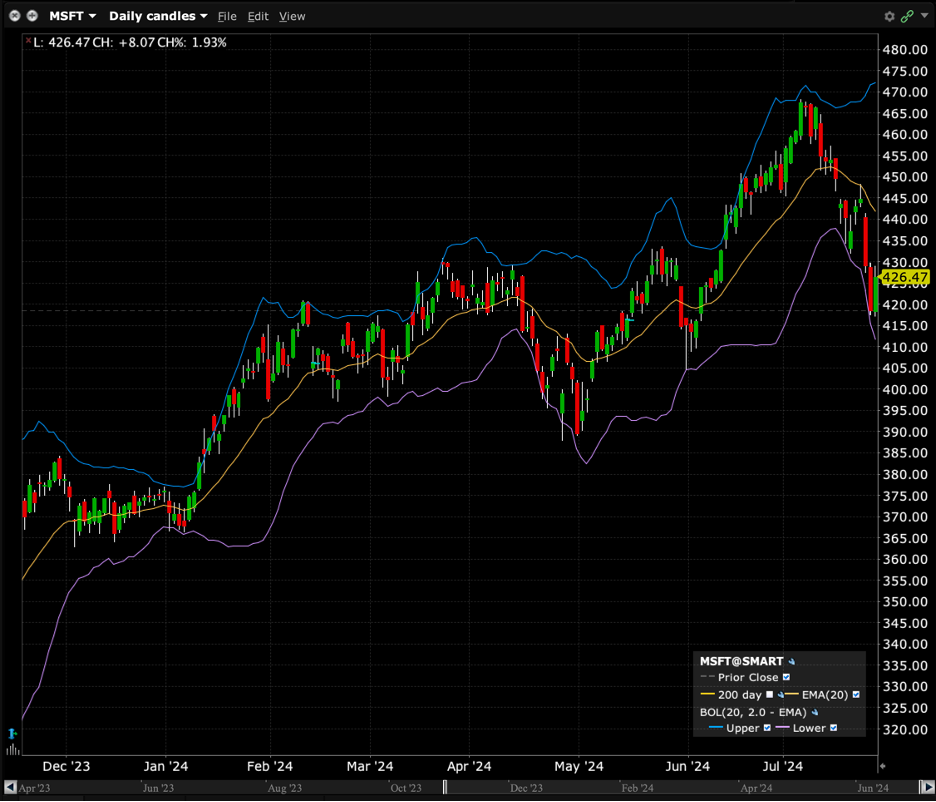
The Middle Band (MA) in orange:
The middle band is typically a 20period simple moving average (SMA). It serves as the baseline for the upper and lower bands.
The Upper Band in blue: This is Calculated by adding two standard deviations to the moving average. It Represents the upper boundary of price movement.
The Lower Band in purple: This is Calculated by subtracting two standard deviations from the moving average. It Represents the lower boundary of price movement.
Volatility and Band Width – Bollinger Bands widen during periods of high volatility and narrow during low volatility. In short-term trading, wider bands can indicate potential upcoming price movements, while narrow bands suggest a consolidation phase.
Overbought and Oversold Conditions:
Identify Narrow Bands – Look for periods where the bands contract and move closer together, indicating low volatility.
Anticipate Breakout – A breakout occurs when price moves outside the bands after a period of contraction.
Possibly Enter a trade in the direction of the breakout (long if above upper band, short if below lower band).
Reversion to the Mean – Prices often revert back toward the middle band after reaching extreme levels.
Possibly Enter a trade when price reverses from the outer band towards the middle band.
Directional Bias – Use Bollinger Bands to confirm the direction of a trend.
Uptrend – Price should consistently stay near or above the middle band.
Downtrend – Price should stay near or below the middle band.
Entry – Look for buying opportunities near the lower band in an uptrend and selling opportunities near the upper band in a downtrend.
Confirmation with Other Indicators: Use Bollinger Bands in conjunction with other technical indicators (like RSI, MACD) for confirmation of trade signals.
Timeframe Selection: Adjust the period setting of Bollinger Bands based on the timeframe you are trading (for example 10 periods for intraday trading, 50 periods for swing trading).
Set stop loss orders based on volatility and your risk tolerance. Consider position sizing relative to the width of the bands to manage risk effectively.
Avoid OverTrading: Wait for clear signals based on the Bollinger Bands strategy rather than trading on every price move.
Bollinger Bands are a versatile tool that can help shortterm traders identify potential entry and exit points based on price volatility and overbought/oversold conditions.
By understanding the principles of Bollinger Bands and applying them with other technical analysis tools, traders can enhance their decision making process and improve their overall trading performance.
Remember, like any technical indicator, Bollinger Bands are most effective when used in conjunction with other forms of analysis and with proper risk management strategies in place.
For specific platform feedback and suggestions, please submit it directly to our team using these instructions.
If you have an account-specific question or concern, please reach out to Client Services.
We encourage you to look through our FAQs before posting. Your question may already be covered!
The analysis in this material is provided for information only and is not and should not be construed as an offer to sell or the solicitation of an offer to buy any security. To the extent that this material discusses general market activity, industry or sector trends or other broad-based economic or political conditions, it should not be construed as research or investment advice. To the extent that it includes references to specific securities, commodities, currencies, or other instruments, those references do not constitute a recommendation by IBKR to buy, sell or hold such investments. This material does not and is not intended to take into account the particular financial conditions, investment objectives or requirements of individual customers. Before acting on this material, you should consider whether it is suitable for your particular circumstances and, as necessary, seek professional advice.
The views and opinions expressed herein are those of the author and do not necessarily reflect the views of Interactive Brokers, its affiliates, or its employees.










I am truly delighted to glance at this webpage posts
which consists of plenty of helpful data, thanks for providing these kinds of information.