
- Solve real problems with our hands-on interface
- Progress from basic puts and calls to advanced strategies
Interactive Options Course

Posted December 26, 2025 at 10:45 am
Last week, President Donald Trump ordered a blockade of oil tankers entering and leaving Venezuela, dramatically escalating U.S. pressure on the Maduro regime. The U.S. has already seized a Venezuelan oil tanker, and in a Truth Social post last Tuesday, Trump insinuated that U.S. forces would leave the South Americans country when it returned “all of the Oil, Land, and other Assets that they previously stole from us.”
Stephen Miller, Trump’s top policy advisor, went further on X, accusing Venezuela of the “largest recorded theft of American wealth and property.”
Before last week, U.S. involvement in the country was being framed as part of a broader war on drugs, fentanyl specifically.
The Trump administration has told Congress that the U.S. is engaged in an “armed conflict” with drug cartels and has charged Venezuelan President Nicolás Maduro with supporting “narco-terrorism.” There have been 25 boat strikes near Venezuela, killing at least 95 people.
But the uncomfortable truth is that Venezuela is not a source of fentanyl, the synthetic opioid responsible for killing over a quarter of a million Americans since 2021. According to the State Department and the Drug Enforcement Administration (DEA), Venezuela is primarily a transit country for cocaine.
Fentanyl, by contrast, is overwhelmingly produced in Mexico using precursor chemicals sourced from China and India, and it enters the U.S. mostly through legal ports of entry… and mostly by Americans. In 2024, four out of five (80%) convicted drug traffickers were U.S. citizens, according to an analysis of government data by the libertarian Cato Institute.
So if this isn’t really about fentanyl, investors should be asking: Why Venezuela, and why now? The answer, I believe, has far less to do with drugs and more to do with energy and power.
Earlier this month, the Trump administration formally revived the Monroe Doctrine, the 19th-century idea that the Western Hemisphere is off-limits to foreign powers.
In its 21-century incarnation, which the administration calls the Trump Corollary—others are referring to it as the “Donroe” Doctrine—the policy emphasizes U.S. dominance in the Americas and rejects the influence of globalization.
Viewed through that lens, Venezuela makes some sense. The country has significant mineral resources. It sits atop the largest proven oil reserves in the world, estimated at 303 billion barrels, over 6.5 times more than the U.S. has.

And after years of U.S. sanctions, Maduro has leaned hard into relationships with China, Russia and Iran to stay afloat. Most Venezuelan crude oil now flows to China at steep discounts, often through secretive shipping agreements designed to skirt sanctions.
According to one Venezuela expert, the idea of a resource-rich country in the Americas trading with China and Russia “doesn’t really fit into Trump’s view of the world.”
That brings us to oil and diesel.
Venezuela’s crude is famously heavy and sour, meaning it’s thick, high in sulfur and difficult to process. Over the decades, complex refineries, especially in the U.S., have been engineered specifically to handle this kind of oil.
This matters because heavy crude is disproportionately important for diesel production, and diesel is the lifeblood of the global economy. It powers trucks, ships, mining equipment, agriculture and other industries.
When diesel prices have spiked, inflation has quickly followed suit. After Russia invaded Ukraine in early 2022, disruptions to heavy crude and refined product flows sent diesel prices soaring, contributing to higher food and consumer prices across the globe.
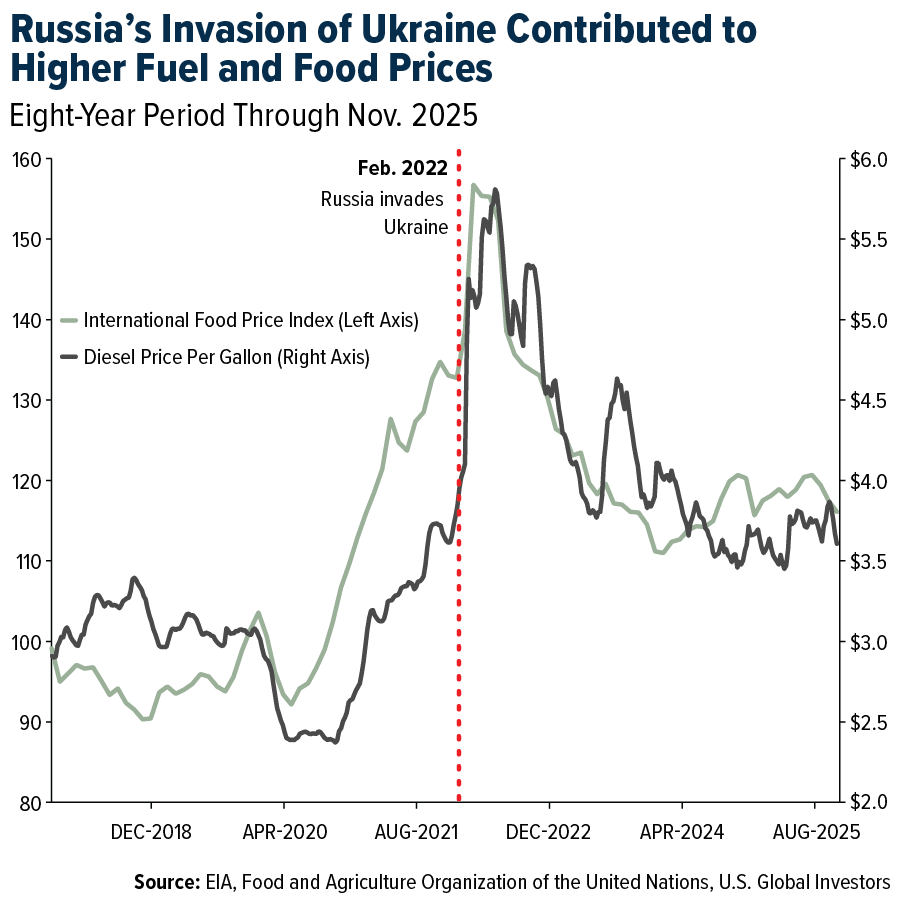
For now, Venezuela insists that oil exports are proceeding normally, but if trade is disrupted, the impact wouldn’t be limited to Venezuela or even South America. It would ripple through the global economy.
Oil prices are down sharply this year. Brent Crude is off more than 20% year-to-date, weighed down by slowing demand in China and oversupply fears.

Middle distillate inventories, including diesel, remain historically tight in many regions, according to the International Energy Agency (IEA).
I’m not predicting an immediate oil price spike, but I do believe diesel-driven inflation risk is being underpriced. And when governments underestimate inflation risks, they tend to react late and overcorrect. That’s rarely been good for markets.
That’s why I think diversification into real assets remains attractive, even when oil prices are falling.
As I’ve pointed out many times, gold has historically performed well during periods of uncertainty and inflation risk.
According to the World Gold Council (WGC), the precious metal has now risen for five consecutive weeks, closing last week at a new record high above $4,300 an ounce. Year-to-date, it’s up roughly 67%, dramatically outperforming most major asset classes, including stocks, bonds and commodities.
As for the drivers, monetary policy is turning more supportive. Historically, periods of rate cuts and balance sheet expansion have been constructive for gold.
The U.S. dollar is also weakening. A softer dollar has traditionally been one of gold’s most reliable tailwinds.
Finally, geopolitical risk remains high, and not just in Venezuela. The WGC highlights continues tensions involving Russia and Ukraine, the Middle East, and rising instability across multiple regions.
This is why I continue to recommend a 10% allocation to gold, split between physical bullion and high-quality gold mining companies. Remember to rebalance on at least an annual basis.
—
Originally Posted December 22, 2025 – The Diesel Shock No One Is Talking About
The FAO Food Price Index (FFPI) is a monthly indicator from the UN’s Food and Agriculture Organization that tracks changes in global international prices of 5 major food groups: cereals, vegetable oils, dairy, meat and sugar, weighted by their export shares.
All opinions expressed and data provided are subject to change without notice. Some of these opinions may not be appropriate to every investor. By clicking the links above, you will be directed to a third-party website. U.S. Global Investors does not endorse all information supplied by these websites and is not responsible for their content.
The FAO Food Price Index (FFPI) is a monthly indicator from the UN’s Food and Agriculture Organization that tracks changes in global international prices of 5 major food groups: cereals, vegetable oils, dairy, meat and sugar, weighted by their export shares.
All opinions expressed and data provided are subject to change without notice. Some of these opinions may not be appropriate to every investor. By clicking the links above, you will be directed to a third-party website. U.S. Global Investors does not endorse all information supplied by these websites and is not responsible for their content.
All opinions expressed and data provided are subject to change without notice. Holdings may change daily.
Some of these opinions may not be appropriate to every investor. By clicking the link(s) above, you will be directed to a third-party website(s). U.S. Global Investors does not endorse all information supplied by this/these website(s) and is not responsible for its/their content.
About U.S. Global Investors, Inc. – U.S. Global Investors, Inc. is an investment adviser registered with the Securities and Exchange Commission (“SEC”). This does not mean that we are sponsored, recommended, or approved by the SEC, or that our abilities or qualifications in any respect have been passed upon by the SEC or any officer of the SEC.
This commentary should not be considered a solicitation or offering of any investment product.
Certain materials in this commentary may contain dated information. The information provided was current at the time of publication.
Some links above may be directed to third-party websites. U.S. Global Investors does not endorse all information supplied by these websites and is not responsible for their content.
Please consider carefully a fund’s investment objectives, risks, charges and expenses. For this and other important information, obtain a fund prospectus by clicking here or by calling 1-800-US-FUNDS (1-800-873-8637). Read it carefully before investing. Foreside Fund Services, LLC, Distributor. U.S. Global Investors is the investment adviser.
Information posted on IBKR Campus that is provided by third-parties does NOT constitute a recommendation that you should contract for the services of that third party. Third-party participants who contribute to IBKR Campus are independent of Interactive Brokers and Interactive Brokers does not make any representations or warranties concerning the services offered, their past or future performance, or the accuracy of the information provided by the third party. Past performance is no guarantee of future results.
This material is from US Global Investors and is being posted with its permission. The views expressed in this material are solely those of the author and/or US Global Investors and Interactive Brokers is not endorsing or recommending any investment or trading discussed in the material. This material is not and should not be construed as an offer to buy or sell any security. It should not be construed as research or investment advice or a recommendation to buy, sell or hold any security or commodity. This material does not and is not intended to take into account the particular financial conditions, investment objectives or requirements of individual customers. Before acting on this material, you should consider whether it is suitable for your particular circumstances and, as necessary, seek professional advice.
Futures are not suitable for all investors. The amount you may lose may be greater than your initial investment. Before trading futures, please read the CFTC Risk Disclosure. A copy and additional information are available at ibkr.com.
U.S. Spot Gold trading through IB LLC accounts is only available to legal residents of the United States that do not reside in Arizona, Montana, New Hampshire, and Rhode Island.
Related Articles
















Join The Conversation
For specific platform feedback and suggestions, please submit it directly to our team using these instructions.
If you have an account-specific question or concern, please reach out to Client Services.
We encourage you to look through our FAQs before posting. Your question may already be covered!