
- Solve real problems with our hands-on interface
- Progress from basic puts and calls to advanced strategies
Interactive Options Course
Posted July 15, 2026 at 10:15 am
Editor’s note: This article has been updated with additional content.
Producer inflation came in well below expectations in June, reinforcing market expectations that the Federal Reserve will keep interest rates unchanged this month.
The Producer Price Index (PPI) fell 0.3% month-over-month in June, below the flat monthly reading economists expected and a sharp reversal from May’s downwardly revised 0.6% surge. It marks the lowest monthly print since April 2025.
The annual producer inflation rate eased to 5.5%, from a downwardly revised 6.0%, versus the 6.2% consensus.
Core PPI, which strips out food and energy, 0.2% on the month against the 0.4% expected, with the annual core rate eased from 4.9% to 4.7%. Economists had penciled in a pickup to 5.2%.
The cooling-than-expected print lands a day after June consumer inflation fell 0.4% month over month, the biggest monthly decline since April 2020, dragging annual CPI down to 3.5% from 4.2% as energy prices dropped 5.7%, with core CPI flat on the month and up 2.6% year over year, a report that pushed July hold probabilities to over 90%.
The entire June decline sits in goods. The index for final demand goods fell 1.4%, the largest monthly decrease since a 1.9% drop in July 2022.
Energy did the work.
Final demand energy prices dropped 6.4%, with gasoline down 12.0%, a move that accounts for nearly two-thirds of the goods decline on its own. Diesel fuel, jet fuel, crude petroleum and thermoplastic resins all fell alongside it.
That is the Hormuz premium unwinding at the wholesale level. Crude prices spent the spring repricing the war risk premium into every input cost in the economy. June is the first month the pipeline ran in reverse.
Food prices offered a second leg down, with the final demand foods index off 0.6% and fresh vegetables leading the decline.
Strip out both and the picture inverts. Prices for final demand goods less foods and energy rose 0.2%, with plastic products up 1.6% and residential electric power higher.
Services never cooled at all. The index for final demand services rose 0.2% in June after falling 0.1% in May, with more than 60% of the advance traced to trade margins, which climbed 0.4%.
The Street treated the print as confirmation of a cooler-than-expected consumer inflation, bolstering bets on rates to remain on hold this month.
For the July 29 meeting, CME FedWatch pricing puts an 87.71% probability on the Fed holding the target range at 3.50%–3.75%
S&P 500 futures rose 0.17% to 7,572.40 in the minutes after the release, with Nasdaq 100 futures up 0.23% to 29,746.12 and Dow futures up 0.19% to 52,707.15.
Small caps led. Russell 2000 futures gained 0.36% to 2,975.40, the sharpest reaction across the four major benchmarks — the rate-sensitive corner of the market taking the print hardest.
The rates market moved the most. The two-year Treasury yield – the most sensitive to Federal Reserve’s monetary policy – dropped 5 basis points to 4.17%.
The dollar eased 0.1% to 100.588 on the U.S. Dollar Index.
Gold rose 0.46% to $4,058.78 an ounce, the clearest expression of a market pricing a lower real rate path.
Crude barely moved. WTI traded up 0.10% at $79.73 a barrel — the commodity that caused the disinflation registering none of it.
Still, the market is not reading two consecutive cool inflation reports as the start of an easing cycle. It is reading them as a breathing window.
By the Sept. 16 meeting, the modal outcome is no longer a hold. Traders assign 64.15% to the 3.75%–4.00% range, compared with 35.85% for an unchanged 3.50%–3.75%.
By Oct. 28, that hardens to 86.29%.
By the Dec. 9 meeting, one hike is fully priced, and by the Jan. 27, 2027, meeting, the probability of a second hike rises to 39.29%.
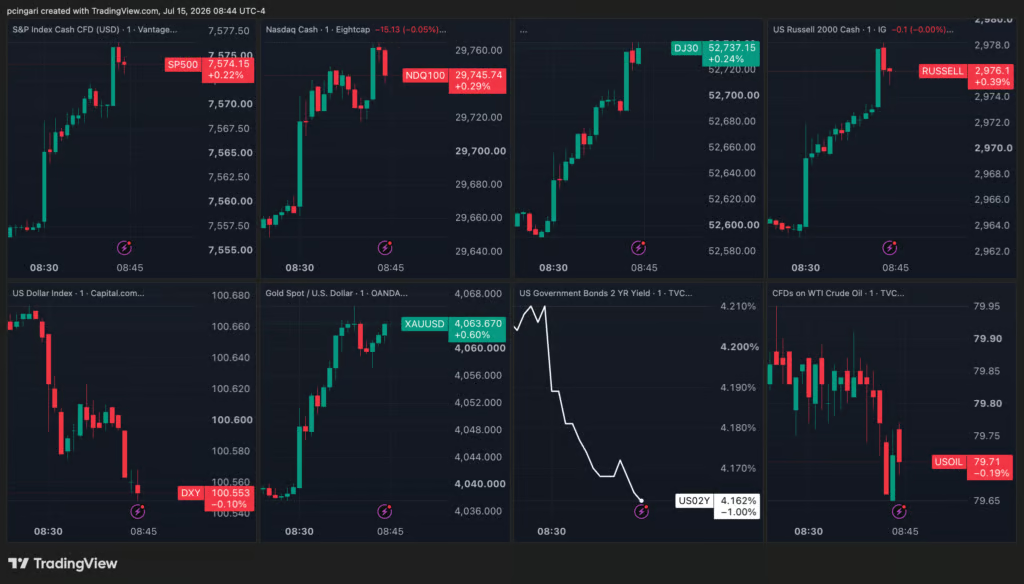
Photo: Shutterstock
—
Originally Posted July 15, 2026 – Producer Inflation Drops by 0.3% in June, Backing the Case for a Fed on Hold (UPDATED)
© 2022 Benzinga.com. Benzinga does not provide investment advice. All rights reserved.
Information posted on IBKR Campus that is provided by third-parties does NOT constitute a recommendation that you should contract for the services of that third party. Third-party participants who contribute to IBKR Campus are independent of Interactive Brokers and Interactive Brokers does not make any representations or warranties concerning the services offered, their past or future performance, or the accuracy of the information provided by the third party. Past performance is no guarantee of future results.
This material is from Benzinga and is being posted with its permission. The views expressed in this material are solely those of the author and/or Benzinga and Interactive Brokers is not endorsing or recommending any investment or trading discussed in the material. This material is not and should not be construed as an offer to buy or sell any security. It should not be construed as research or investment advice or a recommendation to buy, sell or hold any security or commodity. This material does not and is not intended to take into account the particular financial conditions, investment objectives or requirements of individual customers. Before acting on this material, you should consider whether it is suitable for your particular circumstances and, as necessary, seek professional advice.
Futures are not suitable for all investors. The amount you may lose may be greater than your initial investment. Before trading futures, please read the CFTC Risk Disclosure. A copy and additional information are available at ibkr.com.
There is a substantial risk of loss in foreign exchange trading. The settlement date of foreign exchange trades can vary due to time zone differences and bank holidays. When trading across foreign exchange markets, this may necessitate borrowing funds to settle foreign exchange trades. The interest rate on borrowed funds must be considered when computing the cost of trades across multiple markets.
U.S. Spot Gold trading through IB LLC accounts is only available to legal residents of the United States that do not reside in Arizona, Montana, New Hampshire, and Rhode Island.
Investments in certain commodities (precious metals) may be subject to significant price volatility and often involve risks related to market fluctuations, liquidity constraints, geopolitical events, and changes in global economic conditions that could adversely affect their value.
CFDs are complex instruments and come with a high risk of losing money rapidly due to leverage. 58.4% of retail investor accounts lose money when trading CFDs with IBKR. You should consider whether you understand how CFDs work and whether you can afford to take the high risk of losing your money.
Spot currencies are not available at IBKR Singapore.
Related Articles
















Join The Conversation
For specific platform feedback and suggestions, please submit it directly to our team using these instructions.
If you have an account-specific question or concern, please reach out to Client Services.
We encourage you to look through our FAQs before posting. Your question may already be covered!