
- Solve real problems with our hands-on interface
- Progress from basic puts and calls to advanced strategies
Interactive Options Course
Posted April 29, 2026 at 9:23 am
Investopedia is partnering with All Star Charts on this newsletter. The contents of this newsletter are for informational and educational purposes only.
The most important chart I’m watching right now is not a mega-cap technology stock.
It’s the Invesco S&P SmallCap Financials ETF (PSCF), and understanding why requires a brief explanation of what the Russell 2000 actually is and why it matters.
The Russell 2000 tracks approximately 2,000 small-cap U.S. companies. These are domestically focused businesses, regional banks, manufacturers, and healthcare firms tied almost entirely to conditions inside the United States.
Unlike the S&P 500, which draws significant revenue from overseas markets, the Russell 2000 lives and breathes on the health of the American domestic economy. When small caps lead the broader market, it carries a specific message.
Investor confidence in domestic growth is expanding.
Credit conditions are loosening. Risk appetite is broadening beyond the handful of mega-cap names that dominate index weightings.
Historically small-cap leadership has preceded periods of durable broader market strength precisely because these companies are so sensitive to credit availability, interest rates, and consumer demand inside the U.S.
The Russell 2000 broke out of a four-year base to new all-time highs earlier this year.
Since March 30th the index has gained more than 15 percent, outpacing the S&P 500 over the same stretch.
What makes this move compelling is the breadth behind it.
Small-cap Industrials, Technology, and Biotech have all joined the trend, each confirming participation in a way that points to a genuine risk-on environment rather than a narrow rally carried by a few names.
However, one group has not yet confirmed: Small-Cap Financials.
They represent more than 17 percent of the Russell 2000, making them the index’s largest sector. And the reason their participation matters so much comes down to what this group actually does.
Small-cap Financials are not Wall Street banks.
They are the regional and community banks that extend credit to the small businesses, local developers, and domestic manufacturers that populate the Russell 2000 itself.
When this group is healthy, it provides fuel for the entire small-cap ecosystem by ensuring credit flows to the companies that need it to grow.
A lagging financial sector limits how sustainably the broader move can run because the lending infrastructure underneath it has not confirmed the expansion.
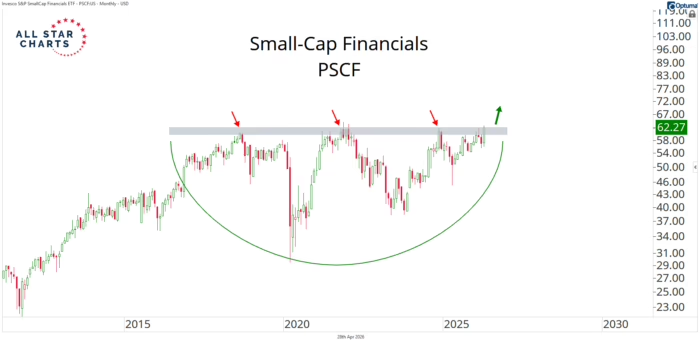
PSCF tells this story clearly on the monthly chart.

The ETF peaked near $67 in 2018, collapsed during the COVID crash of 2020, and has been grinding back toward that level ever since.
The eight-year pattern that formed is a massive base, representing a long period of accumulation before a potential directional move.
Three prior attempts to break through the $62 to $67 resistance zone each failed and produced meaningful pullbacks.
Those failed attempts are marked on the chart.
This is the fourth attempt. But the conditions surrounding it are materially different.
The Federal Reserve cut rates three consecutive times in late 2025, bringing the federal funds rate to 3.50 to 3.75 percent.
For regional banks, which carry significant floating rate debt and rely on accessible credit markets to fund their lending, that reduction in borrowing costs matters directly to their profitability.
The yield curve has steepened, which improves net interest margins. The regulatory environment has loosened. The macro headwinds that weighed on small-cap Financials for two years have shifted in a meaningful way.
A sustained move above $67 in PSCF would carry implications beyond the ETF itself.
It would confirm that the largest sector in the Russell 2000 has joined a trend that Industrials, Technology, and Biotech have already validated.
It would mean that regional banks are actively expanding credit into this environment, which historically has been a prerequisite for durable small-cap leadership cycles.
Watch the $67 level on PSCF closely. If it breaks and holds, the bull case for small caps gets significantly stronger.
The small-cap bull market has been building its case sector by sector. Industrials confirmed. Technology confirmed. Biotech confirmed. PSCF is the last door.
When it opens, the picture is complete.
Tomorrow is the biggest earnings night of the year. Microsoft, Alphabet, Amazon, and Meta all report after the close.
How those names react will say a great deal about where institutional money flows next, including whether small caps continue to attract the capital rotation that has been driving this breakout.
We’re hosting a special YouTube livestream on Wednesday, April 29th, 2026, where we will cover the Fed announcement and dissect the earnings results in real-time.
I spent years auditing the financials of Wall Street’s largest firms. Trust me when I say the number on the page is never the whole story. How the market reacts to it always is.
Join us Wednesday to find out what the reaction tells us.
Watch the Livestream — Wednesday April 29th
—
Originally posted 28th April 2026
Investopedia.com: The comments, opinions and analyses expressed herein are for informational purposes only and should not be considered individual investment advice or recommendations to invest in any security or to adopt any investment strategy. While we believe the information provided herein is reliable, we do not warrant its accuracy or completeness. The views and strategies described on our content may not be suitable for all investors. Because market and economic conditions are subject to rapid change, all comments, opinions and analyses contained within our content are rendered as of the date of the posting and may change without notice. The material is not intended as a complete analysis of every material fact regarding any country, region, market, industry, investment or strategy. This information is intended for US residents only.
Information posted on IBKR Campus that is provided by third-parties does NOT constitute a recommendation that you should contract for the services of that third party. Third-party participants who contribute to IBKR Campus are independent of Interactive Brokers and Interactive Brokers does not make any representations or warranties concerning the services offered, their past or future performance, or the accuracy of the information provided by the third party. Past performance is no guarantee of future results.
This material is from Investopedia and is being posted with its permission. The views expressed in this material are solely those of the author and/or Investopedia and Interactive Brokers is not endorsing or recommending any investment or trading discussed in the material. This material is not and should not be construed as an offer to buy or sell any security. It should not be construed as research or investment advice or a recommendation to buy, sell or hold any security or commodity. This material does not and is not intended to take into account the particular financial conditions, investment objectives or requirements of individual customers. Before acting on this material, you should consider whether it is suitable for your particular circumstances and, as necessary, seek professional advice.
Any discussion or mention of an ETF is not to be construed as recommendation, promotion or solicitation. All investors should review and consider associated investment risks, charges and expenses of the investment company or fund prior to investing. Before acting on this material, you should consider whether it is suitable for your particular circumstances and, as necessary, seek professional advice.
Related Articles
















Join The Conversation
For specific platform feedback and suggestions, please submit it directly to our team using these instructions.
If you have an account-specific question or concern, please reach out to Client Services.
We encourage you to look through our FAQs before posting. Your question may already be covered!