
- Solve real problems with our hands-on interface
- Progress from basic puts and calls to advanced strategies
Interactive Options Course
Posted June 5, 2025 at 11:00 am
Summer gasoline season is underway, and it is likely that consumers will see some respite at the pump. Memorial Day weekend marks the start to the driving season in the United States with increases in travel, warmer temperatures and holidays. Retail gasoline prices declined in May by 15% compared to the year prior. This year, 45.1 million Americans plan to travel over the long weekend with road trips expected to surpass records according to the American Automobile Association (AAA).
Most gasoline in the United States is required to be a “summer” grade of gasoline from May 1 through September 15 and must meet different performance and environmental specifications than fuel sold during the winter, fall and spring.
Reid Vapor Pressure (RVP) measures the rate at which petroleum liquids evaporate. During hot summer months, high volatility fuels evaporate more quickly, increasing emissions of volatile organic compounds (VOCs). The Clean Air Act requires summer gasoline to be less volatile than in the fall. Gasoline with lower RVP is sold at retail stations during the summer season in efforts to reduce evaporative emissions of volatile organic compounds (VOCs) that contribute to ground level ozone formation (smog) and diminish the effects of ozone-related health problems. Gasoline prices tend to be more expensive in the summer due to the cost of the components associated with producing it with these more stringent specifications.
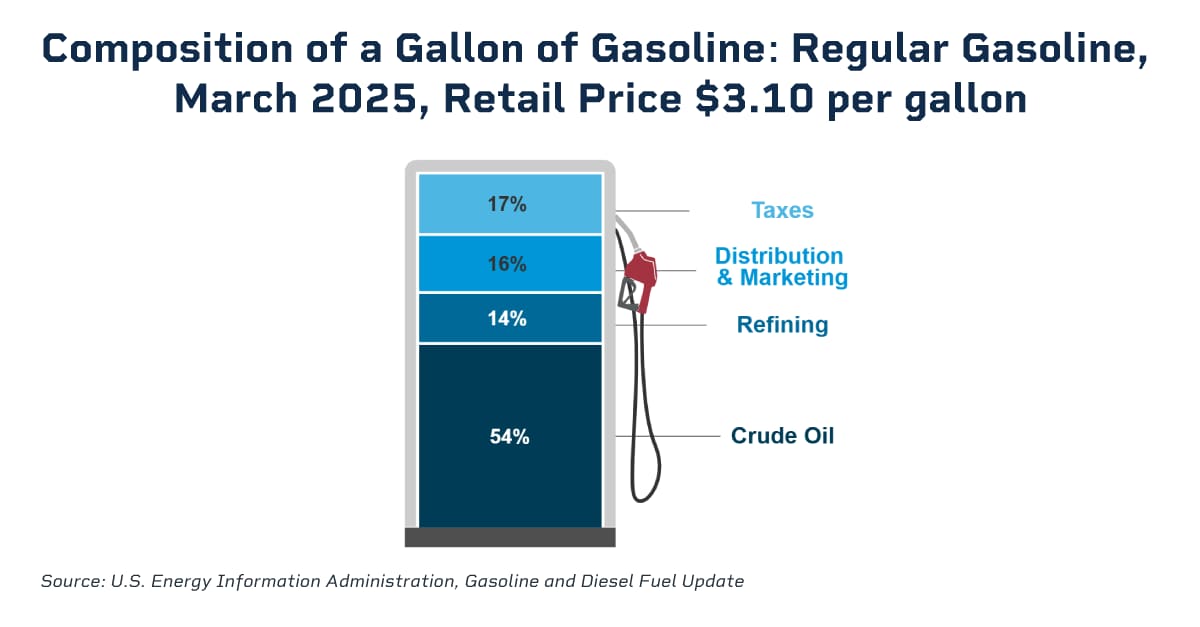
There are four main elements that go into pricing a gallon of gasoline at the pump – crude oil is the largest at 54%, taxes are next at 17%, followed by distribution and marketing at 16% and finally refining at 14%. Gasoline prices follow crude oil closely as it is the largest component of gasoline production. Changes in the price of crude oil and factors such as the economy, geopolitics, supply and demand, and inventories directly impact the price of gasoline at the pump.
In its Short Term Energy Outlook, the U.S. Energy Information Administration (EIA) lowered its retail gasoline price forecast for summer to average approximately $3.14 per gallon over Q2 2025 and Q3 2025, a decrease of 9% over the same period last year. The main driver is the decline in crude prices, which was spurred by the announcement of OPEC+ countries increasing output in June and July, expanding the surplus.
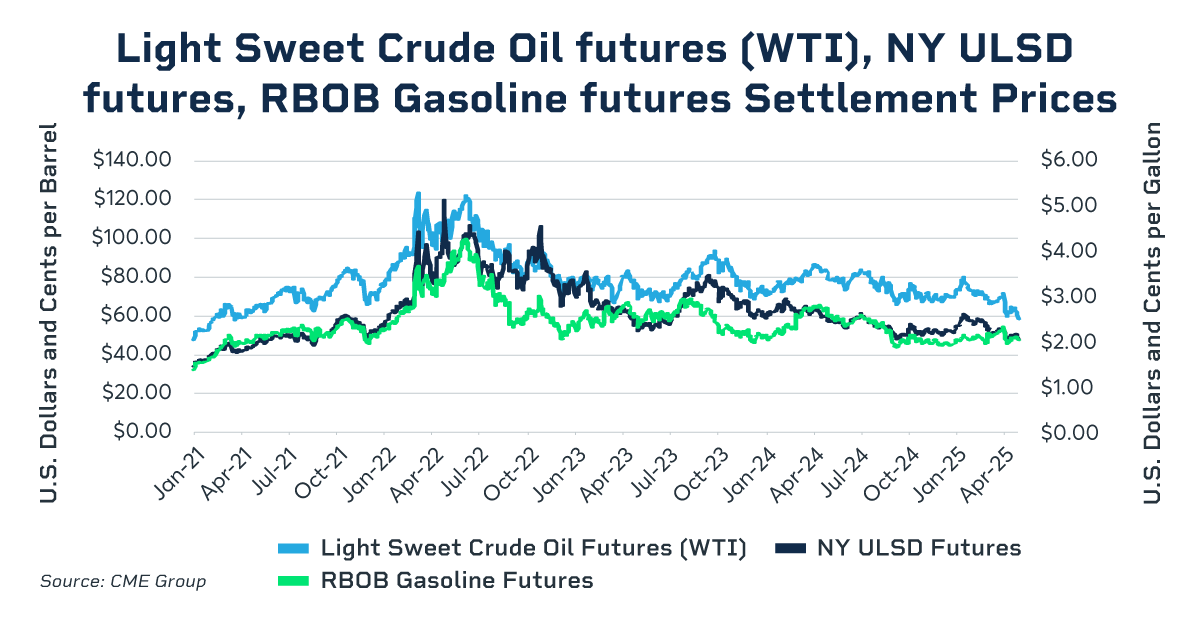
The RBOB gasoline futures benchmark which represents the wholesale price of gasoline averaged $2.0850 per gallon in April 2025. The price of the RBOB futures contract reflects the expectation of the future price of RBOB gasoline for delivery in New York Harbor. It is a key indicator of the current market sentiment regarding gasoline demand, supply and other factors. As of mid-May, futures prices are showing RBOB Gasoline at $2.1309 per gallon and $2.0965 per gallon for the months of July and August. The forward curve for the seasonal transition to winter grade gasoline in September shows $1.9173 per gallon.
Gasoline prices are influenced by a myriad of factors. Summer gasoline plays a pivotal role in reducing pollution and improving air quality during the hottest months of the year. This year, it looks like the summer season will provide drivers with savings in their pockets.
—
Originally Posted on May 27, 2025 – Will Summer Drivers See Lower Gas Prices?
© [2023] CME Group Inc. All rights reserved. This information is reproduced by permission of CME Group Inc. and its affiliates under license. CME Group Inc. and its affiliates accept no liability or responsibility for the information contained herein, including but not limited to the currency, accuracy and/or completeness of this information, and delays, interruptions, errors or omissions. This information is an unofficial copy and may not reflect the official and accurate version. For the definitive and up-to-date version of any of this information, please see cmegroup.com.
Information posted on IBKR Campus that is provided by third-parties does NOT constitute a recommendation that you should contract for the services of that third party. Third-party participants who contribute to IBKR Campus are independent of Interactive Brokers and Interactive Brokers does not make any representations or warranties concerning the services offered, their past or future performance, or the accuracy of the information provided by the third party. Past performance is no guarantee of future results.
This material is from CME Group and is being posted with its permission. The views expressed in this material are solely those of the author and/or CME Group and Interactive Brokers is not endorsing or recommending any investment or trading discussed in the material. This material is not and should not be construed as an offer to buy or sell any security. It should not be construed as research or investment advice or a recommendation to buy, sell or hold any security or commodity. This material does not and is not intended to take into account the particular financial conditions, investment objectives or requirements of individual customers. Before acting on this material, you should consider whether it is suitable for your particular circumstances and, as necessary, seek professional advice.
Futures are not suitable for all investors. The amount you may lose may be greater than your initial investment. Before trading futures, please read the CFTC Risk Disclosure. A copy and additional information are available at ibkr.com.
Related Articles


















Join The Conversation
For specific platform feedback and suggestions, please submit it directly to our team using these instructions.
If you have an account-specific question or concern, please reach out to Client Services.
We encourage you to look through our FAQs before posting. Your question may already be covered!