
- Solve real problems with our hands-on interface
- Progress from basic puts and calls to advanced strategies
Interactive Options Course
Posted February 6, 2026 at 10:45 am
A volatile start to the year for precious metals has reinforced an important lesson from the end of 2025: it’s no longer solely about gold. While the yellow metal has risen to over $4,500 an ounce – an 83% increase since January 2025 – its peers, silver, platinum and palladium, are no longer just following in its wake; they are beginning to significantly outshine it.
Despite a recent correction, over the past 13 months, gold has been significantly outpaced: Platinum is up 127%, palladium over 86% and silver nearly 158% as of midday London time on February 5.

So, what is fueling this significant demand for precious metals? Investors are increasingly looking for alternatives to traditional fiat currencies, driven by the convergence of three key macroeconomic factors:
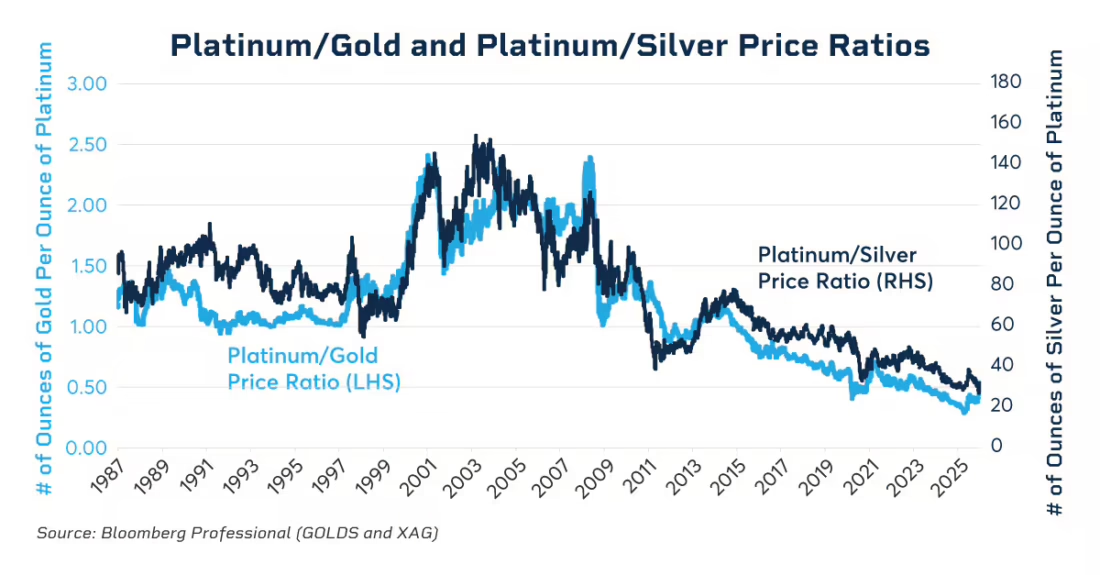
Initially, these conditions created a tremendous appetite for gold. However, as gold continued its multi-year rally, its trading ratios moved far beyond historical standards relative to silver, platinum and palladium. This created a compelling “bargain hunting” scenario. Investors began to diversify beyond gold, realizing that silver, platinum and palladium – by historical metrics – were trading at incredibly low ratios compared to gold.
A critical factor in the outsized moves of these other metals lies in their market size. Gold’s mining supply last year was valued at around $460 billion. Silver, by contrast, was only $66 billion – about one-sixth or one-seventh the size of the gold market. Even smaller, platinum and palladium combined accounted for only around $12 billion to $13 billion, roughly 1/32nd the size of the gold market. As investors began to diversify beyond gold, these smaller markets experienced enormous and accelerated price movements.
The intrinsic value of these precious metals is rooted in their limited supply. Gold, for instance, sees about 100 million ounces mined annually. Silver’s production is eight times higher at over 800 million ounces, yet its price is about 1/50th that of gold, suggesting it could still be perceived as undervalued relative to its supply. Platinum and palladium are even scarcer, with just 6 million ounces of each mined annually – only 6% of gold’s supply. This highly concentrated production, primarily from South Africa, Russia and Zimbabwe, makes them highly sensitive to supply or demand shifts.

Silver’s recent performance clearly illustrates this relative value shift. A few years ago, one ounce of gold bought over 100 ounces of silver; more recently, it was around 80 ounces. As of mid-January, that figure was below 50 ounces of silver per ounce of gold. While silver has not yet reached its historic high of approximately 25 ounces of silver per ounce of gold, it has certainly made enormous strides in that direction, making the argument that “silver is still cheap” harder to sustain compared to previous years.

Platinum stands out as a compelling, if temperamental, opportunity. For years, its use in diesel engine catalytic converters declined, causing its price to lag. However, with an exceptionally tiny mining supply – just 6% of gold’s and less than 1% of silver’s – platinum is highly responsive to renewed interest. If investor or industrial demand for jewelry or other applications grows, platinum’s price, having only recently surpassed its 2007 peak, could see further gains.
—
Originally Posted February 5, 2026 – Why Relative Value is Key to Understanding Precious Metals
© [2023] CME Group Inc. All rights reserved. This information is reproduced by permission of CME Group Inc. and its affiliates under license. CME Group Inc. and its affiliates accept no liability or responsibility for the information contained herein, including but not limited to the currency, accuracy and/or completeness of this information, and delays, interruptions, errors or omissions. This information is an unofficial copy and may not reflect the official and accurate version. For the definitive and up-to-date version of any of this information, please see cmegroup.com.
Information posted on IBKR Campus that is provided by third-parties does NOT constitute a recommendation that you should contract for the services of that third party. Third-party participants who contribute to IBKR Campus are independent of Interactive Brokers and Interactive Brokers does not make any representations or warranties concerning the services offered, their past or future performance, or the accuracy of the information provided by the third party. Past performance is no guarantee of future results.
This material is from CME Group and is being posted with its permission. The views expressed in this material are solely those of the author and/or CME Group and Interactive Brokers is not endorsing or recommending any investment or trading discussed in the material. This material is not and should not be construed as an offer to buy or sell any security. It should not be construed as research or investment advice or a recommendation to buy, sell or hold any security or commodity. This material does not and is not intended to take into account the particular financial conditions, investment objectives or requirements of individual customers. Before acting on this material, you should consider whether it is suitable for your particular circumstances and, as necessary, seek professional advice.
Investments in certain commodities (precious metals) may be subject to significant price volatility and often involve risks related to market fluctuations, liquidity constraints, geopolitical events, and changes in global economic conditions that could adversely affect their value.
Futures are not suitable for all investors. The amount you may lose may be greater than your initial investment. Before trading futures, please read the CFTC Risk Disclosure. A copy and additional information are available at ibkr.com.
Related Articles



















Join The Conversation
For specific platform feedback and suggestions, please submit it directly to our team using these instructions.
If you have an account-specific question or concern, please reach out to Client Services.
We encourage you to look through our FAQs before posting. Your question may already be covered!